
PITFALL Review: FRIDAY THE 13TH Meets 127 HOURS, Yet Can't Avoid Pitfalls
UFC legend Randy Couture stars in James Kondelik's slasher survival film.

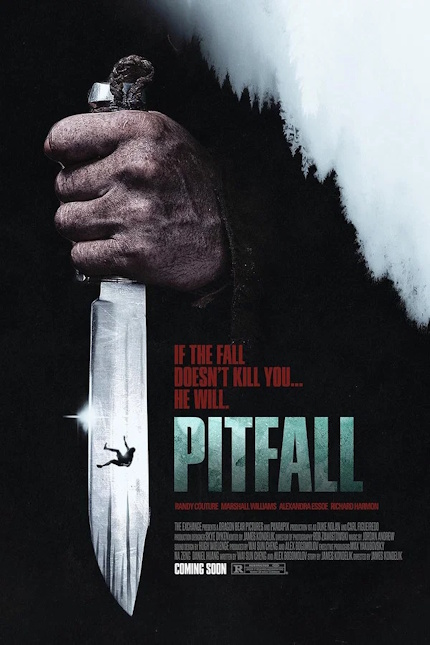
How many more slasher-in-the-woods movies can we get?
The subgenre of a subgenre that was popularized by Friday the 13th in 1980, continued by The Burning and Sleepaway Camp in the ‘80s, and cleverly reinvented in the 2000s with The Cabin in the Woods and American Horror Story: 1984, has certainly shown legs over the decades and reemerges once again in Pitfall, an indie horror flick that admirably attempts, yet ultimately fails, to put a spin on this saturated horror trope.
From director James Kondelik, Pitfall follows Scott (Marshall Williams) and Ashley (Alex Essoe), siblings grieving from the sudden and violent deaths of their parents in a car accident several years earlier. In an attempt to repair their fractured bond, Scott and Ashley embark on a camping trip in the woods with their old friend Lars (Richard Harmon) and respective spouses Charlie (Matt Hamilton) and Gwen (Jordan Claire Robbins).
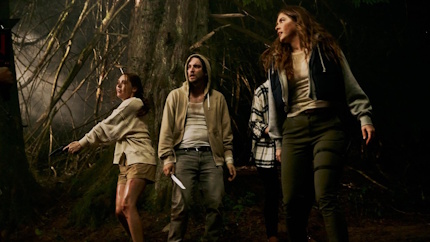
But things go awry fairly quickly when Scott falls into a hunting pit lined with spears, unbeknownst to his friends, forcing the rest of the group to search for him in the forest. To make matters worse, a silent, hooded killer (Randy Couture) lurks in the background and uses a bow and arrow, axes, and a series of elaborate traps to hunt the group down.
Pitfall is Friday the 13th meets 127 Hours, with none of the cheap thrills of the former and nail-biting intensity of the latter. Kondelik’s film cuts back and forth between Scott trying to escape the treacherous hunting pit and his group of friends wandering the forest trying to rescue him. The scenes with Scott lean into the same kind of tension that isolated survival movies like Buried, Phone Booth, and the aforementioned Danny Boyle film flourished with, although conceptual issues with the film’s narrative are ultimately its undoing.
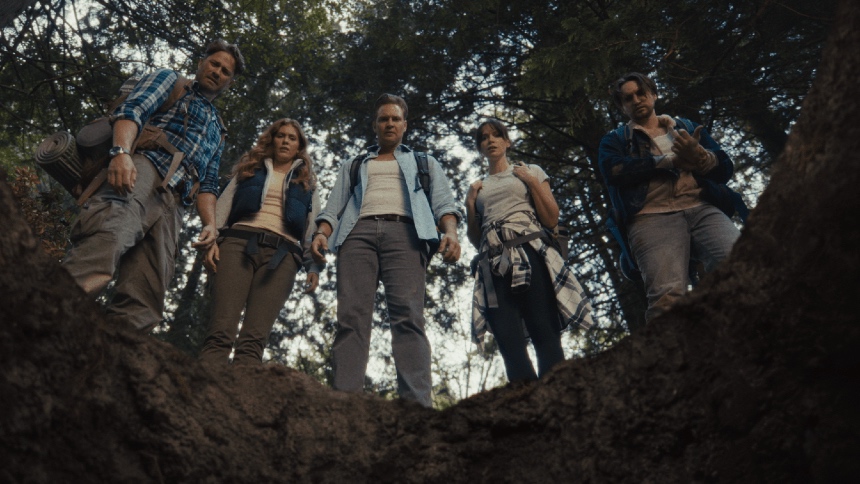
Much of the pulse-pounding suspense that movies like 127 Hours foster come from trapping the audience with the protagonist as they desperately try to escape and survive. The fact that Pitfall offers reprieve from Scott’s battle for survival, by cutting back and forth to the other characters trying to find him, may make Kondelik’s film structurally unique compared to other slasher-in-the-woods movie, but ultimately and repeatedly deprives the story of tension at several critical junctures.
That being said, the half of the film that focuses on the members of the group outside the pit certainly possesses a dynamism and energy that the other half sorely lacks. The audience is aware of Randy Couture’s hooded slasher before the characters, in turn imbuing the film with a sense of dread and knowledge that violence is sure to come.
When the violence does arrive, there’s some decent kills for particularly bloodthirsty horror fans to feast on. And the screenplay from Victor Rose subverts expectations by having characters one would expect would make it to the end die rather early, while others who you’d bet good money are bound to be early slasher fodder end up enduring to the climax.
But at approximately 10 minutes shy of two hours, Pitfall proves painfully protracted. There’s a reason most slashers have a runtime in or around 90 minutes, as the repetitive structure of the genre and simplicity of the narrative typically struggles to sustain itself for much longer. Admittedly, Kondelik’s film offers a bit more than the average slasher in having the survival movie scenes to cut back to, but this does little to prevent the film from becoming progressively unbearable.
Coupling the drawn-out pacing are characters who continually make illogical decisions. While people doing dumb stuff is a staple of horror dating back to the origins of the genre, Pitfall removes one from caring for the characters by replacing empathy with frustration toward them. If edited or acted somewhat differently, the inanity of the characters may have made the film quite funny, but this is unfortunately not the case.
Pitfall similarly stumbles in its attempts to establish emotional arcs for its two lead characters. Kondelik’s film is one of (far too) many horror movies to explore grief and posttraumatic stress, meaning the filmmaker has added undue pressure on himself to craft a movie that justifies its usage of an over-utilized theme of horror cinema.
The story sporadically flashes back to the events surrounding the deaths of Scott and Ashley’s parents, with every flashback revealing a little bit more and seemingly encroaching on some twist or point of subversion. This never arrives, however, as the flashbacks converge on a reveal that can be hardly described as a reveal and which has been forecast by characters’ dialogue from nearly the very beginning.
The film should be commended for having the ambition to put a somewhat clever twist on the slasher-in-the-woods subgenre of a subgenre, although its execution is sorely lacking. From a dull killer devoid of personality or novelty to sluggish pacing that derails investment in the story, Pitfall ultimately can’t avoid pitfall after pitfall, in turn rendering it a forgettable horror flick.
The film opens Friday, May 29, only in movie theaters. Visit the official site for more information.


Do you feel this content is inappropriate or infringes upon your rights? Click here to report it, or see our DMCA policy.


-thumb-80x80-107109.jpg)

