ALPHA Review: Violent Grief and Desperate Love
Julia Ducournau's third feature stars Golshifteh Farahani and Tahar Rahim

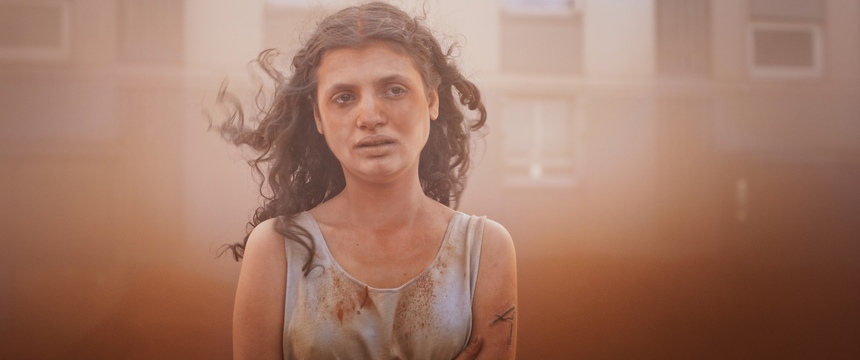
Grief is not a straight line that slowly leads from deep sorrow to acceptance and remembrance; it comes in waves, and can reignite like a bonfire at the strangest moments, even decades on. Fear can likewise come like an tornado that threatens to fling you into oblivion. Addiction can be a blessed relief from all that which tears at our souls, even if it kills us.
Alpha, the third feature from Julia Ducournau (Raw, Titane), is an exploration of wounds fresh and old, the pain of growing up an outsider, the treatment of those marked as different and those who mark themselves. In this story of a girl's brush with death, the harsh lesson inflicted on her by a mother who blames herself for that over which she had no power, and an man who has no wish to prolong what he sees as inevitable.
Alpha (Mélissa Boros), a 13-year-old girl living in a seaside town with her mother (known only as Maman, played by Golshifteh Farahani) is perhaps at her first teen party, possibly drinking, when she does something that risks devastating consequences: she lets someone give her a tattoo of her initial, using pen ink, with a dirty needle. Maman, a doctor, is terrified. There is an illness being spread by such and other methods, that slowly turns those who suffer from it into marble. Not long after this happens, Maman's drug addict brother Amin (Tahar Rahim) comes to stay, and Alpha is forced to share her room with him.
Needless to say, this does not sit well with the young Alpha. She is already at a tipping point of teen girl life, starting to explore physical affection with a boy, navigating bullies who dislike her for being Arab (in this case, Berber), for being smart, for being an outsider. Not only is she now literally and figuratively marked by the possibility of a disease that will make her a complete pariah, she can't understand why her mother is trying so hard to save the brother who seems beyond redemption. Amin himself seems more than a little indifferent to his survival.
Ducournau is not subtle in the colour paletes of the past and present, the former being warm and the latter cold, as if the years that separate Maman from her brother and the love she felt for him had hardened as his body did, chiseled in grief, as more bodies, like his, become statues. The return to warmth comes at the end in the red dust, simple of that which decays and which finds its way into every literal and metaphorical crack. Maman must find a way to live with her grief, even if she can never forget her pain.
At the other end of this is Alpha, too young to understand this grief, and now finding herself the kind of pariah that her uncle has been. But she is a girl in school, with peers both ignorant and cruel, boys who use her in secret and girl determined to keep her under their proverbial heels. But Alpha finds an anger within to fight back, and even if she is punished that for, we can't help but support her. This is not her problem, but society's.
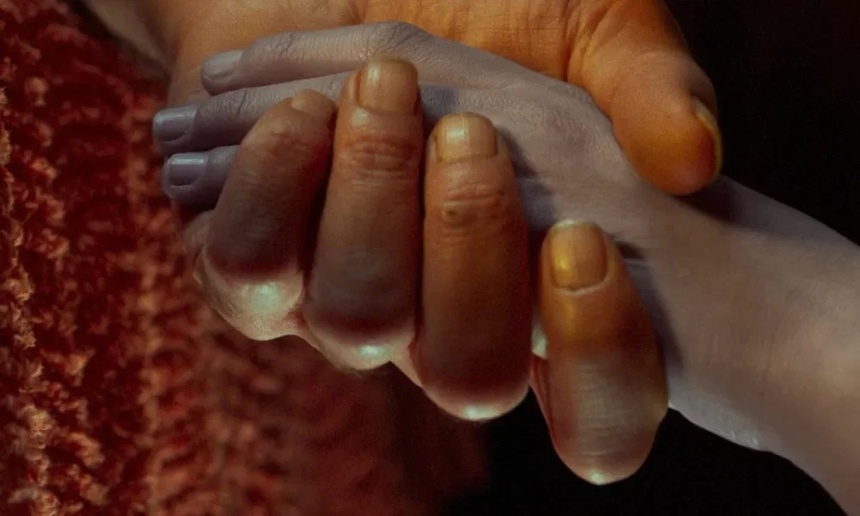
To those of us who were around during the 1980s and 90s, the height of the AIDS crisis, it can be hard to explain how we were told to be afraid of this disease. Groups and individuals had to fight tooth and nail to get any recognition of it, let alone proper care and research into treatment and a cure, as it was seen as the 'gay cancer', inflicted on queers, drug addicts, prostitutes, anyone that those in power could say brought it on themselves and whom they were glad to see disappear. In shifting to a symbolism of the marble statue, Ducournau shows those whole generations lost become what they were: people of importance, of beauty, of individuality and necessity to our human world, lost by negligence and hatred.
If Raw was the body horror of the animal, and Titane that of the machine, then Alpha could be described as the body horror of artist. The hand of a child making a drawing out of the needle tracks on her uncle's arm are juxtaposed against the needle that pokes into Alpha's arm, as she lies in a kind of trance, either unaware or unbothered by the pain. Amin is also unbothered by the pain of both his body and his mind in giving himself entirely over to his addiction. In one fateful scene, as Maman is trying to take samples from his marbled back, it partially crumbles, revealing his spine, and this moment is a shock as much for him as us; he has so long ignored his body that to be confronted in such as way frightens even a jaded Amin.
In one scene, Amin takes Alpha to a club filled with leather-bound rockers, smoking and drinking and probably shooting up. One woman, her leg already frozen in its growing marble state, dances as best she can on the bar. This is the world that those in power, and those who see themselves as more worthy, look down upon. But the people who inhabit these places are just as important and worthy as any, and instead of despair, there is a reckless joy, even if it is fatalistic. This is another kind of body horror, that Ducournau transforms into beauty.
Ducournau ruffles a lot of feathers in France, with her uncompromising views, her commitment to exploring the lives of those on the margins, whose bodies and souls are transformed in horrifying and yet miraculous ways, and seeing the dark beauty of it. Alpha is a body-beauty-horror-coming-of-age-accepting-loss film (seriously, so many ways to look at this film, all of them valid, and all of them blending in a mostly seamless tapestry that shows just how much love is possible in the world.
Alpha is currently in limited release in the USA and Canada, and opens in wider release in the USA on Friday, April 10th.
Alpha
Director(s)
- Julia Ducournau
Writer(s)
- Julia Ducournau
Cast
- Tahar Rahim
- Golshifteh Farahani
- Mélissa Boros