Visegrad Film Forum 2026 Interview: Alexander Nanau on Shooting Without a Script, Building Trust, Discovering the Story in the Edit

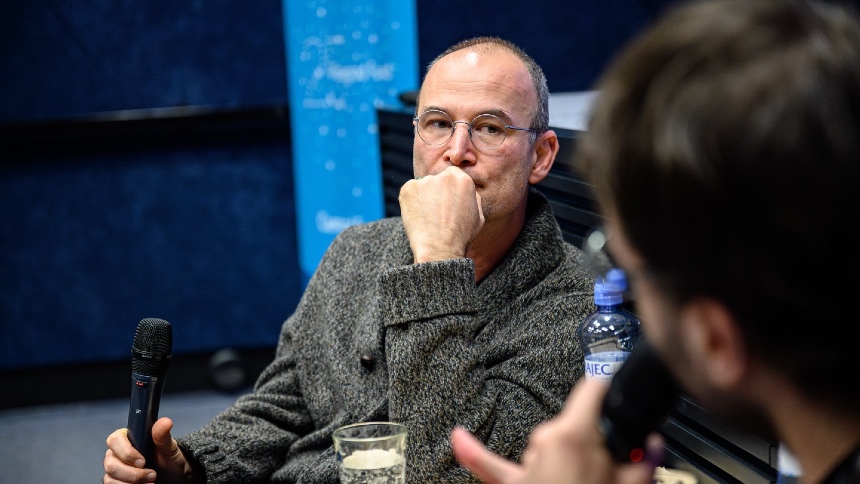
At the Visegrad Film Forum in Bratislava, Alexander Nanau approached documentary filmmaking not as reportage, but as a long-term process of proximity, one that begins without a fixed thesis and gradually takes shape through sustained presence, observation and editorial construction.
Across films such as The World According to Ion B., Toto and His Sisters and Collective, Nanau has developed a working method that collapses traditional distinctions between director, cinematographer and editor, placing the act of filming in direct continuity with the process of understanding.
His masterclass, Cinema as Civic Inquiry, outlined this approach with unusual precision: research conducted with a camera already running, protagonists identified through extended trial and error, and narrative structure discovered only in the editing room after months, often years, of accumulated material. Rather than entering a project with a predefined argument, Nanau works outward from people and situations, testing whether a film exists through iterative edits, provisional cuts and constant re-evaluation of what the footage reveals.
The interview with Screen Anarchy expands on these principles. Nanau discusses the practical mechanics behind films like Toto and His Sisters, from building access in closed environments and navigating ethical limits of observation, to incorporating participant-shot footage as part of the film’s authorship. He reflects on the role of editing as the primary site of authorship, the instability of narrative during production, and the point at which a film declares itself finished.
Screen Anarchy: How do you actually find your protagonists in a film like TOTO AND HIS SISTERS?
Alexander Nanau: It took several months. I traveled around Romania, looking at different Roma communities, trying to understand where a story might emerge. Eventually I ended up in Bucharest, in that neighborhood you see in the film, where there was this educational club for kids. That became my entry point.
From the beginning, I do research with the camera in my hand. I’m always filming. I’m not just looking for people, I’m also trying to understand: how does this world translate into images? What kind of cinematic language does it need?
At first, I thought I had found my protagonist, another boy, older than Toto. But the moment we started thinking of him as the main character, something changed. He became very self-aware. Suddenly I would arrive in the morning and he would perform, asking things like, “Did you sign the contract with my mother?” And I realized: this won’t work.
Then he brought Toto to the club. And Toto was completely different. He didn’t try to impress me. There was a kind of dignity there, and something very strong behind his eyes. Later, his sister Andrea came in, and she immediately started telling me her story, about their mother being in prison, about their lives. And only after a while I realized they were siblings. That’s how it came together.
From there, I got access to their environment, spoke to the extended family, and even went to prison to ask the mother for permission to film. It became a kind of agreement — also for her, because someone would be around her children.
You mentioned that first boy who didn’t work. How important is that kind of false start in your process?
It’s most of the process. I wouldn’t even call it failure, it’s trial and error. Maybe 80% of the work. You enter a world, and you try to understand people, their emotional reality, and at the same time you’re trying to find a cinematic form. You film, then you go back and watch the footage. And the image is very different from your experience in the moment.
When you are there physically, you are emotional. People tell you stories, sometimes they lie, and you believe them because you are involved. But the image doesn’t lie.
When you watch it in the editing room, you immediately see what works and what doesn’t. So it’s a constant loop: filming, watching, adjusting. At some point I start editing a kind of trailer, just to test whether there is actually a film there. That can take months.
So you are already checking footage and trying out edits while still shooting?
Of course. You shoot, you come home, you download, you look at it, you try things out. You see if there is a scene, if it can be edited, if there is already some kind of tension or relationship in it. That doesn’t mean you have fixed the film. It stays fluid. But yes, you constantly verify the material. You are not just accumulating footage blindly.
That brings us to time. Your films clearly require a long observational process. How do you know when you have enough?
You don’t. Not until you have the film. During shooting, it’s a constant process of thinking about story, structure, truth, whether what you’re capturing really reflects reality. I keep notebooks, I write constantly, trying to understand what I’m doing.
With Toto, I started with a very clear idea: the mother will come out of prison, and the film will be about the family reuniting. That was the concept. Then we filmed the parole hearing, and she wasn’t released. And I thought: I don’t have a film anymore.
But life writes better scripts than we do. In the end, the mother comes out, but at the end of the film, not at the beginning. And I could only understand that structure much later. There was one final scene where the children had changed, fundamentally. When we saw it in the editing room, it became clear: this is the end. You cannot go further. From here, it would be a different film.
How long did the editing take?
About one and a half years.
So there were many versions?
Of course. Many rough cuts, many versions. You try out different structures, different balances, different ways in. That’s normal.
Do you show those versions to other people?
Yes, sure.
And do you take their feedback?
Yes, but not in a simple way. For me, it’s not mainly about what they say. It’s about what happens when I watch the film with them. When somebody sits next to you, you suddenly see the film with fresh eyes. You feel if they are with it, if they disconnect, if they connect with the characters, if the focus drops after half an hour. You feel it in the room.
So yes, you use other people, but not as a market test. More as a way to restore your own perception.
It’s interesting that you speak about observational documentary in such strongly narrative terms. Do you consciously apply classical storytelling rules?
Of course. Why wouldn’t I? Storytelling is storytelling. Whether it’s fiction or documentary, you still think about relationships, stakes, desire, conflict. Who wants what from whom? Will they get it? What changes?
Even inside a scene, there is dramaturgy. That doesn’t make it less observational. It just means that if you want a film to work for an audience, you have to understand how people watch stories. For me, relationships are the core. In a novel, in a film, in a documentary, what we follow are relationships. That’s the basic rule.
So you don’t see a strict border between fiction storytelling and observational documentary?
There are borders, of course. But the principles of how a story functions are not so different. The way people watch a story is the way people watch a story.
And yet in terms of method you are very strict. No reconstruction, no restaging?
Never.
Even if something important happened and you missed it because of a technical problem?
No. Then it’s gone. Because once you reconstruct it, it’s not observation anymore. And normal people are not actors. They cannot reproduce something truthfully in that way. It becomes something else. It’s a certain kind of cinema. Frederick Wiseman is the clearest example. And I work in that tradition.
But with the children, did you ever rehearse anything?
No. I never tell them what should happen. I only film what happens.
At the same time, the world has changed. People are so used to performing themselves now, to building their own image. Does that make your kind of documentary harder?
Of course. It changed a lot. It’s harder now to get to something authentic, because people are so used to promoting themselves, presenting themselves, curating themselves. Everyone is the maker of their own image now.
So yes, it makes the work harder. It just means you have to do more work in building trust and in finding the person beneath that.
Watching the parole hearing in TOTO, it’s hard not to read it politically, especially in terms of systemic discrimination. Do you see your work as political filmmaking?
I don’t like to define myself as a political filmmaker. But of course, politics is there. I grew up in Romania under communism and then in Germany, and that experience, of authority shaping your life, is part of me. It influences how I see the world.
But when I start a film, I don’t start from politics. I start from people. From curiosity. I want to understand: how do they live? how do they survive? With Toto, yes, there was the context of racism and social exclusion. But what really interested me was identity, how someone like Toto can remain himself in an environment that constantly tries to shape him into something else.
The same with Collective. People see it as political, but for me the core was different: how do you survive losing a child? How does a whistleblower live with themselves after being part of a corrupt system? So for me, it’s always human first. Politics comes from the context.
You also shot much of the film yourself. Why is that important for you?
Because I need that direct connection. For me, filming is about trying to understand a person, almost trying to grasp their soul through the lens. That’s why I don’t separate directing and camera. It’s one process.
How big is your crew usually?
Very small. Usually it’s me, the sound person, my assistant, and maybe someone from production around us. That’s it.
In TOTO, you also gave cameras to the protagonists themselves. Why?
Because I knew there were parts of their lives I would never be able to film authentically. Especially with Andrea, when she was living with other teenagers, my presence would have changed everything.
So I taught them filmmaking. We watched films together, Abbas Kiarostami, for example, and I showed them how to think about images, how to edit. Then I gave them cameras. Andrea became, in a way, a co-author of the film. And honestly, some of her footage is the strongest in the entire film.
There’s always an ethical question in this kind of work: where is the line between observation and intervention?
It’s a constant negotiation. With Toto, I knew that what was happening around him, the drugs, the environment, had been there long before I arrived. If I had stepped in and tried to fix things immediately, I would have lost access, and I wouldn’t have been able to tell the story truthfully.
But that doesn’t mean we did nothing. For example, when Ana was diagnosed with HIV, we made sure she got the best treatment possible. We were involved in decisions that the children should move to the orphanage, because things were becoming too dangerous. So yes, there were interventions. But you have to be very careful. You are not there to become a parent or a savior.
Did the people around Toto, the adults, the drug users, ever expect something from you? Fame, help, rescue?
Not fame. Most of them died by the end of the film. But I think some of them did understand that the film could help Toto. And that may have been one reason why they opened up. Also, they were interested in us. We really were like people from another planet to them, filmmakers who travel, who come from another world. But the relationship only works if they feel that you are not above them. That you don’t judge them.
One of them said something very important to me: that they trusted us because we didn’t put ourselves above them. That was crucial. I do have one regret with Toto, though: the way the junkies come across for the viewer. In reality, some of them were very smart, very reflective people who had simply ended up there. For me, they were Toto at an older age. And that complexity is not always fully visible.
Were there red lines for you, things you would not film or would not include?
Of course. There were situations where people were so completely destroyed by drugs, so vulnerable and so absent, that it was clear: you don’t film this. That’s a border.
You do not film people when they are completely out of touch with reality and unable, in any meaningful way, to be present in what is happening.
And how do you think about consent in a case like this? You mentioned earlier that everybody was signed. What does that mean in practice?
It means exactly that: everybody is signed. With children, you sign with the parents or legal guardians. With adults, you sign releases stating that they are aware they were filmed and that they agree that the material may be used in the film.
Are they compensated?
Not beforehand. Never. That’s a basic documentary rule for me. If you pay people beforehand, then they are performing a service for you. It changes the relationship. It interferes with authenticity.
In the case of the children, yes, in the end they received money. The mother too, afterward. But not before or during in a way that would shape behavior.
So the legal work around a film like this must be huge.
It is. All my films are complicated in legal terms. I work with lawyers throughout the production. There are many minors, unclear guardianship situations, institutions you suddenly have to enter, state bodies you have to deal with. So yes, I have lawyers working in the background all the time.
Are they on set?
No, not on set. They do the paperwork. But because observational filmmaking is unpredictable, you may suddenly learn that a protagonist has to go somewhere, an institution, a hospital, whatever, and then you have to move very fast and get the right contracts in place. And yes, the contracts have to be specific. If someone was filmed in a certain vulnerable context, you specify that. You have to be precise.
So festivals and broadcasters really check that?
Of course. Festivals, TV stations, streamers, everyone wants to know that you have done due diligence and that the participants are aware. It’s like publishing. Institutions do not want to be sued because you were sloppy.
Some people compare observational documentary to reality television. What do you make of that?
The difference is very clear. In reality shows, people are paid to expose themselves. They perform. It’s commercialized exposure. That doesn’t automatically make it illegitimate if adults agree.
But if vulnerable people are exploited because they can sign something without fully understanding the consequences, that’s ugly. In the end, the key thing is your own moral compass. The filmmaker has to have one. The producers have to have one. The people releasing the film have to have one.
How did the protagonists react to the finished film?
I first screened it for Toto and Andrea alone. At that point, they were no longer living together. They watched it, and they laughed a lot, and they cried a lot. And what was incredible is that through the film, they rediscovered their relationship, how much they meant to each other. After that, they moved back together. So in that case, the film became a kind of catalyst. But it’s a fragile process. It can also go wrong.
You produce your own films as well. How do you navigate financing, especially in a system that is increasingly unstable across Europe?
It’s difficult, and it’s getting more difficult. I use the classical European system: film funds, co-productions, partnerships, in my case often with HBO. But even with Collective, which later had major success, it was a fight to get it financed. Nobody wants to take risks anymore.
What helps is to invest your own money early and create a strong trailer. Because on paper, these films often sound terrible.
Toto and His Sisters on paper is almost a cliché, a poor boy becomes a dancer. You would think it’s the worst American melodrama. But when you see the material, when you see the cinematic language, it changes. So you need to show the film, not just describe it.
Do festivals and awards, like the Oscar nominations for COLLECTIVE, change anything in practical terms?
They help in terms of visibility and access. You can pick up the phone more easily. But the reality is more complicated.
For me, it happened during the pandemic, so at the moment when everything was opening up, the whole system was also collapsing. And in general, independent cinema, especially documentaries, is disappearing from traditional distribution. Festivals are important, but they were never the end goal for me. The question is always: does the film reach audiences beyond that?
You mentioned burnout. These projects are clearly very demanding. How do you deal with that?
I don’t deal with it very well. After films like Toto, I fall into a deep depression for months. You give everything, emotionally, mentally, and then there is nothing left. Over time, you understand yourself a bit better. You learn how to come out of it. But it’s always there.
How do you know, while filming, that you have captured something that belongs to the film?
You feel it. Physically. There are moments where you know: this has something. This is the seed of the film. And I usually start editing from those moments.
But even then, some of the strongest scenes might not make it into the final cut. Sometimes they are too strong, they break the balance of the film. That’s one of the hardest lessons: letting go of material you love.
What are you working on next?
I’m developing a fiction film, and at the same time I’ve started working on a documentary again, but in a more personal way. It’s closer to an essay film, built from footage I began shooting almost 20 years ago when I returned to Romania. That’s all I want to say for now.
Image courtesy of Visegrad Film Forum.