Sound And Vision: The Safdie Brothers

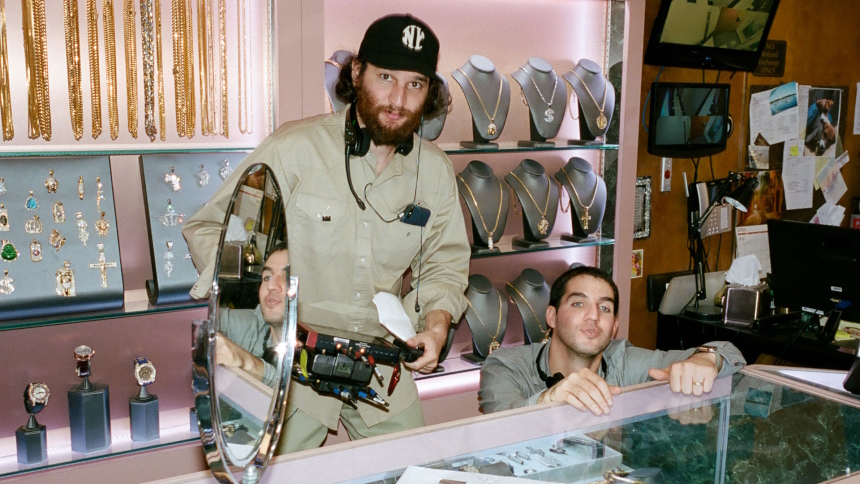
In the article series Sound and Vision we take a look at music videos from notable directors. This week we look at several music videos directed by Josh and Benny Safdie.
In the Sound and Vision I explore the connection between a directors cinematic output and their music videos. So it might be surprising that I rarely discuss so-called tie-in music videos, those music videos for songs that feature heavily on a film's soundtrack. There is a reason for that: I feel it goes against the thesis of the Sound and Vision as these are as often about the schisms between the two mediums as they are about the similarities. It also would constitute laziness on my part: most tie-in music videos are nothing more than clip shows, which is as boring to write about as they are to watch.
Rarely do tie-in music videos evolve into something worth writing about. But such is the case when it comes to two music videos the Safdie Brothers made as a tie-in for their films Heaven Knows What and Good Time. These pieces are in conversation with their films proper, but diverge in interesting ways. They can be watched apart from the film they stem from, but watched in tandem with their bigger counterpart, they take on a different meaning, as do the films themselves.
Ariel Pink's I Need a Minute (see below), taken from the Heaven Knows What soundtrack, features the lead actress Arielle Holmes starring alongside Ariel Pink. Arielle Holmes also wrote the memoir Heaven Knows What was based on, the story being taken from her life as a homeless addict who was in a volatile relationship with a fellow addict. Her addiction to crack cocaine and heroin is essential in understanding the setting of the music video, which features imagery from hundreds of public bathrooms, the kind in which Arielle would use drugs. It's the kind of grimy location that the Safdie Brothers see beauty in, their work being very specific in their use of location. There is also the feeling of them stumbling opun these images, the idea of 'found footage' running somewhat throughout these music videos.
That certainly is the case for the tie-in music video to Good Time (see also below), in which footage excised from a dream sequence that was meant to be seen just before the end of the movie, is re-purposed into something entirely its own. In the dream sequence the two main protagonists, played by Robert Pattinson and Benny Safdie himself, are seen in a decrepit house, where Connie Nikas (Pattinson) is confronted by a seemingly supernatural hyena. The surrealistic sensibility is heightened by the presence of a machinima-like CGI facsimile of singer Iggy Pop, who is the vocalist for the central track of the music video, Oneohtrix Point Never's The Pure and the Damned. The usage of the computer generated monstrosity that is this Iggy Pop-clone elevates this video from being just a repurposed deleted scene, making the video quite unique. Call it a sidequel, if you will, a fever dream short version of the film proper.
The idea of repurposed cinema is central to the other music video they made for Oneohtrix Point Never, this time for the track Lost But Never Alone (also below). In the music video we are channel surfing through a few feverish clips: a documentary about a talking chimpanzee, a haunting no-budget slasher, a sit-com after school special, and musical footage of Oneohtrix Point Never's Daniel Lopatin in a deliciously chintzy eighties get-up. The footage looks unearthed and out-of-place and time, but all has that Safdie-sensibility. So much so that Rolling Stone assumed erroneously that all footage was shot especially for the video. It is not, as the slasher for instance is footage taken from the trash-chiller Curtains. The footage from the sitcom after school special, about a misunderstood punk who absolutely kills it on the guitar due to frenzied teenage angst, is shot for the video specifically. It does feel surprisingly realistic in its pastiche though.
It shows the Safdie's as great stylists, who repurpose their own work, or that of others, in pieces that are in conversation with their own work and pop culture as a whole. The latter is true too, of the music video I hadn't mentioned yet. The one for Jay-Z's Marcy Me (finally below). That one was made for Jay-Z's album 4:44, of which every single got a music video directed by a world famous or up-and-coming director. Marcy Me is a slice-of-life story, where a black kid runs through the streets of New York City on the way to a block-party, framed by the light of a police helicopter tracking him. It's almost a spotlight, framing the kid as a star in his own story, until the police rudely interrupts the block party itself.
It is the kind of heightened use of real life stories, that the Safdies do so well, and that fit well among the other music videos of 4:44 in their reframing of the plights of black people in the United States through the lens of black pop culture. See for instance Mark Romanek's video for The Story of OJ, that is a send-up of racist cartoons, or Ava DuVernay's science fiction-epic Family Feud, that reframes dynastic science fiction stories about royal families (seen in a lot of space operas) through a black perspective. Or Moonlight, by Alan Yang, which is as good of a send-up of sitcom culture as Lost But Never Alone became a few years later, parodying the sitcom Friends with an all-black cast. These videos all react to each other, in some ways, in the same way that you can watch every Safdie music video as a stand-alone, but they take on a bigger meaning when taken as part of a whole.