28 YEARS LATER: THE BONE TEMPLE Review: Give In to Your Inner Beast
Ralph Fiennes, Jack O'Connoll, and Alfie Williams star in the fifth installment of the infected saga, directed by Nia DaCosta.

When we last saw our young hero Spike (Alfie Williams), he was being rescued from some rabid infected by a group of parkouring, blonde-wigged, tracksuit suited hooligan wannabees lead by a gold chain sporting man by the name of Jimmy (Jack O'Connell). Who were this scrawny yet no doubt inventive gang and how had they managed to survive? What would happen to the baby that Spike left at his former island home? What of the fate of the not-quite-mad doctor living in the impressive ossuary near the coast of Northumberland? And that of the rather large Alpha who seems to stalk it?
While not all the questions of the previous film are answered, 28 Years Later: The Bone Temple comes quick out of the gate, swinging for the proverbial fences in violence, gore, and seeking what it means to survive in a ruthless land. While its predecessor film was a bit more experimental in form and somewhat contemplative in its deceptive coming of age in the infected world story, director Nia DaCosta (Candyman, Hedda) takes a more formal stylistic approach, but also leaves us in no doubt that this world demands far too much of its inhabitants that to keep one's sanity is a miracle.
As Spike is forced to almost immediately engage in the level of violence that Jimmy and his gang of Jimmies demands, it's clear that Jimmy is no ordinary survivalist gang leader. He's the young man we saw at the beginning of 28 Years Later, the lone survivor of his household who at 8 years old, saw his Vicar father praise the infected as the coming of Satan to cleanse the earth. Jimmy is following his father's command — that is, his father Satan, or Old Nick — and committing rather gleeful and truly abhorrent murders of any living person he and his gang come across.
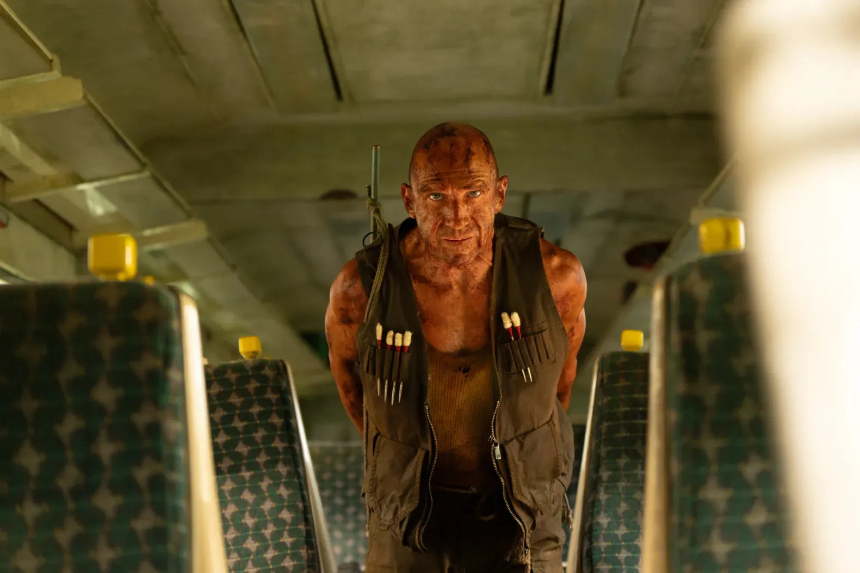
Meanwhile, Dr. Kelsen (Ralph Fiennes) continues his daily routine, which we learn more about. His recovery of bodies found nearby of both survivors and infected, he continues building of the ossuary, and his underground hovel, in which has a few saved photos of his former life, along with a small collection of truly excellent 80s music. Thanks to a morphine concoction which he can blow-dart at the infected, he ends up forming a kind of bond with Samson (Chi Lewis-Parry), the enormous Alpha that roams the area. It seems the drug calms the giant man, to the point where Kelsen begins a different kind of experiment, almost a Henry Higgins to Samson's Eliza Doolittle, coaxing whatever might remain that is human, out of the Alpha's infected mind.
And it's between these two men, these two representations of the post-Apocalypse, pre-industrial world that Spike is caught between. Kelsen has kept a steady routine for 28 years in order to stay alive, stay sane, and perhaps do what little good he could with this medical knowledge and skills. But he was an adult when the world turned. Jimmy was a child, and one left with a very large impression of Telly Tubbys and priests praising Satan, likely managing to survive by the skin of his teeth and perhaps witnessing, and deciding, that extreme violence was the only path forward.

DaCosta reunites with cinematographer Sean Bobbitt (Hedda, 12 Years a Slave) and, as the script (once again by Alex Garland) calls for, gets both bigger and richer than the previous films. This is Spike's world as it is now, full of colour that horrifies (there must have been quite a budget for the blood and other terrific practical effects) and people who both horrify and compel. Spike might be regretting his decision to find his own way in the world, his grief over the loss of his mother having to take a backseat to trying to survive as he seems to have now become a child solider, forced into service by a deranged yet damaged man.
At least one of the other gang members, Jimmy Ink (Erin Kellyman), both believes in Jimmy's message of cleansing the earth through works of 'charity' that involve skinning people alive, while at the same time recognizing the Spike is like her: a lost child who found that this gang was her only way to survive a wretched existence. Spike had the benefit of being born into a somewhat safe place, hence his inability to take an innocent life.
Garland wrote a very different script in ideas and tone for this next instalment, and DaCosta is masterfully weaving this tale. We see how Kelsen has managed to create a very ordered world in his attempt to stave off the madness as long as possible, and how that allows him to empathy, kindness, and even horror at what wrongs he might indirectly perpetrate. We see how Jimmy, who like Spike was forced into a terrible world at too young an age, but without the foundation of care to find the necessary empathy.
DaCosta and her team formally bombard us with this cruel and manic world, from several perspectives, yet it never feels rushed or without purpose. Each character is given their moment, each actor able to convey their story even if in just a single glance. In a world with no rules, what is left but the human spirit: but that spirit is not always right or good.
(And that image of Dr. Kelsen apparently fully giving into his inner madman? I won't spoil this truly magnificent moment, the best scene in the film, except to say: Welcome to your Scream Queen years, Ralph Fiennes, we've been waiting for you.)
28 Years Later: The Bone Temple is a more than worthy follow up to last year's film, visually glorious, a story that deepens the narrative, a great sense of ironic humour, and drops enough literal and proverbial needles to make an audience applaud and craving for more.
28 Years Later: The Bone Temple will be releases in cinemas around the world this week.
28 Years Later: The Bone Temple
Director(s)
- Nia DaCosta
Cast
- Jack O'Connell
- Ralph Fiennes
- Emma Laird