THE THING WITH FEATHERS Review: Big Bird and the Stages of Grief

There are a wide variety of memes on the Internet, where famous movie characters make alternative choices at the start of their story (Neo takes the blue pill, Harry doesn’t go with Hagrid, and so forth), and the end credits start rolling, since there isn’t much point to go on from here.
Dylan Southern’s live-action feature debut, The Thing with Feathers, resembles one of those memes – not even in terms of plot being thin (in all honesty, it is), but in terms of its major meaning being wholly served before the film even began, in the title of the novel it is based on: grief is the thing with feathers.
It's safe to say that by now, the idea that a major trauma, a great emotional turmoil, can manifest through some physical embodiment has been explored pretty extensively in cinema, definitely much more so than a decade ago when Max Porter’s original novel was first published. But the obviousness of the symbolism isn’t the main problem per se. It’s that Southern’s film doesn’t really have anything particularly new to contribute to the topic, and keeping the details of the story decidedly vague might help to further its cause on the intellectual level, but not the emotional one.
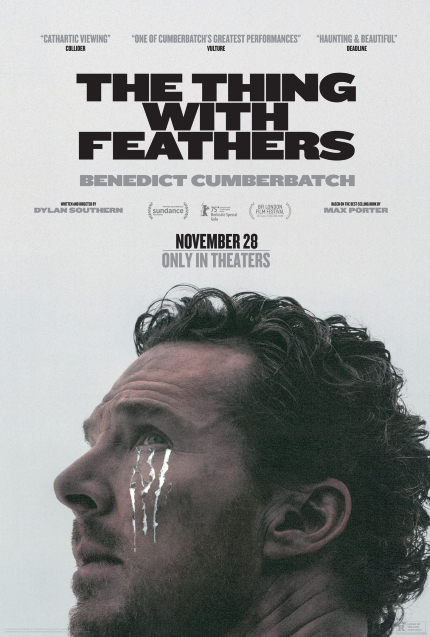
The tragedy that strikes the family at the center of The Thing with Feathers is sudden and unexplained: the wife of Benedict Cumberbatch’s hero, who remains unnamed (a detail that speaks volumes about the kind of movie this is), dies unexpectedly, leaving him to care for their two (also unnamed) sons. Cumberbatch’s character, simply dubbed Dad, tries to put up a good front at first, but then a crow enters his life. The latter is meant to be taken quite literally: a gigantic, intimidating-looking crow, who talks like David Thewlis, invades the man's home, first as a provider of misplaced jump scares, and then as a sort of dark inspiration (the main character is a graphic designer), and a possible representation of the necessary stages of grief.
The most interesting aspect of the whole scenario is that, unlike something of an A24-trademarked production, the Crow doesn’t strive to be a monster. Instead, it starts a dialogue in which it taunts and mocks Cumberbatch for his excessive despair and unwillingness to move forward from it. The idea of a macabre big bird using some tough love as a form of psychotherapy is rich, but in reality, it doesn’t get Southern very far here.
In the actual movie, the director of documentaries No Distance Left to Run and Shut Up and Play the Hits seems to be lost between a poetic concept of the original book (where the main plot was also tied to poet Ted Hughes, who actually did suffer horrible loss several times in his life), the expectedly stunning cinematography by Ben Fordesman (Saint Maud, Love Lies Bleeding), and the efforts of the leading actor. Cumberbatch does everything he can and actually breathes life into the role with every hint of emotion he chooses not to reveal; a tall order, when you’re playing a man who lacks not only a name, but an identity.
As a Russian literary classic once proclaimed, generalization can only work when it comes to happiness. To really, truly explore grief, one must dig deep into the gritty details, no matter how unpleasant that might be for all participants, including the audience.
The film opens today (Friday, November 28), only in movie theaters, via Briarcliff Entertainment. Visit their official site for locations and showtimes.