Jihlava 2025 Interview: SUPERHUMANS, Inna Shevchenko Talks Documenting the Body as a Battlefield, Shooting During an Ongoing War

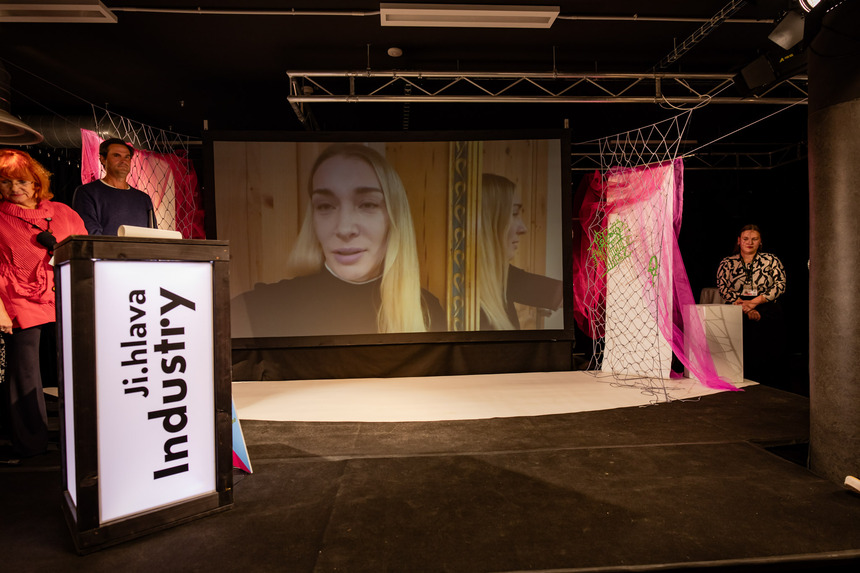
Ukrainian activist, writer and FEMEN leader Inna Shevchenko has recently expanded her work into filmmaking, developing two projects that reflect a shift from public protest to long-form audiovisual storytelling.
The documentary Girls and Gods, which she originated and scripted, examines women’s roles across the three major monotheistic religions through direct conversations with figures ranging from excommunicated Catholic priests to women imams and ex-Muslim activists. The film aims to reintroduce open debate around religion, gender, and political power at a time when such exchanges have become increasingly polarized.
At the same time, Shevchenko is directing her first feature-length documentary, Superhumans, centered on the Superhumans Center in Lviv, where Ukrainian civilians and soldiers undergo prosthetic rehabilitation. Filmed largely inside the facility, the project focuses on the physical and psychological aftermath of the war, presenting the Center as a contained environment where reconstruction of the body intersects with questions of identity, resilience, and national trauma.
Talking to Screen Anarchy, Shevchenko discusses the development of both films, the editorial and structural decisions behind Girls and Gods, and the ongoing production of Superhumans. She also reflects on the broader context of her work, including her background in activism and the long-term challenges of documenting a war that continues to reshape lives far from the front line.
The work in progress Superhumans won two industry awards at the 29th edition of Ji.hlava International Documentary Film Festival: Ji.hlava New Visions Award for Most Promising European Project and #Docs Connect Taskovski Training Award.
Screen Anarchy: Before we talk about your directorial feature SUPERHUMANS, you also appear in another project, GIRLS AND GODS. How did that film come about?
Inna Shevchenko: Yes, that’s actually my idea and my script. I came up with the project and reached out to the directors and to the production company here in Austria, Golden Girls Filmproduktion. I knew them from before, we’d already worked together on another film, where I appeared as an activist. That earlier project explored non-violent protest tactics.
So, Girls and Gods was in a way a continuation of my activist life. It was born out of several things, one of them was a desire to reach people I could never reach through my radical and often controversial protests. I wanted to connect with those on the other side, the people with whom we rarely have conversations.
It also came from the realization that authoritarian forces, often backed by organized religions or religious regimes, are gaining power again, and women are always among the first victims. We don’t even have to look far to see it. In Iran, in Afghanistan, but also in Poland, the first thing the conservative government did was to ban abortions. The same happened in the United States.
And then there was another realization: we live in a time when society is more and more divided. Different groups isolate themselves, and open debate between people with opposing opinions has become almost taboo, something seen as unsafe. I wanted to do the opposite. I wanted to meet those who disagree with me, to have those uncomfortable, unpopular conversations, and to bring back the joy of debate. Especially through such a controversial topic as religion, women’s rights, and women’s freedom.
Why did you decide to express these ideas through film?
I’ve expressed myself in many ways. I started with protest and activism, then moved to writing, I’ve published several books, and now, film felt like the next natural form.
For Girls and Gods, I thought cinema was the ideal medium, because movie theatres might be the last spaces where strangers still agree to sit side by side, close to one another, and share a moment together. So yes, cinema felt perfect for this project, whose goal is to bring people with different opinions and visions together again. To show that we can still debate, and even hug it out at the end, just like our protagonists do in the film.
I imagine there were many encounters and journeys that didn’t make it into the final cut.
Oh, absolutely. We have so much material, honestly, enough to make a whole series, and it would be extremely engaging. But of course, every filmmaker suffers through this during editing, you simply can’t include all the amazing footage and moments you captured.
We could easily make another film or even a series on this topic. Whether it happens, I don’t know, I’m the writer, not the producer, but it’s definitely a project that could live on in other formats.
Were there any encounters that particularly stood out, even if they didn’t end up in the final version?
You know, Girls and Gods could never be called mainstream. From the start, it deals with topics that many people, and even some film festivals, are afraid to engage with. It’s a brave film. A controversial one, yes, but that sense of controversy disappears once you start watching. You begin to realize that it’s not controversial to disagree, disagreement can actually be productive, even joyful. It’s about having the freedom to express that disagreement and to understand it.
Those who watch the film, who dare to watch it, really love it. We had a successful cinema release in Austria, and now in Germany as well. Each screening is followed by long debates, sometimes lasting even longer than the film itself. And I love attending them, they show the real power of such a project.
We didn’t omit anything for content reasons, only sometimes for stylistic balance. From the very beginning, we knew Girls and Gods would not be welcomed by everyone. What was crucial for us was to maintain a balance between the three monotheistic religions we explore, and between the ideas they represent, so that the film doesn’t promote or attack any one of them.
Our goal was to create a pluralistic piece, a film that celebrates pluralism despite featuring very opinionated characters, including myself. I have strong views, of course, but we never wanted to make a propaganda film. It was all about balance. So yes, some material was left out simply to preserve that equilibrium.
The film includes women who were excommunicated by the Vatican for daring to preach, women imams, women rabbis, ex-Muslims who left Islam, and Catholics defending abortion rights. We show a wide spectrum of experiences and perspectives. If certain unique moments didn’t make it into the final cut, it was only because we had to keep the film balanced and not let one idea overpower another.
You mentioned rabbis, imams, Catholics, the mainstream faiths. Did you also engage with more fringe or alternative spiritual movements on the subject of gender?
We didn’t, and that was a conscious decision. We chose to focus on the three monotheistic religions because they still shape the lives of billions of people, and, crucially, they still hold political power. These institutions influence policies, social structures, and, in many places, they shape political regimes themselves. So for us, that was the most relevant focus.
When you think of the Protestant Church, for example, a woman priest is no longer unusual, it’s quite common today. But in the Catholic Church, women are still prohibited from taking leadership roles, and those who dare to do so are punished, even excommunicated. It’s almost a witch hunt. So yes, our choice was deliberate and very clear.
As a Ukrainian, it was also important for me to address the Russian Orthodox Church and the enormous political power it exercises. Today, that power goes far beyond religion, it legitimizes and even sanctifies crimes committed by the Russian army and political elite in the war against Ukraine.
In this context, I also met with Pussy Riot’s Nadya Tolokonnikova. In a way, we come from the same roots of activism in our part of the world, the early 2010s, and that meeting was remarkable. Not only from the perspective of women’s rights, but also of women standing against authoritarian regimes like Putin’s Russia. At that moment, the film expanded beyond the question of women’s rights alone and looked at the broader picture: how religious institutions shape and sustain political power.
And now, coming to your directing project SUPERHUMANS. You first wrote about the Superhumans Center in Lviv, right? What made you decide to turn it into a film rather than just continue reporting?
It might not seem obvious at first, but Superhumans is, in many ways, a continuation of everything I’ve done before. I’ve always used images to communicate, even as an activist, I used my own body to create images that spoke louder than words. So for me, this step feels natural.
When I first entered the Superhumans Center, I was there as a journalist, writing a book about Ukrainian women during the war and publishing a series of reports for the French press. I was struck by something simple yet profound, the realization that war doesn’t end when the bombing stops.
The war continues, inside the bodies of those who survive. Even if the guns fell silent tomorrow, the war would persist in the physical and psychological scars carried by thousands of Ukrainians.
At the Superhumans Center, you see this literally. The body becomes a battlefield, a site of ongoing conflict and reconstruction. Even if peace were declared today, that war would not end inside those bodies. There are thousands of amputees in Ukraine now, soldiers, civilians, women, children, all living with the visible reminders of this war.
When I walked through that place, I saw tragedy, yes. But I also saw resilience, people rebuilding themselves, step by step, learning to live again, and doing so with humor and strength. It’s heartbreaking, but it’s also profoundly inspiring.
In some places, the pain is more visible; in others, less. But tragedy is everywhere. What struck me at the Superhumans Center, though, was how much invention and creation coexist with that pain. It’s a place where I saw, very tangibly, how suffering can be transformed into creativity, how medicine meets art.
For me, this is the real frontline of the war, a quiet, invisible one. A kind of heroism that doesn’t make the headlines. A war without explosions, without blood or gunfire, but one that’s just as essential to understanding what Ukraine is living through.
When I saw this place, I knew immediately: it has to be documented. I wanted to make a war film that shows the war without bombs, without drones, one that reveals how strength and meaning are reconstructed after total collapse. Because that’s what’s happening there: rebuilding from fragments, fragments of bodies, of lives, of identities.
Inside the Center, people are literally reconstructing themselves, starting with the body, the bones, the skin, and through that, they are also reconstructing the country. Every act of healing there is also an act of reclaiming the future.
Of course, everything I do is political, but it’s also personal. I’m from Kherson. My family lived under Russian occupation. They saw the worst of this war. We lost our home, we lost people we loved, we lost everything. But when I stepped into the Superhumans Center, paradoxically, I felt hope. I felt power.
It may sound strange to those far from war, but amid all that destruction, I found a kind of art of life, a parallel world of resilience. The name “Superhumans” itself is symbolic: it feels futuristic, but it’s also deeply human and intimate. In the ruins of war, there stands this small laboratory of the human spirit. It absolutely deserves a film.
The body as a battlefield has always been a central theme in my life, and there it was, right in front of my eyes, literal and alive. I knew I had to come back with a camera, and I did. In fact, I’ll be returning again next week.
How far along are you now in the project?
We’re entering our fourth block of shooting. So far, we’ve secured almost half of the total budget, which means we’re already in the production phase, filming and financing simultaneously.
Do you have a written script, or does the story evolve as you shoot?
I do have a script, of course, you need one, especially for financing, but a documentary writes itself. That’s the beauty of it.
In a place like this, I don’t even think it’s fair to say the filmmaker “writes” the film. The true writers are the people, the superhumans, and the place itself. The Center is a character on its own. I might put things on paper, but in truth, the script is written by them. I’m just transcribing what already exists there.
I meant more in terms of your vision, whether the film will include testimonials or family stories, or if it’s primarily observational inside the Center.
The film already has a very defined vision, both visually and narratively. The space itself shaped its cinematic language for me. From the first moment, I could see how it should move, breathe, and feel.
It will be a very physical film. I want the camera to move like a body, to tremble, to inhale, to follow. The visuals will be sensual and tactile. I see Superhumans as a sensory archive of this war.
There will be light on skin, reflections, the meeting of textures that shouldn’t coexist, metal prosthetics against warm flesh. The aesthetic is clean but deeply emotional, where surgery and poetry meet in a single frame.
A first step on a prosthetic leg might unfold to the rhythm of a rap song composed by one of the survivors. Through this juxtaposition, I want to restore dignity to the image, to show survival not as tragedy, but as rebirth.
For me, the body becomes architecture, each one a temple of resilience. That’s how we film: with reverence. The camera treats these bodies as sacred spaces, as monuments of endurance.
The Center itself also plays a crucial role in the film’s language. Many of the rehabilitation spaces are lined with mirrors. When patients practice walking or movement, they constantly face their reflections, they meet themselves again, piece by piece.
This imagery of mirrors, of fragmented bodies reflected in glass, runs through the film. It’s both literal and symbolic: a reflection of physical fragmentation, but also of the psychological process of becoming whole again.
So will you be filming entirely inside the Center, or also in other locations?
The film is essentially locked inside the walls of the Center. I want to show it as a kind of parallel universe, a contained world of recovery that still feels the pulse of the war outside.
Even within those walls, we’re constantly reminded of what’s happening beyond them. For example, some rehabilitation sessions are interrupted by air raid alarms. People in wheelchairs or with prosthetic legs must evacuate immediately, and then, when the alarm stops, they return to continue learning how to walk again.
Every morning at 9 a.m., there’s also a nationwide minute of silence for the fallen soldiers and civilians. Everyone in the Center stops what they’re doing. These moments, the alarms, the silence, are daily reminders that the war continues outside, even as life is being rebuilt within.
So, yes, most of the film, about ninety to ninety-five percent, will be filmed inside the Superhumans Center. The only exceptions are the final scenes that follow the journeys of certain individuals beyond rehabilitation.
One of them is Ada, a drone operator who lost one leg and suffered severe injuries to the other. When we met her, she was learning to walk again with her first prosthetic. During filming, she made the difficult decision to amputate her remaining leg, it was no longer functional in order to receive a second prosthetic and regain balance and mobility.
We documented this entire process: the operation itself, the rehabilitation, the first steps. Today, Ada is already out of the Center and preparing to return to the front line to sign a new contract. Her story will culminate outside, on the front line, where she continues to fight, now with two prosthetic legs.
But apart from cases like Ada’s, the film remains almost entirely within the walls of the Center.
I asked because there’s another film, TIME TO TARGET, by Vitaly Mansky, which takes a timelapse approach to civilians and the war, with a lot of exterior shots around Lviv.
Oh, no, I haven’t seen it.
Yes, so his film focuses on the outside world, while yours focuses inward.
Exactly. And that’s why the city itself doesn’t play a major role in Superhumans. The people at the Center come from all over Ukraine, from Kharkiv, Kherson, Kyiv, Kryvyi Rih, the front lines. Some have been liberated from Russian captivity, returned without limbs, and sent here to recover. Others are children injured by shelling or landmines.
So in a way, Superhumans isn’t really about Lviv, it’s about Ukraine itself. The Center becomes a kind of microcosm of the entire country. All of Ukraine is there, inside those walls.
So this is the only center of its kind in Ukraine?
Not exactly. A second Superhumans Center opened just a few months ago in Dnipro, and there are other facilities across the country offering prosthetic rehabilitation. The number of people who need this kind of care is enormous.
But Superhumans is truly one of a kind. It’s not only about medical treatment or prosthetics — it’s about helping people regain their dignity as human beings. It’s a place that restores identity as much as it restores movement. So yes, in that sense, it’s unique.
When do you expect to have the final cut ready?
We’re doing everything we can to have the final cut ready by early summer 2026.
Will there also be a book connected to SUPERHUMANS?
It’s very possible. I’ve already published a book in France, about half a year ago, based on testimonies from Ukrainian women across the country: civilians, frontline medics, drone operators. I merged their voices into a single collective monologue, and the book just received a literary award in France last month.
So yes, Superhumans could certainly become a book as well, in parallel with the film, but that’s something to be seen later.
In addition to SUPERHUMANS and GIRLS AND GODS, there’s also a film being made about you, READ MY BREASTS.
To be honest, I have no idea how the final film will look. The shooting lasted for years, it was long, intense, and often very difficult for me personally. I think it will be both deeply personal and highly political, which is why it’s not easy for me to even think about watching it.
Anja Salomonowitz, the director, has a very unique style. She works in a way that allows her to reach places, emotional and psychological, that most people wouldn’t dare to go. The process was demanding, sometimes exhausting.
Anya has invited me several times to watch different versions of the cut, but I keep refusing. I’m simply not ready yet, I know it will be too personal, maybe too painful to watch.
Has she been following you during your recent projects, like SUPERHUMANS or GIRLS AND GODS?
No, not at all. We haven’t collaborated on these films. Read My Breasts is very much her own project. It focuses on activism, on the limits and the nature of activism, told through one personal story, which happens to be mine.
Most of the material was shot before Girls and Gods, and certainly before Superhumans. We filmed some scenes that touch on the war in Ukraine as it began to unfold, but most of the footage predates that. The shooting went on for many years, so even I’ve lost track of when we first started.
Cover image courtesy of Ji.hlava International Documentary Film Festival.