San Sebastian 2025 Review: REDOUBT, Measured, Poetic Study of Obsession, Isolation in Rural Sweden
Swedish filmmaker John Skoog reconstructs the true story of Karl-Göran Persson, a Cold War-era farm laborer who turned his home into a private fortress.

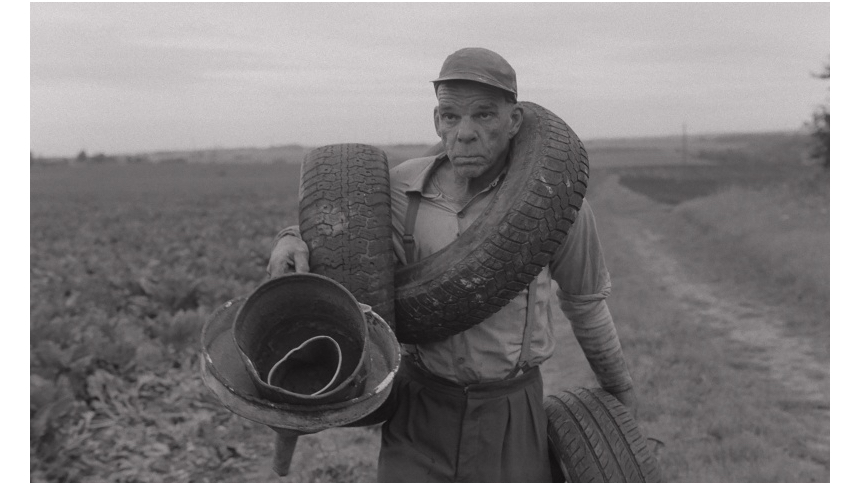
At the edge of a quiet Swedish village, a man gathers rusted metal from the fields, bicycle frames, bed springs, milk cans, and casts them into the concrete walls of his new house.
The action is obsessive and compulsive, as the only purpose of the man´s life becomes the sole target of building a fortified building to the point of obsession when people from the surrounding area come to laugh at him. Swedish director John Skoog reconstructs this true story of Karl-Göran Persson, a farm laborer who, during the Cold War, transformed his modest dwelling into a private stronghold, in Redoubt.
The film unfolds in measured, patient rhythms, following Persson’s lonely, methodical labor and his growing estrangement from the community around him. What begins as an act of protection gradually turns into a portrait of obsession, a meditation on fear, solitude, and the fragile boundaries between vigilance, paranoia and delusion.
Skoog’s work has revolved around rural life and its silent transformations. His earlier films, such as Ridge, examined the agricultural rhythms of southern Sweden, treating the landscape as a living organism shaped by time, weather, and human persistence.
In Redoubt, he extends these concerns into a historical and existential dimension. The director revisits the Skåne region of his childhood, not merely as a setting but as an archive of memory, where myth, rumor, and reality coexist. Like Ridge, Redoubt observes physical labor with quiet intensity, yet here the toil acquires symbolic weight. The act of building, pouring, hammering, and scavenging becomes both a ritual of endurance and a symptom of fear, a way to impose meaning on an uncertain world.
Redoubt follows a relatively simple structure. Skoog observes Persson over the course of changing seasons as he builds a war-proof house. At first, Persson works on the project alongside his job as a laborer; after retiring, he devotes himself to it entirely, turning the construction into the central purpose of his life.
Initially, Skoog does not portray Persson as a local eccentric, he remains an active member of the community, taking part in singing, dancing, and local festivities. Gradually, however, he withdraws from these activities and becomes increasingly isolated.
Not much of a talker, Persson is portrayed by the unmistakable Denis Lavant, who learned Swedish specifically for the role. Lavant delivers a largely physical performance, conveying the character’s inner life through movement and gesture rather than dialogue. His portrayal captures a man burdened by collective paranoia yet sustained by a personal sense of mission, an ordinary individual with a modest, almost domestic version of a messianic complex.
Persson’s only real understanding comes from the local children, who accept him without question. Most of his interactions are with them, as they play together in the forest. Lavant embraces the character’s childlike qualities, naïve but unwaveringly devoted to his construction.
His performance carries a Chaplinesque aura, embodying the archetype of the fool: not the village idiot, nor the wise fool, but a harmless dreamer who means well and relies on the limited tools within his reach. In this case, that means building his own version of a war bunker, complete with imagined chambers for the royal family.
Redoubt operates on both literal and figurative levels, merging biographical observation with allegorical resonance. Persson’s house still stands today, serving both as a record of one man’s life and as an unintended monument to the anxieties of the twentieth century.
Yet his story remains relevant to the present. Persson’s obsession began after reading the government’s pamphlet When the War Comes, issued during a period when even neutral Sweden prepared for a conflict that never came. Fear ultimately consumed his existence, turning precaution into fixation. In Skoog’s film, the only moments when Persson seems to experience genuine joy are those spent with children, his brief expressions of carpe diem in an otherwise isolated and monotone life.
Skoog chooses children as the voice-over narrators of Persson’s life, allowing the story to unfold as something between memory, folklore, and testimony. This narrative device turns Persson’s solitary labor into both a historical account and a collective myth. Through the children’s perspective, Skoog suggests a gentler understanding of the misunderstood, diminutive man, an unlikely Don Quixote of Skåne.
Working once again with cinematographer Ita Zbroniec-Zajt, Skoog employs long, static takes and expansive compositions that emphasize duration and space. The wide fields of southern Sweden are presented as vast and open, contrasting with Persson’s self-built, labyrinthine and claustrophobic house, which gradually begins to resemble catacombs more than a human dwelling. The use of natural light, often diffuse or overcast, creates an atmosphere of muted apocalypse, as though the landscape itself bears traces of past conflicts and latent fears.
Visually, Skoog’s method approaches ethnographic realism while also evoking the sculptural quality of an art installation. Persson’s house becomes, in this sense, a work of outsider art. The film’s black-and-white palette lends it a subdued, melancholic tone, counterbalancing Lavant’s performance, which draws on the physical intensity and expressive gestures reminiscent of silent cinema.
At first glance, Redoubt may appear to recount a curious anecdote from simpler times, yet its allegorical dimension gives the film broader resonance as part of Skoog’s wider artistic project. The repetitive rhythm of Persson’s work, marked by his obsessive dedication, gradually transforms the film into a meditation on the nature of fixation itself.
Through its measured pacing and observational style, Redoubt adopts elements of slow cinema to explore how fear and anxiety can be metabolized and reimagined through the idiosyncratic quixotic story, based on real person.
Redoubt
Director(s)
- John Skoog
Writer(s)
- Kettil Kasang
- John Skoog
Cast
- Denis Lavant
- Michalis Koutsogiannakis
- Livia Millhagen