Toronto 2025 Review: TRAIN DREAMS, Where the New World Is an Old Place

Nature is vast and indifferent. It is often cruel. And yet the sunrises and the sunsets are glorious, any life is extraordinary, and regardless of the time, place or circumstances of one’s birth, there are unfathomable wonders intermingled with pain and suffering.
Werner Herzog and Terrence Malick have spent their entire careers trying to articulate this with the medium of cinema. Director Clint Bentley (Jockey) clearly is aiming for the visual style and structure of the latter, possibly to his detriment by comparison. Nonetheless, the slow cinema experience on offer with Train Dreams is well worth the trip -- if only because the plot of the film, and the antagonist as well, revolves around the passage of time.
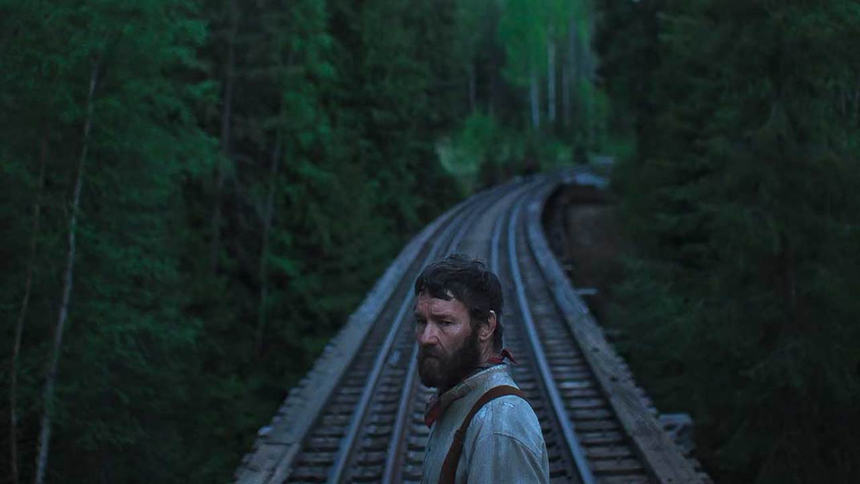
Filmed almost entirely at either sundown or sunrise, often with candles and firelight, one of the visual pleasures of the film is Adolpho Veloso’s low-angle cinematography projected in a curiously rare 3:2 aspect ratio. It puts the humans in the film in stark contrast to the immense and sprawling forests and deep rocky landscapes of the American northwest, often centering the main character in the frame while slowly zooming out.
The storytelling is not ever in a hurry, even during the film's lone action set-piece, that of a raging and all consuming wild fire. It is a film of birth and death and re-birth. If I have any complaint, it is that the film was shot digitally. Instead of the soft dance of analog film, scenes are often distractingly crisp, with dreams and flashbacks occasionally over-edited, which diminishes the power of the longer, thoughtful sequences.
The story is based on a novella from Dennis Johnson (Jesus’ Son) and follows the entire life of an orphan and quiet loner named Robert Grainier. He comes of age earning a living as a logging man in the Idaho panhandle.
As the railroads expanded towards the Pacific Ocean, north of California, it employed a vast army of American and Chinese labour. Existing mostly in temporary camps and living among itinerant men, Robert works the seasonal cycle of cutting down 500-year-old trees, by hand, for timber to construct trestle bridges as progress moves west. Men die. Men are replaced. Manifest destiny and all that.
There is a rugged and beautiful recurring image of leather work-boots nailed to a tree to mark the passing of a human life; consumed by the march of time and capital.
Early on, we are told by the narrator of the film (Will Patton, omnipresent but only as a voiceover, not a character) that Robert lives to old age. Absent the suspense that he will meet his demise at the hand of his dangerous profession, instead we are left to focus on Granier as a witness to change, as the old world forests are altered by human technology.
From the eve of the 20th century, through two world wars, to the first men in launched space, Robert glimpses history from the periphery; while he chops and strips lumber, he sees the wooden bridges he helped build replaced by concrete highways. He observes tough men become frail and too old to continue to work, wondering philosophically what the consequences of taming and adjusting the natural world will be.
He finds and marries the love of his life, Gladys, and builds a homestead with her in the woods. Felicity Jones, building upon her career-defining performance from last year's The Brutalist, channels the Malickian female archetype, both twirling barefoot at times, as well as firing a rifle, and existing in harmony with both church and the forest.
They have a daughter together, and make plans for the future. Many of the best moments in the film are these idyllic, unstructured times, with his family. To earn a living, Robert must disappear for long gruelling stints to work during cutting season. The moments missed of that life, with his daughter and wife, for his nearly solitary existence on the job is at the core of the film's somewhat melancholy experience.
Joel Edgerton has always shown a quiet and haunted face on screen, from his early-career cameo as Owen Lars in Star Wars prequels to his creepy antagonist in The Gift, to his soft-spoken Navy Seal in Zero Dark Thirty. This specific quality is put to, perhaps, its ultimate purpose here as a hardworking man of few words with a humble and rich inner life.
Granier offers water out of his boot to a man pinned under a tree while the man suffers and expires, an early and fleeting cameo from Clifton Collins Jr., which once again points to Malickian influences, via ephemeral casting in minuscule roles.
He bears witness to a young man from Shanghai who is thrown off a half-completed bridge into a deep gorge for a transgression that is never explained. The nature of this human cruelty haunts him to the point where he often sees the man sitting silently beside him, in moments of his own extreme solitude.
He befriends a dynamite specialist (William H. Macy) whom he encounters several times over the passing years on various jobs. As well, there is as an indigenous man who runs the general supply store in the town which Robert uses often for building (and at one point rebuilding) his homestead. Much later, he befriends a kindred soul, a brashly independent forestry worker (Kerry Condon) hired to minimize future forest fires in the region.
These are minor, but not insignificant relationships, but belie the typical structure of a 'normal' movie in interesting and compelling ways, ones that are particularly satisfying once you become keyed into the film’s distinct M.O.
Train Dreams flirts with the inevitable consecutiveness of nature, and subtly hints at the friction of progress and consequences of industrializing ancient lands. It obliquely asks if the bad things we do follow us through life as penance. Or is it indifferent randomness and progression? The people who drift around passive, but not helpless, Robert, are both good and bad. His time with them is fleeting, but never wasted.
He bears witness to everyone in his life passing out of it or away from him. He never makes a phone call, or drives a car, but he often takes long, silent train rides on very the rails and bridges he was a part of building. Eventually this becomes travel for travel's sake, to the big cities in the east of the country that bore the fruit of his lifetime labour.
In the final moments of the film, Robert hires an open-cockpit pilot to fly him on a tour to see the land from a vantage point he was never able to fully appreciate. Not from the drop over a long-spanning bridge, not strapped to the top of the tallest tree, nor a multi-story observation tower built for his forest management friend.
As the pilot sharply banks the plane sideways, heading towards flying upside down, she tells Robert, “You better hold onto something.” Which is exactly what the film desires of its audience with this elegiac experience in the dark. And also in life.
[On a side distribution note: It is a kind of crime that Train Dreams will end up as a Netflix film, likely watched in the background on a laptop or a phone via streaming. Given its contemplative themes and vast visuals, it begs to be watched, alone or communally, in a cinema if possible.]
Train Dreams
Director(s)
- Clint Bentley
Writer(s)
- Clint Bentley
- Denis Johnson
- Greg Kwedar
Cast
- Kerry Condon
- Felicity Jones
- Joel Edgerton