CAIRO STATION Blu-ray Review: An Egyptian Classic Gets the Proper Treatment

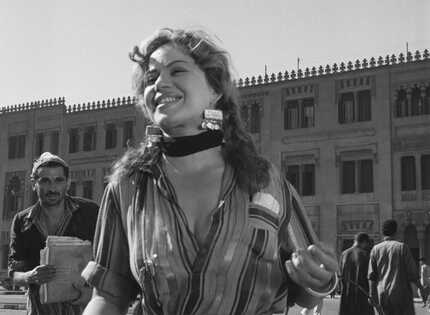
It's impossible for any one film to complete define a particular country at a specific moment in time. Countries and cultures are too vast, too multiple, too varied to be quantified in 90 minutes. But a film can capture a place and time strongly enough that it becomes not only a time capsule of the past, but a window into how a place and culture might be what it is in the contemporary.
Cairo Station is arguably such a film. While it was not successful in its home country when released, over the decades it has become recognized as a pillar of Egyptian cinema. Youssef Chahine's tale of the working poor at the main railway station, their struggles, their love, their obsessions and their violence, is a joy to watch time and again, and remains as fresh as it did more than 50 years ago.
Kenawi (played by Chahine himself), a lame country lad who turns up at the station with nowhere else to go, is taken in by the newsagent Madbouli (Hassan El Baroudy) and given a job and a shed to live in. Over time, he becomes enamoured of the beautiful and vivacious Hanuma (Hind Rostom), one of the women who hawks sodas to thirsty travellers. But she's engaged to Abu Siri (Farid Shawqy), a porter, who is trying to form a union.
The film begins almost as a documentary, with shots of the hustle and bustle of the station, and the narrator, Madbouli, introducing himself; as he says, being the newsagent, he has one foot in the outside world, and one here in this place. It doesn't take long to understand that the focus of the story will be on the workers, the people who keep the station running. They weave between customers, hop over tracks, know its secrets and hiding places. It's not a luxurious life to say the least, and the push and pull between large personalities, desires for better working conditions, are examined alongside someone like Hanuma who at once wants the tradition of marriage, but also the freedom that her personality demands.
When we first see Kenawi's face, it's through a glass display, distorted. We already know he's physically lame, and it seems that lameness caused a life of neglect, and a personality that often doesn't understand certain social boundaries. He lacks for the kind of love and affection he wants; others encourage him to find a fellow lame person, as the only kind of woman who would have him. Despite this being set in 1958, it doesn't feel that the world has matured much in it attitude towards the disabled. We feel sympathy for Kenawi, at least to a point.
Chanine begins the film as social realism with a fair dose of comedy; perhaps neorealism, but these are professional actors, and there is a sense, at least in the first act, that this will end with happiness and a wedding. But the second act shifts, almost imperceptibly, into drama. Abu Siri is abusive towards Hanuma when she continues to work even as he ordered her not to. Others in the station see her as a disruptive force, and Kenawi's little crush on her seems to veering into dangerous obsession.
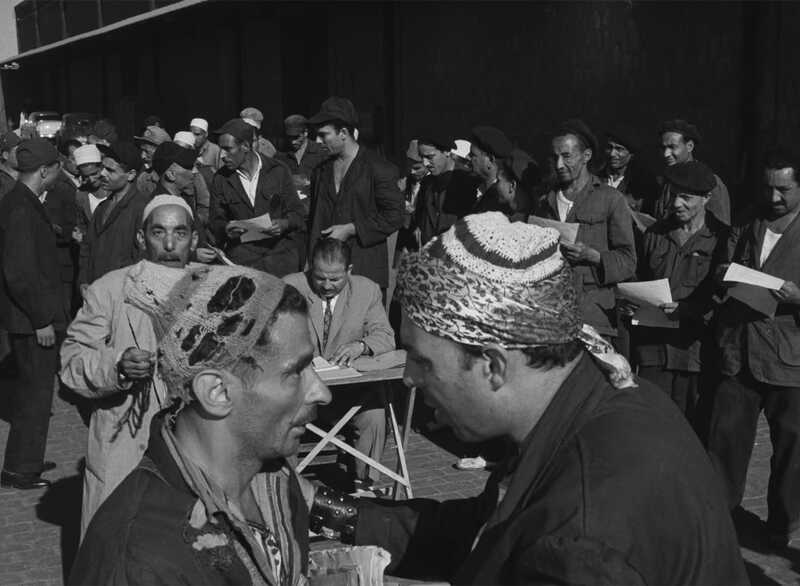
It's hard to blame Kewani for his obsession; Rostom's Hanuma is street smart, uninhibited, independent, ambitious, sometimes kind, and yes, sometimes a little unthinkingly cruel. But she knows the world she lives in and what it wants her to be, and she will only conform so much. We might dislike some of her behavioiur, but we understand it.
Chahine not only proves himself as an actor, making us both sympathize with and distrust Kewani, but as a director, with these shifts in tone. In a gorgeous scene, Hanuma dances with young people, who are playing music on a train. These are the young, somewhat privileged people, wanting solidarity with the working class, understanding how bridges are forged through art and culture. It's a scene that reflects joy and rebellion, from the students and Hanuma. But as soon as she is spotted by Abu Siri and other workers who are fed up with her behaviour, the film shifts from this joy, to the drama, and soon enough, a psychological noir.
But the noir, and the psychological unrest, lies at the heart of the film. These might be poor workers left behind by the revolution, but they also live in the noir shadows, subject to anger and violence. As Kewani's unfulfilled leads him to violent actions, it has not only personal ramifications, but social and political meaning. Chahine uses all cinematographic and audio tools his disposal, the final 10 minutes being some of the most tense and nail-biting of the era's cinema.
A delightful comedy, a stirring social drama, and a harrowing thriller, Cairo Station packs a lot into its barely 80-minute running time. And yet it does so seamlessly, with energy and precision, and a window onto a Cairo at a unique moment in its past.
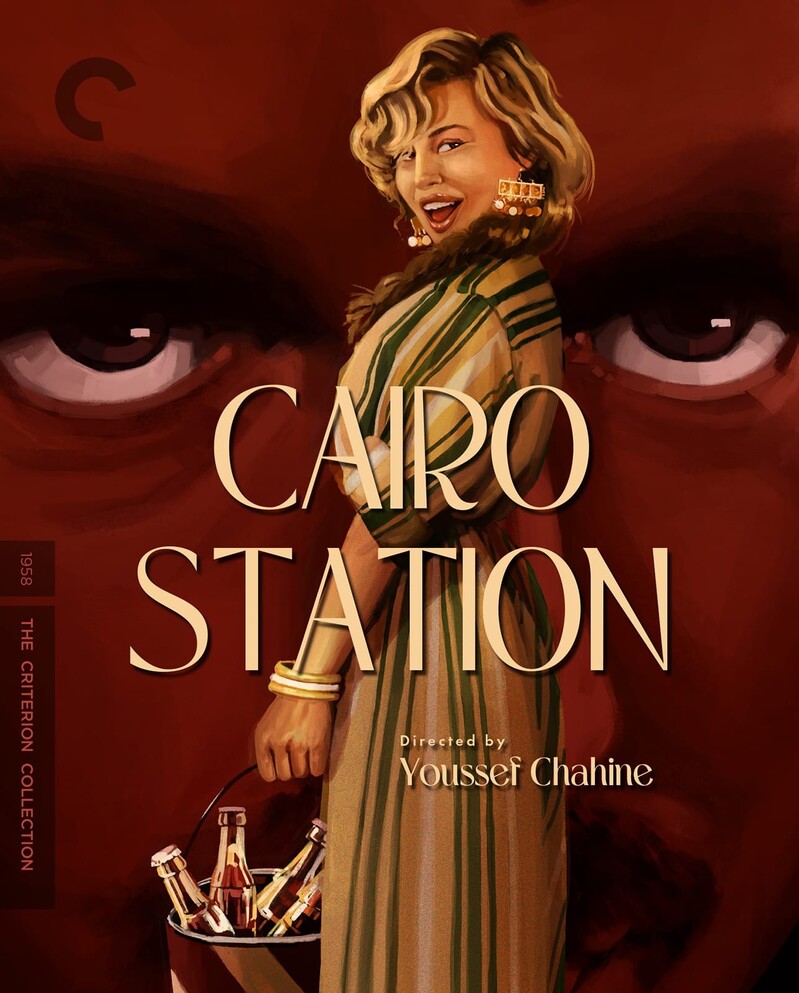
Special Features
The beautiful 4K restoration was created from the original 35 mm. negative, in its original 1.37:1 aspect ratio, helping to preserve its wonderful use of light and shadow. Chahine has a way of making a scene coming to life that you almost forget it's not in colour, his actors giving their own in every scene.
Critic and curator Joseph Fahim does double duty, providing not only an interview that gives an overview of the film and Chahine's career, but also a wonderfully detailed essay. Rather than repeating himself, the two pieces compliment each other, with the essay giving great detail on the film and its various meanings, how the main actors were somewhat playing against type, how the film fits in the Egyptian director's œuvre, and what happened to Cairo after the film.
There is a documentary by Mona Ghandour, Chahine ... Why? which includes recollections from some of the cast and crew of Cairo Station, as well as how Chaine came to take on a role in the film that was originally meant for another actor. An excerpt from an on-stage conversation between Chaine and Peter Von Beght at the Midnight Sun Film Festival could have been a good addition, though the sound quality unfortunately makes it extremely difficult to hear.
The highlight of the special features is Chahine's controversial documentary Cairo, as Seen by Chahine. Made in 1991 for French television, it was banned in Egypt, as the government was not happy with how it was portrayed. The 2K restoration introduces it to a new audience, who once again see Cairo, though now at a very different point in time. This is something of a film within a film, Chahine shown taking a young man under his wing who is trying to find a job; discussions with young people as to the state of Cairo; how the city 'performs' for outsiders. Like his fiction film, it's a window onto the city and the people struggling to fulfil their dreams.
Cairo Station
Director(s)
- Youssef Chahine
Writer(s)
- Abdel Hai Adib
- Mohamed Abu Youssef
Cast
- Farid Shawqi
- Hind Rustum
- Youssef Chahine