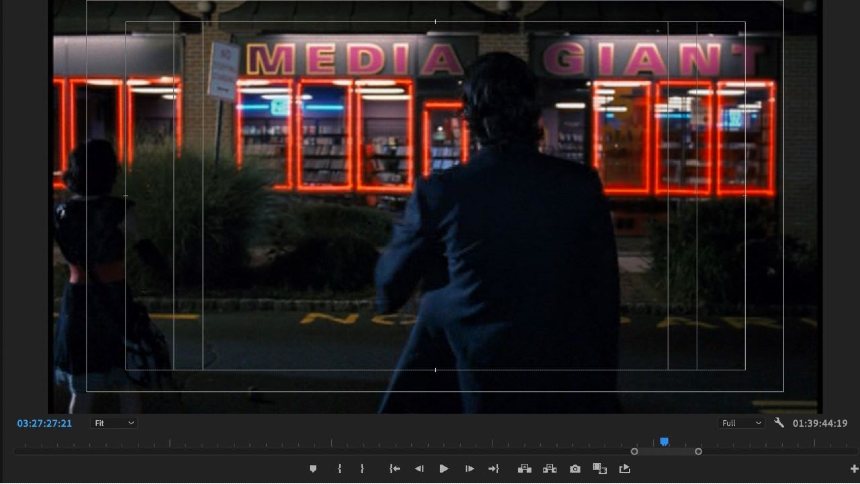
VIDEOHEAVEN Interview: Alex Ross Perry on Finding Clips, Video Stores and Their Place in Social Culture

In Alex Ross Perry’s three-hour-long (but not long enough) collage film, Videoheaven, two different adaptations of the Richard Matheson novel, I Am Legend, pay homage to the meaning of movies as they pertain to the 20th century.
First in The Omega Man, Charlton Heston, as the last man on Earth, stumbles into a still-operational movie theater, despite the lack of the living, and sits down in an empty auditorium to watch evidence of his now-extinct species projected onto a ghostly silver screen.
Similarly, in 2007’s I Am Legend, Will Smith spends his empty post-apocalyptic days basking in the comfort of a once-popular Manhattan video store, browsing the aisles as was the beloved pastime of his era. Ironically, by the time of the release of this modern retelling, the once-thriving Tower Video store in Manhattan, like almost all video stores at this time, was already a relic of an increasingly ancient civilization.
The title, Videoheaven, carries a delicious double meaning. First, for creatures of the late 20th-century video store boom, like myself, who will always delight in seeing depictions of the cultural phenomenon frozen in time by old movies, Perry’s documentary serves as a visual compendium cataloging every instance in which a video store scene was captured on film.
But far more tragically, the film also exists as a graveyard, hence the second meaning of its title. Videoheaven is a facing-the-facts acknowledgment that the cultural institution that defined so many of us is dead, buried, and resting peacefully in our hearts.
One byproduct of Perry’s multifaceted examination is the stark retrospective realization of the relatively brief lifespan of the video store. For those of us born into the middle of its thriving heyday, there was no reason to believe such a wonderful and seemingly indestructible institution would ever end. But it did end. And with cinema itself now being revealed to be a prominently 20th-century concern, its future disturbingly uncertain, is it any wonder that we should be faced with the reality of video mortality?
On top of providing a vivid, almost National Geographic presentation of the rise and fall of the home video industry, Videoheaven digs through its evidence of store-set scenes in an attempt to ascertain clues as to how it all went so wrong. Perry, himself a former clerk of a beloved NYC archive, clearly annoyed by the media’s increasingly negative depictions of the in-store experience, not to mention its snooty gatekeeper, has some strong ideas of where things went astray, but ultimately, it does little to ease the pain of video’s untimely demise.
If you, like me, like Perry, and I imagine a swath of other former tapehead zealots who have found themselves wandering the streets of some strange new tomorrow, attempting to unpack the decline of something so culturally, socially, and personally rich, pondering what it all meant, or perhaps more to the point, what life means without it, there are no words of consolation to be offered beyond what can be said in times of death itself. We must take our comfort in the fact that the video store’s beloved memory will live on in the hearts of those who cherished it… not to mention in the films that eternalized them.
One hopes that in the aftermath of the not-too-distant machine takeover, there will still be opportunities for the roaming Charlton Hestons of the Earth to stumble upon moving picture relics of the obliterated past. When that happens, and future survivors are looking specifically to understand this long-forgotten cultural staple called ‘the video store’, and what it meant for the human species as it barreled toward the Y2K, here’s hoping they find Alex Ross Perry’s beautifully elegiac Videoheaven.
ScreenAnarchy: As soon as I started watching your movie, I was hit with the realization that ‘My God, this is like Thom Andersen’s documentary but for video stores!’ I was obsessed with LOS ANGELES PLAYS ITSELF, and I’m assuming you were as well. So I'm wondering if, firstly, you also responded to that film, and if so, how you wanted to take that format and utilize it for this topic that you've been steeped in for your whole life.
Alex Ross Perry: I mean, that is, I would say on any given day, my favorite documentary of all time, and a movie that the first time I ever saw it, it was just instant obsession because I didn't know you could make a movie like that. That's a rare thing for me to come upon in the 2000s where you're like, I didn't know that this was a format of filmmaking.
At the time, I'd seen none of the essay films, like the comparable Godard films that are just essentially combining sound and image, but not necessarily from the same thing, Histoire(s) du cinéma, of course, being the biggest one, but I had not seen that when I saw Los Angeles Plays Itself. Obviously nobody would accuse Histoire(s) du cinéma of being easily watchable, whereas Los Angeles Plays Itself, and more recently, Room 237, to me, they're both movies that I went into thinking, ‘How will this play? And 40 minutes in, I'm like, ‘This is like pouring hot liquid. Like this is just moving and moving and moving and I could watch this forever. ’
And I just became obsessed with that means of storytelling. And certainly, it's not like I left seeing Los Angeles Plays Itself thinking, like, I need to find a way to create something in this mode. But as a filmmaker, you hope to always be just looking for something else to do. And I don't really understand or relate to the artist who does not do that. The artist who says, like, I know what I do. Everything I do is consistent and fits in. If I've made fiction films and I see a documentary that blows my mind, my brain says, ‘What would a documentary made by me look like? How can I crack that?’
Thom Andersen is a special case. Obviously, he's not a filmmaker primarily; he's an academic. But I just worship artists like Spike Jonze and Scorsese and Spike Lee, and so many of my heroes who make scripted films will also make a concert film, make a documentary, make music videos. They have this sort of omnidirectional sense of like, ‘I can find my way into any number of ways of visual storytelling’.
And this was just right there for me. Around the same time as the 2013 restoration and legal re-release and then the eventual Blu-ray release of Thom Andersen's film, Daniel Herbert published his influential book (on me), Videoland. And the fact that these two things came together, you know, it's like pregnancy. It's like one thing fertilizes the other with this book combined with the fact that I could now own Los Angeles Plays Itself, and I was just popping it in and looking at a few scenes of it or just listening to it for a little bit.
So suddenly, I have this book and so I write to Dan and I say ‘I'm a fan, I'm a video clerk myself, could we ever do something’? He says I deleted a chapter about the depictions of video stores on screen because it was too redundant. And I said, give me that chapter, I want to make a movie out of it. And that's where it went.
Cool. So like you, I imagine, I've always gotten excited when I watch a movie and see a scene that takes place in a video store because you get to watch a video store - it's like frozen in time. And now I'm watching your movie and I'm thinking,’ Oh my God, every single one of these scenes has been combined into one entity. I get to watch all of my video store scenes in a single package.
So for that alone, I just wanna thank you. You're doing such a service. How did you go about accumulating so many clips? How many did you know going into this movie? Did you put out a call to your network and ask ‘Who knows scenes that take place in video stores?’
Yeah, I mean, it's hard to say what came first because, through Dan's research for his deleted chapter, he covered probably the 25 big ones that anybody who is you or me could just rattle off. He covered Clerks, he covered Kicking and Screaming, he covered Body Double. But in his research, he had also then found 40 more that he was like, ‘I looked at it. It's a 45-second-long scene. It just doesn't hold weight for my academic argument’. And I said, ‘But for us, we could really work with that’.
And because he's a full-time university professor, when I contacted him, he had a paid research assistant at the university provided for him to do this bookwork. And then he just had them keep digging. And they were able to find another 40. So now we have like 100. And we have this spreadsheet that Clyde Folley (editor) and I would still look at up until the very end. Like, ‘Let's make sure of that initial hundred (which became what was on our first hard drive in 2015), let's make sure we got every single one of those because some of these are so long ago, we probably forgot about them.
The remaining like 80, it's not me putting out a call. It's just if you're me and you tell everybody, you know, for 10 years, working on this, at some point, everyone says, ‘I got one for you. And there's probably 40 in this that if you were to say, ‘Where'd you find that one?’ I would say, ‘Between 2014 and 2024, I watched that movie’. I didn't watch it because I was looking for a video store. I didn't watch it because I thought there might be one in the background. At some point in the last 10 years, I can't explain it, but that got watched. Or Clyde is the same. ‘Hey, I was watching this, I got another one.’
So what's the juiciest one for you? Do you have a favorite scene shot in a video store?
I try not to be redundant -- the film addresses this -- but Body Double, to me, which we say emphatically, is the first one in a Hollywood film. It's October ‘84. So that movie came out a few months after I was born. That frames our story in my lifetime, but also the atmospheric allure of that Tower Video is so consistent with my earliest memories, four years old, five years old, of what electronic stores and video stores looked like in 1988, 1989, 1990.
On the other hand, your very shaggy strip mall Mom & Pop places, which I also would have frequented. There's a commercial in the film for a Pennsylvania-based chain called West Coast Video. That was my chain even before Blockbuster took off in my town. And West Coast Videos are very important to me. And you see that kind of shaggy, like, ‘this is next to a grocery store or next to a pizza parlor in some town’ quality.
So I love the Body Double clip and I love the meal that we make with The Toxic Avenger 3. Because that is a film, I mean, that scene is 11 minutes long! And for us to be given the gift of that much footage to edit, but then also to really elevate… I love that clip because I love Troma Films and I love 80s low-budget horror and exploitation films. But what I really love is that we were able to take an outlandish clip from a ridiculous movie made purely for fun and say, ‘In hindsight, this might be one of the most fascinating texts we have in our arsenal.’
Because a movie like this, showing the destruction of an independent store in a strip mall in November ‘89 when the film was released, is such a perfect omen of what the 90s are about to be. So it has become a favorite of mine, because, first, I already like it, but then, because it is so laden with useful meaning for me..
By the 90s, things get unremarkable. And a lot of the sitcom ones are clearly a set. Whereas these 80s ones are obviously filmed on location. The final film in our doc, I Am Legend, it's not a good movie. It's a fine movie, but I never liked that Tower Video. And I lived two blocks away from it. When I worked at Kim's Video, we sent people there every day when they were looking for Hollywood titles we didn't have.
They said, ‘Do you have this, you know, Hollywood action film?’ Maybe we had it, but if we didn't, we'd say, ‘Go to Tower or the Virgin Megastore, which was still then in Union Square. So I had no nostalgia for that store that I went in dozens of times. And I walked by it every single day of my first three years in New York because it was directly between my dorm and NYU.
However, I love watching it because you look out the window and you can see Other Music. And while I have no affinity for that store and no nostalgia for what it represented, when it was filmed, New York, 2006, even though it's a dystopia where there are no other people, I can see myself walking around the filming at that time. And I know that while they're shooting that movie in late 2006, I know that I'm walking to Kim's. I know that I'm down the street at a better store while they're shooting that. So while I don't love the clip itself, I love it for what it represents. And I love what it represents in my own personal memory.
I think your film makes a very compelling argument that the increasingly shitty depiction of video stores in the media had a subliminally negative impact on video store culture at large, and I think there's a lot of truth to it.
Yeah, I mean, I was a Cinema Studies minor. So I'm not saying the conclusions I reach from putting 200 clips together is objective fact. I'm saying the first half of the movie, which is based on Dan's research about the statistical rise of the video store, when it happened, how it happened, how geographically consistent they were, the homogenous architecture of chains, that is a fact. Those are all facts. You can make a hundred video store docs. Those are just the facts. Dan's an academic. He found those facts. We cite those facts.
The second half of the film is just my interpretation as a clerk, who's spent my entire life loving these spaces, and was sitting in the front row of their demise, sad as hell. And I just looked at all this and I thought, when you've got 40 million people on must-see TV, being told every time you go out to the store, something bad's going to happen. My interpretation is just the psychological toll of that on the American subconscious over a decade is telling people, ‘Forget it!’. And then right when that's happening, here comes an alternative, easier, more convenient way of getting the same product. That's just, that's just the conclusion I reached. I didn't start out with that conclusion.
I like that. And I think it's accurate. I want to add one more conclusion to the pot because I’m curious to hear your perspective on it. So I personally never got to be a clerk at an archive-style indie store (just a Rogers Video and a beloved year spent solely manning a Chinese Ma & Pa). I applied for jobs a few times, but I never got to cross that barrier. So I come at this from more of a customer perspective, right?
And my video store experience is kind of defined by the hunt, the search, you know? Trying to see everything, find the rarest movie. And then it becomes kind of like a scavenger hunt. I'm sure this existed in your history as well. Like, I'm sure there are some movies Kim's Video didn't have, so you needed to go out to some of the more fringier stores. I don't know. I didn't grow up in New York. I'm in Toronto. (Queen Video, Suspect Video). Maybe Kim's Video had everything?
We liked to think so.
So I, on the other hand, when it came to the extremely rare stuff, the early Internet was my only means of acquiring things like THE DIRK DIGGLER STORY.
Did you get that from Five Minutes to Live? That was a bootleg DVD website. It's where we would go. That's where I got The Dirk Diggler Story, which I think had that and the Bottle Rocket short on it.
I believe my site was called Bovine Video. Where I also got PTA’s SYDNEY, Todd Phillips’ FRAT HOUSE…
Oh, we had that at Kim's. Yeah, but Five Minutes to Live was beautiful. That's where you would get Brazilian Star Wars. It's where you would get Turkish Captain America VS Spider-Man.
So I guess if I was sort of making an essay film, mine might have to do with the psychology of availability. What's interesting is, we talk about the movie theater and also video stores, as these social hubs, and before the Internet, it's like these social hubs existed as a space where we could sort of accumulate knowledge, share tastes, and this is how we expanded our tastes to an extent, right?
We’d see movies with other people, discuss them, and find out what their favorite movies were, and we kind of had to do more work to arrive at the movies we've seen and all that stuff. So I guess what the Internet really did, and what YouTube did, was just make everything available. And when you stopped having to go to a hub, once everything became so easy, unsocialized, and unremarkable, it's like the desire concurrently waned.
Yeah. Well, you're hitting on an interesting point and you're using a good example. There's nothing I am more confused by than when I see something uploaded to YouTube and it says ‘rare’. Like you used to go on eBay or Five Minutes to Live as I did, and buy a bootleg, and it would say ‘rare’. And you know, it was rare because you've been looking for it for five years and you'd never found it. If it's on YouTube, it's not rare. That's like having something at the 99-Cent Store that says ‘expensive’. It’s not expensive if it's here.
And something like The Dirk Diggler Story or Frat House, these were legends, but these were legends by well-known Hollywood mainstream public figures. If you had a friend with a copy of The Dirk Diggler Story, you had to go to their house to watch it. Now it's on YouTube, or it's probably on some edition or whatever. You can find it in five minutes.
And when you’d get it, as you just said, you might invite people over, and so it's inherently a social experience because there's only one copy.
Yeah, and that was really exciting. And to me, that created this sort of mythological quality around certain viewing experiences. Another example, and these were not bootlegs, but, if you had a friend, or in that case, the friend was me, with The Short Films of David Lynch box set. That wasn't available everywhere. You had to get that from his website. So not everybody had that. You wouldn't have access to it. But if someone's just getting into Lynch and I'm like, ‘I've got the short films, come over. We'll knock them out. One hour, let's check it out.’ I'm curating that experience.
Now they're all on the Criterion channel. Obviously, it's better that people get to see them more easily. But there was something really exciting about the social quality of being a hub, of putting things together and, for me, what you're saying, a sort of parallel story, is the story of how access, which used to be inconsistent, by and large, is the defining factor in what becomes canonized in film history. If everything's available, everything is an equal playing field. If you can cull up on Amazon or YouTube, the most mainstream things and the rarest things, then everything is fighting for the same scrap of attention.
This was true of the top 100 most important cult films of all time. If you couldn’t get Holy Mountain or El Topo or Eraserhead or Pink Flamingos or a thousand other such films, you either needed to know someone who had it, because they're not going to have it at Blockbuster or they don't have it on video at all, or you needed to go to a screening of it. And you see, over time, access radically influences what is canonized.
And that has changed 180 degrees in my film-watching lifetime because access is ubiquitous now. And the worst you can have is that something is exclusive to a streaming service that you don't subscribe to. So you can't access it. If you're psychotic, you'll just torrent it. And that's fine too, but nothing is more under-analyzed, I feel, than the impact of access on what gets elevated and what gets forgotten.
And I say this all the time. Zulowski's Possession is now, I would say, indisputably probably one of the 500 most acclaimed, canonized, beloved, and rewatched films of the last 10 years. That is because, for 20 years before that, it was unseeable. But everybody who saw it knew that it was remarkable. And they spent 20 years putting it in people's hands, saying, ‘You've got to see this thing!’. The other important thing about that film in relation to Videoheaven is it had the ugliest DVD art you have ever seen. It is unspeakable. This is a visually robust movie!
And we've seen these now with some of the most remarkable posters ever made. The DVD cover is something that you could put directly in front of a thousand people, and 999 of them would not think, ‘I bet this movie is good’ So once that movie was on DVD, it was essentially something nobody would be inclined to watch because of how poor the DVD cover was. That set the movie's status back for an entire decade until screenings of it became ubiquitous. And the screenings were not using the original poster! And, to me, this is just such a crucial way for people to know about the process and understand what gets elevated and what gets forgotten.