Heartland 2020 Review: MINARI, Perfect Exposition on What It Takes to Grow Together as a Family
At this point, there is already a bunch of immigrant-centric movies out there. Some are great and touching, while some others are not. What separates between the two categories is how genuine the story being told in such a movie, and that is not hard to identify once you see it with your eyes.
Minari happens to be “great and touching” on every level because it’s very apparent that Lee Isaac Chung truly cares about what he tries to express. The film’s bigger picture tells the hardships an immigrant family goes through to fit-in in a new environment. On a micro-scale, it’s conveying each family member’s struggle to find their place within the family itself.
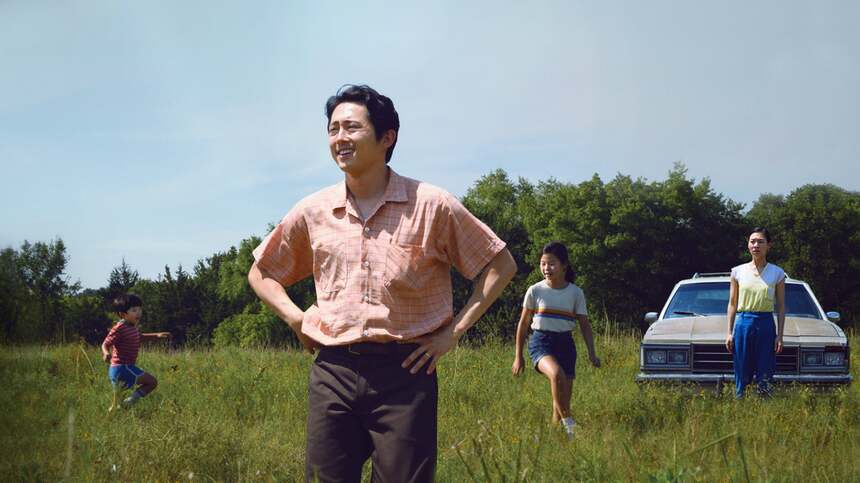
Jacob (Steven Yeun) takes his family to move to Arkansas, where they will live in a trailer house in the middle of nowhere. Her wife, Monica (Han Ye-ri), is skeptical over the change of scenery, but Jacob argues that the land they now occupy has the best dirt in town. He’s one step closer to achieve his dream: establishing his own farm. They both also work as chicken-sexers (basically deciding whether a chickling is a male or female by quickly peeking at its genital) at a nearby factory to support the family until they can rely entirely on Jacob’s farm as the source of income.
In the wake of the ongoing situation, they mutually agree to let Monica’s mom (Youn Yuh-jung) move-in from South Korea to help them looking out for David (Alan Kim) and Anne (Noel Kate Cho) when they’re working. What happens afterward is a culture shock for the kids, especially David, as it turns out that the grandma is an oddball individual. She’s nothing like what these children believe a grandmother should be. It marks the beginning of adversity for the family, and with more conflicts coming in their way, they’re bound to be shaken to the very core.
Minari is a testament to Isaac Chung’s prolific writing seeing how each significant character receives equally riveting development. There’s at least one big takeaway the audience could grab from every single figure appearing in this movie. Jacob is an instrument to recount a highly relatable clash between dreams and reality. When someone earnestly hangs onto either one of them, they tend to lose control of the other, and Jacob is no exception to this vicious cycle.
He’s sick of doing chicken-sexing because that is not what he wants to do with his life in the first place. His desire to become a farmer is undisputed to the point where every time he attempts to convince Monica that he’s pursuing it for the sake of the family, it is evident that is not what his heart is saying. The crops have always been about Jacob putting his passion above anything else. Yeun brings plenty of colors to the character and his enactment of Jacob across the whole story arc is fulfilling to watch.
On the other hand, Monica must stand firm as the gatekeeper who can remind Jacob of his duty as the patriarch, although she has to deal with insecurities herself. She might appear to be in denial, but deep down, she knows what she’s afraid of the most is the feeling of alienation. Getting used to new surroundings alone is already hard; imagine being an immigrant who lives with practically no one aside from her super busy husband, peculiar mother, and two rebellious kids. She doesn’t have anyone with whom she can share her stories. Being allowed to be heard is what she needs, but nobody is emotionally present for her when everyone is scrambling with their stuff. Ye-ri’s acting is pretty intense and she hits the mark with such a showing in her international debut.
Then there is Soonja, the grandma who is prone to be misinterpreted as the source of problems. Her carefree manner is not something that the kids are familiar with because what they’re used to seeing is their much more rigid parents. Despite all of her shenanigans, she does try her hardest to be acknowledged. As a mother who has been separated from her daughter for quite some time, and it’s just natural that she wants to feel belonged to the daughter’s family. It is not easy to pick who marvels the most in a movie teeming with fantastic performances, but the brilliant display from Yuh-jung would surely stick to your heart.
David and Anne are as integral as the adults in Minari. It is reflected by how Isaac Chung evenly treats them as the cornerstone that prompts the plot progression. The shifting circumstance around David, including his eccentric grandmother’s arrival, seems too complicated for him to digest, which causes a sudden shift in his behavior. As the firstborn, Anne experiences confusion because she’s in a position where everyone irritates her. Her younger sibling is a real annoyance, her parents continually opposing each other, and there’s no way she can afford a smooth relationship with the grandma. They are forced to mature sooner than they’re supposed to due to the harsh ordeals they are dealing with.
Those complex matters are seamlessly sewn together in a powerfully written script. The imageries also speak for themselves, blending in glaring and bleak nuances to reflect our tumultuous life where nothing stays at the exact same spot forever. The title Minari, which refers to the Korean watercress capable of flourishing in any kind of milieu, symbolizes the strength of a family that grows together through peaks and troughs. This movie will undoubtedly hit close to home for so many out there, so let’s all give Isaac Chung the thanks he deserves.