
ONCE UPON A TIME IN TIBET review

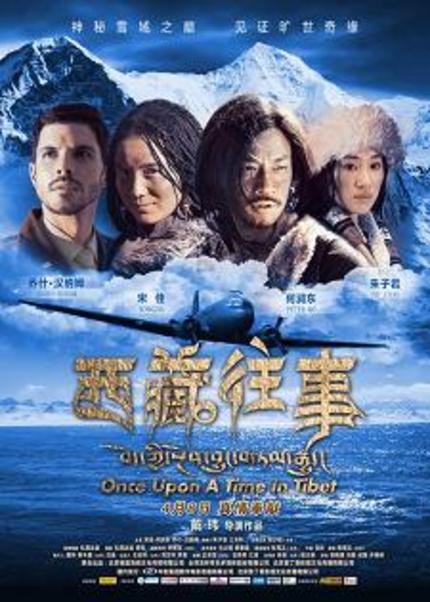
Despite what the background scenery might suggest, the story's actually fairly low-key: Robert (Joshua Hannum), a US officer in World War II parachutes out of his downed plane and lands in rural Tibet, miles from anywhere he needs to be. When he's rescued by local villagers, the headman hands him over to Yong Cuo (Song Jia), a widow ostracised after everyone decided her bad luck caused her husband's death. The village wants the red-haired devil gone, and though the Chinese authorities are trying to rescue Robert, a rumour's doing the rounds that he killed someone after the crash - and the man on his trail is Yong Cuo's brother Jiang (Peter Ho), who's been promised freedom to marry his sweetheart if he just brings the American in.
This is more or less the kind of convoluted soap opera plotting Feng's films traded in, though to give him credit, for all their lack of subtlety they still rate as pretty entertaining cinema. Something like Purple Sunset is very much removed from the patronising, borderline xenophobic moralising in 'main melody' releases like A Kang Ding Love Story. Similarly, with Once Upon a Time... and her debut Ganglamedo Dai Wei seems genuinely concerned with casting Tibet in a positive, balanced light, rather than an exoticised tourist trap populated by backward noble savages. She does occasionally lapse into that kind of lazy approach, but for the most part this is surprisingly thoughtful, emotive stuff.
Casting big names as ethnic Tibetans is a good example - while the decision is maybe a little problematic, and the protagonists' individual character arcs fairly predictable, both leads give the material consistent, genuinely affecting gravitas. Yong Cuo is an obvious archetype and much of her plot thread feels like marking time, but Song Jia disappears almost completely into the part, totally free from 'it girl' mannerisms, her emotions credibly real. Peter Ho has even less dialogue, admittedly, and relies on sullen stares a little too often but Once Upon a Time... still leaves you furious he had to waste his time on trainwrecks like My So-Called Love and Sophie's Revenge, if he had a performance like this in him.
Joshua Hannum is weakest as Robert. The actor tries pretty hard, and Dai Wei spares the Westerner any misplaced cheerleading - there's nothing here quite so embarrassing as Paul Kersey in Red River Valley and Lover's Grief droning on about how China is, like, the greatest country on Earth. Hannum is clearly out of his depth, though, mostly stuck in a very broad comfort zone of wide-eyed stares and excited yelling, looking like a poleaxed Ben Stiller. All the same, he's not entirely without talent, and the script gives him enough to work with to make the character seem just that much more human than archetype to kick the film across the gap between above average and genuinely good.
Much of Once Upon a Time is largely the same - clumsy, but effective. Jiang Cuo exists mostly to advance the plot, but after handing a group of terrified German escapees over to the Chinese authorities, broad strokes or not Peter Ho still conveys a real sense of the man's frustration. 'They weren't really devils', Jiang tells his sweetheart later. 'Just in the wrong place at the wrong time.' It's an obvious narrative ploy, but it works, as does Robert and Yong Cuo's halting romance, or Jiang's bitterness driving him to score points off his sister - all of them are rooted in plausible, very human expressions of pain and longing.
And while the story may be more intimate than the presentation suggests - as in, plenty of wide shots, but not much actually going on back there - the setting does seem to matter. It's not even close to something like The Horse Thief, but veteran DP Mark Lee Ping-Bin frames some gorgeous backdrops and Dai Wei does occasionally manage to work these into key scenes to haunting effect. There's nothing here to trouble SARFT: Once Upon a Time is hardly out-and-out propaganda, but it's more a comforting pat on the head for Tibetans than anything subversive. Still, there's a real empathy for the protagonists, and a sense the director has some grasp of how the place they live makes them who they are.
Once Upon a Time in Tibet is hardly a great film - it's still a shamelessly manipulative chocolate-box romance in period clothes in large part, for all its sensitivity and moral ambiguity. All the same, there is some fine detail there, enough to get you to care about what's going on if you can put up with big, melodramatic gestures and stock cliches. The basic feelings the story evokes are solid, for all they're being used to coax a gut-level response out of the viewer. It's a guilty pleasure, of sorts, but one with feeling, delivered by a talented cast and beautifully put together. If you prefer your drama with a bit of sugar, or your romance with grit, consider Dai Wei's second feature recommended.

Do you feel this content is inappropriate or infringes upon your rights? Click here to report it, or see our DMCA policy.


