
SXSW 2010: Taqwacore: The Birth of Punk Islam

[With the film screening at SXSW we now re-post Andrew Mack's previous review of Taqwacore.]
'When he was 17, Michael Knight left his mother's home in Rochester to study Islam at a Pakistani madrassa. It was his first act of rebellion - against his abusive, schizophrenic, white-supremacist father. Years later, burned out on the demands of religious dogma, Mike rebelled once more - by penning a Muslim Punk manifesto called The Taqwacores. His work of fiction struck a chord with young Muslims around the world and before long, real-life Taqwacore bands were creating a scene. This film follows Michael and his band of Muslim punks as they journey across the U.S. and Pakistan, transforming their worlds, their religion and themselves through the spirit of Taqwacore".
In 2003 Michael Muhammad Knight self-published his debut novel The Taqwacores. The central character, Yusuf Ali, is a Pakistani American engineering
student from Syracuse. He lives off campus with a diverse group of
Muslims in their home in Buffalo. In the house they also have punk rock
parties and it becomes a place for Muslims not comfortable with the
Muslim Student Association or local mosques to have Friday prayer. The
novel found a distributor in 2004 and Knight soon found that his novel
was helping young Muslims find their voice and what was once fictional
became a reality as Taqwacore became its own movement in the music
scene. Soon, bands and those moved by the words in Knight's novel began
contacting him, looking for more of this Taqwacore movement.'When he was 17, Michael Knight left his mother's home in Rochester to study Islam at a Pakistani madrassa. It was his first act of rebellion - against his abusive, schizophrenic, white-supremacist father. Years later, burned out on the demands of religious dogma, Mike rebelled once more - by penning a Muslim Punk manifesto called The Taqwacores. His work of fiction struck a chord with young Muslims around the world and before long, real-life Taqwacore bands were creating a scene. This film follows Michael and his band of Muslim punks as they journey across the U.S. and Pakistan, transforming their worlds, their religion and themselves through the spirit of Taqwacore".
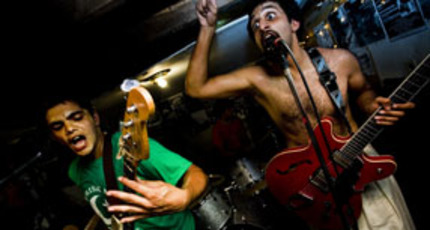
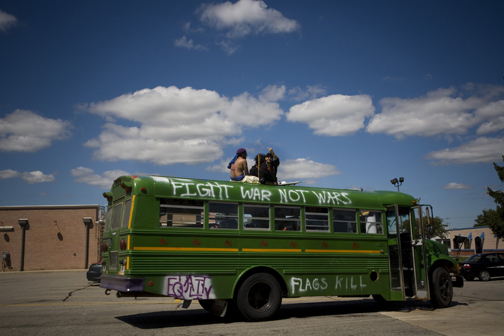
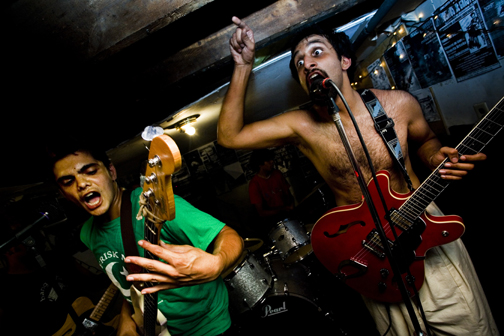
The film accounts a couple journeys. The first journey follows the gathering of those influenced by Michael's book. The Taqwatour crossed America and featured bands and music acts the all female punk band Secret Trial Five, Vote Hezbollah, the band central to Omar Majeed's documentary The Kominas, Al-Thawra, and Diacritical. The tour culminated in Chicago at the Islamic Society of North America conference. ISNA does not approve of women singing in public so you can imagine the unrest created when Secret Trial Five took the stage. This group does the usual punk things. They sing loud, smash guitars, smoke up, and get pulled over by the police because someone reported they had cocaine on their bus. You know, typical punk stuff. Some of the more culturally specific events is when Michael dons a burqa and dives into a hotel swimming pool, a show on the tour is canceled because of their Islamic beliefs and the bands are interviewed by the popular media with head-slapping results. But all in all it is pretty average stuff. It is punk bands doing what is expected of punk bands.
Majeed's film got more interesting after the tour- six months later- and Michael decides to go back to Pakistan, to where he began his Islamic faith at the age of 17. He reconnects with the band members of The Kominas who have become more or less squatters, sitting in their apartment smoking hash. But The Kominas have changed their sound from raw garage punk to ska punk and are looking to put on show. They know there is interest. We follow them to a village where their act is received with the expected mixed reviews. But they are determined to put on a show at the heart of the city where they live. So while in the midst of his own spiritual refresher Michael helps them put on this show. But watching Michael follow his path to spiritual refreshment is the most interesting part of the film because it also looks closer at Shi'a Muslims, including a very interesting scene which I can only assume, based on some quick research, where we are watching Michael joining with Pakistanti men beating their chests in a gesture of mourning during Ashoura, a 10-day festival that commemorates the death of the Shiite saint Imam Hussein, a grandson of the prophet Muhammad. Michael returns from his pilgrimage, refreshed and ready to challenge his friends to get off their asses and put on this show for everyone to come. The film finishes with the show on a rooftop, a celebration of music, a gathering of all the social classes. Theirs is a minor victory for the faithful living outside of their faith.
This is not a film about rebelling against Allah. This isn't a film about turning away from faith. Some of them still have a faith. Band members still take time out to pray. Though Michael's own journey in the Islamic faith has certainly not been without controversy he still believes. No, what they are rebelling against is religion and convention. They just don't like doctrine, or rules, or dogma. And this is nothing new under the sun for anyone who follows any numbers of the faiths in the world. But perhaps this will broaden our perceptions of Muslims, break through the stereotypes. Sometimes we see the sad outcome for those who show even the slightest inclination to object to religious practices of the Islamic faith. The so-called honor-killings are horribly tragic and taint our perceptions of this particular social structure. And with Majeed's film we see this is not always the way. These figures in his film haven't apostatized from Islam. They're seeking a way to be faithful outside of what they perceive to be the confines of religious practice. They are not what outsiders perceive to be your typical Muslims. They have kicked hard, in their Chuck Taylors or Doc Martins, against the box of religious Islam and torn with their bare hands at its walls. Some still believe. Some have walked away. Some struggle. And what we see is that they're just like anyone else who has rattled their drums against the beat of conformity.
Quickly, A testimony to punk and its longevity and place as a sub culture within the fabric of social demographics. Wherever a society or a culture ripples with discontent or disillusionment those yearning to have their voices heard look elsewhere. Punk, more often has been that creative outlet for such people, known to be outspoken and controversial since its breakout in the mid 70s. It is the shoe that fits.
It makes for very interesting viewing.



Do you feel this content is inappropriate or infringes upon your rights? Click here to report it, or see our DMCA policy.


