Review: Chris Marker's THE CASE OF THE GRINNING CAT

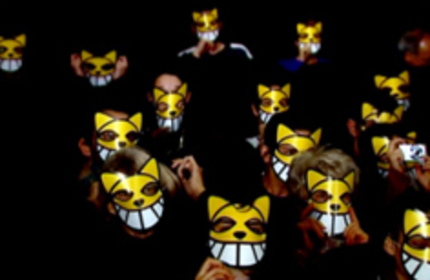
Chris Marker begins The Case of the Grinning Cat (2004, 58 minutes, color, separate English and French audio tracks) by documenting the convergence of a flash mob in Paris. Above the public space where the mob convenes is a painted image of a grinning cat that began to appear throughout Paris after the September 11, 2001 terrorist attacks. Marker uses the image of M. Chat, as this yellow feline would be called, to weave together a real-life mystery about the cat's origins that that ties together politics and humor in post-9/11 France.
The film's politics arises from Marker's examination of the left's response to the first French presidential elections to occur after the United States terrorists attacks (2002). The humor mostly arises from Marker's riffing about his favorite animal: the cat. Marker's commentary reflects an obvious sympathy towards European Left. As in his other later era films, however, Marker shows a sense of skepticism about the reality of actual change. The film's focus on protests and the 2002 elections makes it seem a bit passé as the global nature of post-9/11 politics makes today's local protest seem completely ephemeral and ineffective.
The DVD is rounded out by a series of animal-themed shorts: The Bestiary (five short films about animals ranging from 3 to 4 minutes), Three Cheers for the Whale (1972, 17 minutes, black and white + color, English) and a one-minute film called Leila Attacks (2006, 1 minute, color). While these shorts tie into the the DVD's overall animal theme, they are essentially minor works. The sole exception is Three Cheers for the Whale, a collaboration between Marker and Mario Ruspolis. The film uses drawings, oil, paintings and engravings and footage from Mario Ruspolis's film The Men of the Whale to speak against the cruelty of whale hunting. This work operates as an early and bracing example of using film in support of an ecological cause.
Overall, Case of the Grinning Cat is probably the least of the new Chris Marker releases from Icarus Films. This is not to say that it does not feature some captivating material. It seems that the choice of subject matter drives the tone in political documentaries, and despite obvious parallels, politics in the new millennium carries a different energy than the street fightin' 1960s. As such, the Case of the Grinning Cat lacks the interest and urgency of films like Sixth Side of the Pentagon and The Embassy. This is not necessarily a failing on Marker's part but it is definitely a signal that different methods and tools might be in order to really capture the current political zeitgeist on film.