THE TESTAMENT OF ANN LEE Review: Portrait of a Lady on Religious Fire
Amanda Seyfried stars in Mona Fastvold's ode to the 18th century religious figure.

Some religious belief comes from what is bred into a person from birth by their community; some people come to it via an event they view as phenomenal; some through tragedy, or anger. Some figures are revered and remembered; some are lost to history. How can we view a religious figure if we do not share those beliefs, or if they come from a tradition we view negatively? How do you present a historical religious figure in a world where so many are using religion to sow hatred and division?
When Ann Lee (Amanda Seyfried) attends her first Shaking Quakers meeting, she was already, according to the narrator, a pious, God-fearing young woman. Unsatisfied with what she saw as the rigid, harsh Christianity of her native Manchester, she immediately connected to this group that not only saw women as equal to men, but allowed her to vocally and bodily express her physical ecstasy to her god.
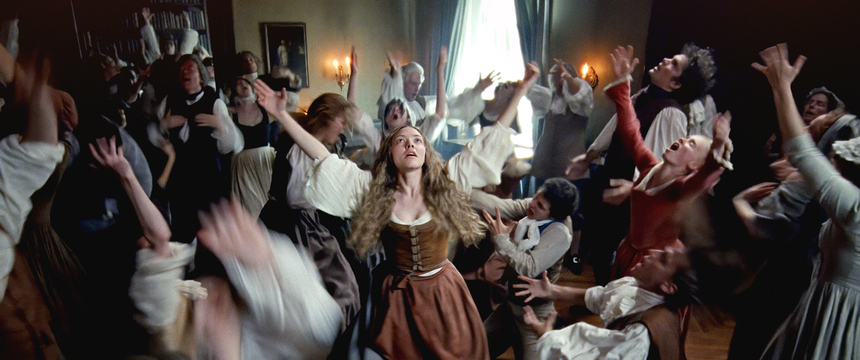
We have already been introduced to the narrator, and this kind of physical manifestation of belief, in the opening scene of The Testament of Ann Lee. Norwegian filmmaker Mona Fastvold’s third feature film, which she co-wrote with Brady Corbett (an exchange, as she co-wrote The Brutalist with him, which he directed), makes it clear from the beginning that this will be, indeed, a Testament, in that we are seeing the life of Ann Lee from hers and her followers’ perspective, in all its pain and glory, with what they believed, and why, and how.
In brief, the film begins with a brief introduction of Ann's childhood, then covers her adult life, from her first Shakers meeting, her marriage and difficult pregnancies, to her elevation to status of faith leader, trying to change the Christian establishment, moving her group to the New World, and spreading her gospel across New England. We see and hear all this from her perspective, and those that loved her, believed as she did, and followed her.
Thus beginning with something of a moving tableau: a choreographed representation of the religious ecstasy of the Shakers, as they would come to be known. Despite what could be interpreted as the eroticism of their movements, the closeness of the people in this space as they twist and moan and yes, shake, often in a trance-like state from the power of their connection with god, theirs was a group that practiced and enforced celibacy. For Ann Lee, sex was a sin for which she had been punished with the death of all four of her children in infancy. We might proverbially shake our heads, aware of the infant mortality rates of the 18th century, but Fastvold never mocks nor derides Ann for this belief. It was hers to have, her choice to follow this path, and if we are to learn of and understand her, we must engage with her perspective.
Thus, somewhat categorizing this film as a folk musical: beginning with an expression of movement, a credits typeface, and a narrative style that evokes the feeling of a fringe, grassroots English religious movement that would eventually take small but strong hold in New England. Ann was one who saw her religion as embodying not just her thoughts, but her performance of life. Cinematography, art direction, production design, choreography, music composition: all combine to envelope the audience in Ann's and her Shakers's world and perspective.
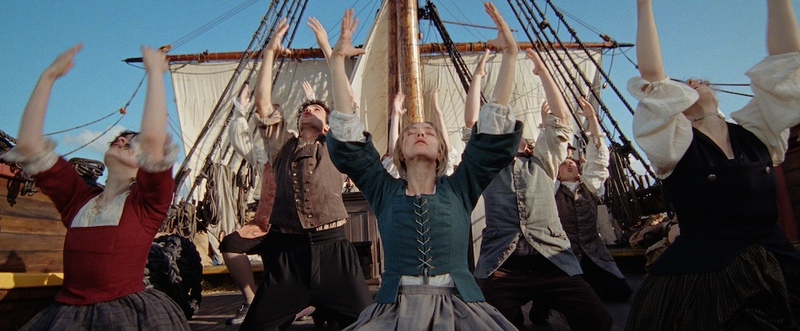
Even in writing about this film, I've used the word 'thus' twice; it speaks to how the film asks us to blend into this world of performance and faith. And it is the two together, for there is never an impression that Ann's performance of her faith is empty performativity; she holds true to her beliefs and lives them in the face of those who follow only for their only gain, or openly mock her. In a pivotal scene, the ship on which the Shakers are sailing to America is beset by storms, and the sailors try to blame her and the Shakers with their on-deck praying. But she and her followers defy them and continue; the storms stop, the sailors believe her, and the prayers are allowed to continue. Is Fastvold asking us to believe that the Shakers' praying created this miracle? Not necessarily; it's about looking deeper into why and how we believe, and what we might take as a coincidence or a miracle.
Seyfried completely embodies this role, as befits the style that Fastvold aims for: Ann's faith never wavers, and she stands firm that everyone must adhere to the tenants of the faith, or leave it. We might think her almost cruel at times in the application of her beliefs, since that would seem to go against the fervour she claims to feel for and of her god's love. Again, this is when we're being asked to understand her, even if our reaction in those moments is that we don't. Ann's unwavering convictions, her faith that she is following the true path of her god, that her expressions of that faith are true and necessary: Seyfried never leaves us in doubt of this.
Therein lies a crux on which your enjoyment, or connection, with the film might depend. Will any judgement, good or bad, that you pass on Ann Lee, then mean you think the film itself is good or bad? Will you only connect with it emotionally if you are a person of faith? I ascribe to no particular faith (though not necessarily none), and while I did not feel any strong emotional resonance with the film, I believe it to be excellent in its construction, performances, and execution of its story, themes, and characters.
Indeed, I look forward to watching it again (in its glorious 70mm print, which it more than earns), when I can spend more time appreciating it without having to think about writing a critique.The Testament of Ann Lee is beautifully made film, an intense and, if perhaps not an epic story, one that never falters in its commitment to its subject and her portrayal on her own terms.
The Testament of Ann Lee will open with a limited release in cinemas in the USA on Thursday, December 25th. A wider release in the USA and Canada will be forthcoming in January 2026.