Venice 2026 Review: JUPITER, Claustrophobic Political Thriller for the Current Time
Alexandre Smia's gripping feature debut locks Denis Ménochet inside the machinery of presidential power, where rational calculations lead toward an unthinkable conclusion.

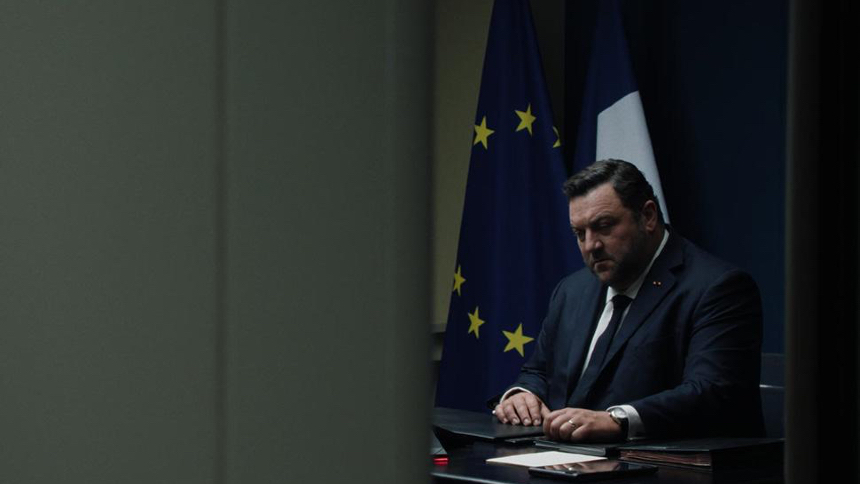
Alexandre Smia’s feature debut Jupiter is a political thriller that goes behind the scenes of the French presidency in a pressure-cooker situation.
Set largely inside the presidential command bunker beneath the Élysée Palace, Smia’s dialogue-driven chamber drama gets maximum mileage from its confined setting and from lead actor Denis Ménochet’s performance as an embattled president facing an impossible decision. The result is a viewing experience that puts the audience on the edge of its seat.
Ménochet stars as Paul Archambault, France’s newly elected president, summoned to the Jupiter command post after an attempt on the Russian president’s life. Moscow blames Ukraine and prepares to retaliate.
The situation escalates at a breakneck pace while Archambault contends with the conflicting positions of his political and military advisers. France’s nuclear doctrine ultimately concentrates authority in the president, and Jupiter locates its drama in the gulf between the number of people who contribute to a decision and the single person empowered to execute it.
Smia, who co-wrote the screenplay with Thomas Finkielkraut (miniseries Kabul), constructs the story almost as a theatre piece. The political apparatus is concealed in a room, deliberating the worst possibilities as pressure mounts outside and the president begins to crumble within, his decision-making faculties possibly weakened by a recent family tragedy.
The drama and suspense stem from a war of words, psychological hand-wringing and stubbornness on both sides of the conflict. Archambault first tries to act as a mediator, then as a leader determined to protect European territory while the alliance remains unwilling to make a move amid the high-wire act of political diplomacy and nuclear decision-making.
The screenplay carries a substantial load of doctrine and geopolitical context. Smia and Finkielkraut, however, shape it into a spectacle of mounting pressure and clashing opinions behind closed doors. The stakes rise by the minute as the crisis approaches the brink.
Cinematographer Nicolas Loir exploits the pressure-chamber setup by gradually tightening the frame until only a single face fits inside it. Loir exquisitely creates a claustrophobic atmosphere capable of sending the viewer’s pulse into overdrive. Editor Pierre Deschamps intensifies the cabin-fever conditions as Archambault runs out of good choices and the situation deteriorates, leaving even his advisers gasping for alternatives.
The film’s timing is apt, as the rhetoric of nuclear escalation has re-entered European political life. Smia began developing the project under a different geopolitical configuration, but events have caught up with its premise. Russia’s invasion of Ukraine ended any comforting notion that France could remain a spectator to nuclear confrontation. As the European Union’s only nuclear-armed member state, as well as a member of NATO and the United Nations Security Council, France occupies several overlapping systems of obligation.
Although the film entertains a fantasy of nuclear apocalypse, that fantasy is not far removed from reality, indeed, it is far too close to it, which makes the experience all the more chilling.
Smia’s drama also carries a stark political message about why competent people must occupy crucial decision-making positions. That applies not only to nerve-racking nuclear sabre-rattling but also to the ripple effects of smaller decisions and manoeuvres that eventually set the dominoes falling, with no possibility of pulling an emergency brake.
Jupiter is an all-too-real apocalyptic film for the current geopolitical moment, a tightly contained, heart-pounding political thriller with a suffocating atmosphere.