
Toronto 2026 Review: MINOTAUR, Russia As A Psychological-Visual Labyrinth

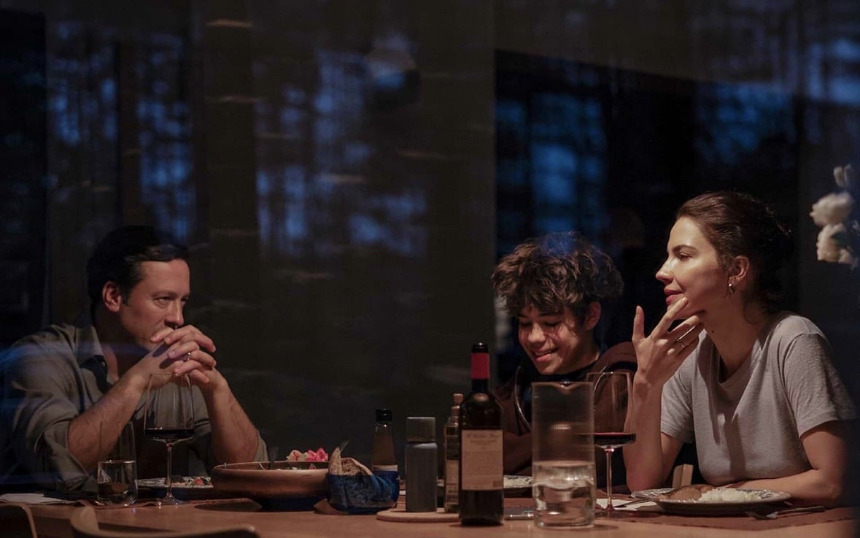
Andrey Zvyagintsev interrogates Russia in the same way 1990s era Zhang Yimou interrogated China: Methodically, metaphorically, and with an astutely savage eye for beautiful visuals to mask the criticism.
There is a scene in his latest film, Minotaur, where the narrative briefly leaves the main characters and drama of the infidelity story, to follow some municipal workers refreshing a propaganda Special Military Operation recruitment poster. It has the purpose of driving Russia’s indifference towards honour and service, while also offering a bit of exposition in the form of a perfect ‘show don’t tell’ visual. Unlike Yimou’s post-Hero nationalistic reinvention as China’s top patriotic filmmaker (and Beijing Olympics opening ceremonies director), I do not suspect Zvyagintsev is going to be welcomed back into the fold any time soon.
The filmmaker has spent several years in exile from his homeland (and filmmaking) in part for, or in spite of, winning awards all over the world for complex works of cinema, such as The Return and Leviathan, that are critical of a certain kind of patriarchal Russkiy-Mir mindset. These are films that also happen to be beautifully lensed with profoundly pregnant images. The opening shot of Minotaur is of a solitary island that contains a row of perfectly spaced dead trees.
It also happens to be the view outside of the country home of Gleb, the main character, tech CEO, husband and father.
Minotaur is a loose remake of Claude Chabrol’s La Femme Infidèle, the story of an bourgeois husband who finds and murders his wife’s lover and covers up his crimes. Plotting changes and location here are tellingly specific to the current invasion (and destruction) of Ukraine by Russia. From the visual nature of the opening shot to the instrument of murder, to most tellingly, the extremely loaded and cynical ending, this is a beautiful example on how to remake something of a time and place to another time and place, and have the two versions echo and rhyme in interesting ways.
Gleb’s company is losing its top IT staff as men flee the country and the war, while the mayor has demanded quotas of all the top companies in the city. The CEOs are to quietly provide a list of men to be mandatory mobilized. Sanctions and isolation from the West are likely going to add further headwinds to Gleb’s business.
When someone calls him with more bad news, he interrupts the hesitation of his underling immediately with crisp command, “Go on, don’t mince words.” He is different from the other men of industry who either comply, or attempt to convince themselves that this will all blow over in a few weeks. One even takes his new wife to Thailand to get away from the political and economic fracas, convinced that out of sight, out of mind is a cogent strategy.
Meanwhile, Gleb’s son is being bullied at school, and his wife is acting very suspicious and sexually remote. In this labyrinthine set of overlapping circumstances, Gleb problem-solves all of these things in ways that are both devious and efficient.
He is good at his job, and capable of anything. He asks his friend, who is also head of his companies security, to discreetly find out what his wife is up to when she claims to be getting her hair done, or shopping. While Gleb is far from the perfect criminal mastermind (his crime scene clean-up is a rushed and clumsy effort) he knows the score, and can connect disparate opportunities that may arrive in in the chaos of social upheaval.
His perfect house and modern office are almost entirely glass, and Zvyagintsev keeps Gleb on full display behind these transparent panes (or his Volvo SUV windshield) for nearly the entirety of the film. We can only watch what he does, like an anthropological experience.
At one point, the narrative follows his wife to her photographer lover’s apartment, and in a subtle, rarely used camera movement, ‘the omega shot’ from the end of Antonioni’s The Passenger, in which the camera tracks from and back to the same location with no cuts, to reveal an change. An outcome. It is brilliantly repurposed here as a bit of loaded foreshadowing.
Later, when the married couple are on the verge of confronting one another around the infidelity, another subtly cribbed bit of framing, the other mirror shot from Kubrick’s The Shining, where Shelly Duvall serves Jack Nicholson breakfast. I am sure that both of these homages involve Jack Nicholson is only a coincidence here, but everyone in this film is a kind of haunted antihero, and a cold cynicism permeates the entire affair. It is difficult to look away, however when Gleb's wife intones, "I want to live, not endure."
All of this is perfectly deliberate and shockingly effective in the hands of a director who is both comfortable with his craft and capable of weaponising it as he sees fit. Here is hoping it is not another nine years between films.
Minotaur is another masterpiece, and the kind of film that seems destined to upset authority. That is, if they were capable of connecting the parable of Gleb’s worldview to the current Russian imperialism. Gleb’s advice to his son upon how to confront a bully, “Whoever starts a fight, loses for being stupid,” is far less subtle. Along with shots of trains loaded with tanks, or the aforementioned billboard removal, some parts are much harder to miss in their savage critique.



