
TEENAGE SEX AND DEATH AT CAMP MIASMA: Digging Into the Symbolism of Little Death

What does Spider-Man: Brand New Day have in common with Teenage Sex and Death at Camp Miasma?
Oddly enough, both films, released this summer -- one a queer slasher, the other a two-billion dollar grossing MCU entry -- use the exact same piece of visual symbolism to represent female dissociation.
It's something that has bothered me ever since I walked out of Camp Miasma -- and something actually asked about during the post-screening Q&A, only to have the question promptly deflected:
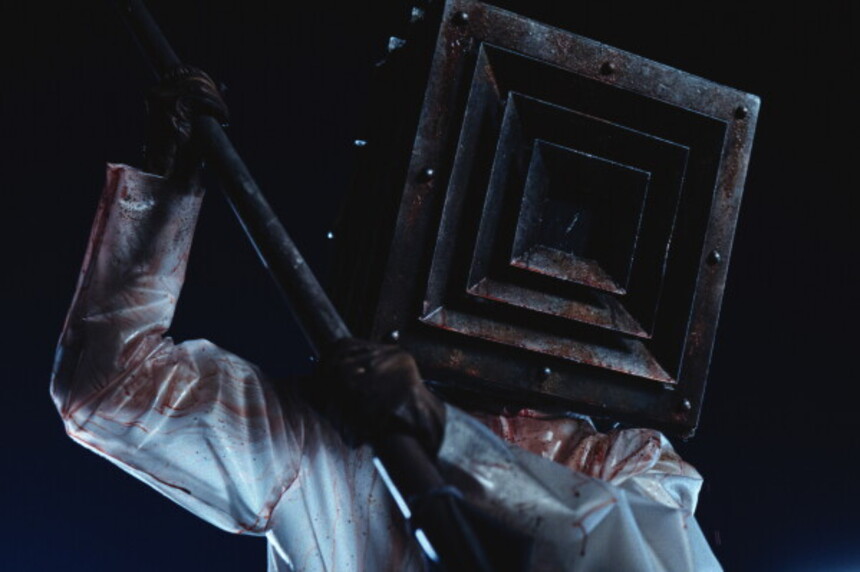
Why does Little Death wear a ceiling vent as a mask?
When it comes to slashers, I am a sucker for lore, probably for the same reason Jane Schoenbrun is. Why was this mask chosen? Why does the killer walk the way they do? Why this weapon? Why this particular visual identity? In a good slasher, those choices are rarely random.
The best killers are built from details that mean something or inspired happenstance, even when the audience doesn't immediately understand what that something is.
Sure, you could chalk Little Death's mask up to the film's wonderfully strange sense of humor, which I did originally. Maybe it's a quirky meta comment on the absurdity of the slasher. Maybe it's simply an attempt to give the killer an instantly recognizable visual identity.
But there had to be something more there.
Then, of all things, I saw Spider-Man: Brand New Day.
There's a scene in which a character connected to Sadie Sink's character is being tortured. As she begins to dissociate, her attention becomes laser-focused on a single object above her: a ceiling vent.
And not just any ceiling vent.
It looks remarkably similar to the one the killer Little Death wears in Camp Miasma.
Suddenly, something that had been bothering me for weeks clicked into place.
It had been right in front of me the entire time.
In Camp Miasma, Kris's queer sexual awakening is triggered by a sex scene -- one that, like so much sex in slasher films, is profoundly one-sided. But rather than doing what these movies traditionally do and pretending the woman is enjoying every second of it, Schoenbrun chooses something much more uncomfortable: reality.
In the first Miasma film within a film, during one of its requisite sex scenes as her camp hookup is jackhammering away, Billy's eyes begin to glaze over. She begins to dissociate.
Her gaze drifts upward toward the ceiling, eventually looking directly into the camera--and, by extension, at the audience. Her attention has moved completely away from the act itself, toward something above her.
Possibly an air vent.
Do they even have air vents in cabins? I don't know. But that's almost beside the point.
Then there's the name: Little Death.
A euphemism for orgasm.
Add to that the killer's giant, aggressively phallic spear, and suddenly the imagery starts snapping into place. The vent isn't simply a bizarre mask. The name isn't simply a joke. The phallic weapon isn't simply an exaggerated slasher prop. Even the see through condom-like jumpsuit starts to feel deliberate.
The pieces start to fall into place the longer you stare at them.
What initially looks like a surrealist gag becomes something considerably darker: the visual identity of a killer built around sex, trauma, and female dissociation.
That's what makes Little Death's mask so fascinating. It is a meaningless architectural detail that suddenly becomes intensely important under the right circumstances. And then Schoenbrun takes that image of dissociation and puts it directly on the face of the killer.
Within the film's mythology, Little Death is the ghost of a drowned child who was rumored to have been raised as both a boy and a girl by their parents. It's a playful nod to the mythology of the Sleepaway Camp films, but Schoenbrun seems far more interested in using that mythology as a framework for exploring the women trapped inside these stories--and the ways the scream queen's sexuality, identity, and trauma have traditionally been represented.
Little Death becomes less a singular killer than a distillation of the very thing the women in these films fear more than anything: sex. And that makes Billy (Gillian Anderson) particularly important. Her entire character is defined by her performance within this film-within-a-film, by the way her sexuality is being consumed by an audience. Now that same experience is being folded back into the mythology itself, transformed into the face of the thing stalking her.
Billy looks toward the ceiling to get away from what is happening to her; Little Death wears that same ceiling over their face. The image of dissociation becomes the visage of the killer. What was once a place for Billy to look away becomes the face of the thing she -- and, arguably, the women of these films -- are trying to escape.
It's this bizarre piece of meta-commentary hiding in plain sight, one that takes a character who could have been little more than another strange slasher creation and imbues them with a thematic meaning nearly as rich as the narrative surrounding them. Sometimes the mask isn't simply hiding the killer's face, it's telling you exactly what their prey is running from.
Teenage Sex and Death at Camp Miasma is now playing at select theaters in North America. Visit the official site for locations and showtimes.


More about Teenage Sex and Death at Camp Miasma
- Fantasia 2026 Wrap: All Our Reviews
- Now Playing: TEENAGE SEX AND DEATH AT CAMP MIASMA, LATE FAME
- Opening This Week: TEENAGE SEX AND DEATH AT CAMP MIASMA, ICE CREAM MAN, TONY
- Fantasia 2026 Review: TEENAGE SEX AND DEATH AT CAMP MIASMA, Bold Queer Exploration
- Fantasia 2026: Raising the Curtain on the 30th Edition of Montreal's Smorgasbord of Genre Cinema


