Locarno 2026 Review: ROMA ELASTICA Cannibalizes the Myth of the Movie Star in a Delirious Cinephile Phantasmagoria
Marion Cotillard stars in Bertrand Mandico's a surrealistic tribute to golden age actresses, celluloid cinema and Italian culture.

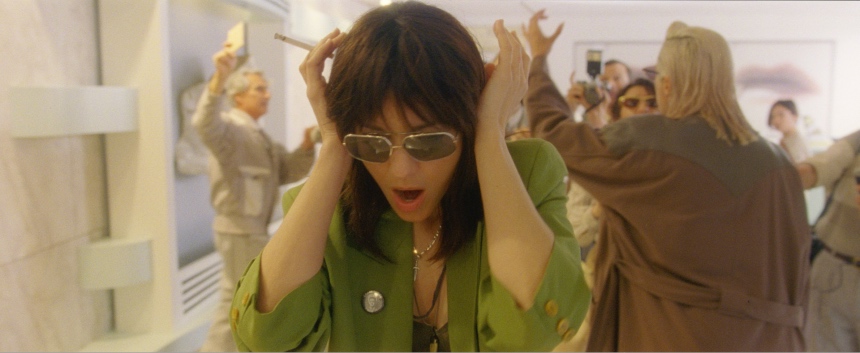
The Locarno Film Festival has become a home for Bertrand Mandico’s projects, and his latest, Roma Elastica, which premiered in Cannes’ Midnight Screenings, is no exception.
Following Conann and Dragon Dilatation, Roma Elastica is an extravagant metatextual venture, as much a tribute to cinema’s golden age as a parody. Bookended by the self-engineered fading of star Eddie Mars (Marion Cotillard) the film remains wrapped in Mandico’s signature surrealism, erotic grotesquerie, gender- and genre-fluid theatricality, and playful transgressiveness.
Roma Elastica is set in 1982, as the industrial mythology of Cinecittà was losing ground to television, economic contraction and cultural exhaustion. Eddie Mars is a former international star who receives a devastating medical diagnosis while working in the American desert.
She decides to travel to Rome for a science-fiction production that may be her last film. Accompanying her is Valentina (Noémie Merlant), her makeup artist, confidante, lover and guardian angel.
Upon their arrival in Rome, Mandico loosens the reins more than he did in the more structured, plot-driven Conann. Roma Elastica becomes a delirious, gonzo procession of eccentricities, at once a series of meta-cinematic excursions, a tribute to Italian cinema and a remaking of the mythology surrounding female screen icons from goddesses to sacrificial offerings.
While the plot is largely confined to the behind-the-scenes drama of a troubled set, with production problems, improvisation and impending catastrophe threatening to make the entire enterprise implode, Eddie becomes the principal conduit for Mandico’s unchained surrealist imagination. The result is a carnivalesque psychological portrait, at once theatrically self-aggrandizing and a cinematic melodrama in pastiche form.
The production design and compositions of Roma Elastica suggest controlled chaos. The film does not brim with excess to quite the same degree as Conann, but it retains Mandico’s signature “incoherent aesthetic,” firmly anchored here in Italian culture. There are nods and tributes to Fellini, Antonioni, Visconti, Vincente Minnelli and Elio Petri, to Toby Dammit, Italian esotericism and the transgressive graphic culture surrounding Andrea Pazienza and RanXerox.
The sets form a collage of architectural memory: Cinecittà remnants, Brutalist corridors, fascist monumentalism, vacant lots, and fragments of movie history, all rendered in conspicuously eccentric stylization. The cherry atop this Italian pastiche-cum-tribute is the casting of Ornella Muti and Franco Nero as quirky supporting characters, with Muti making an especially memorable appearance as a post-apocalyptic mutant.
As the production morphs into a psycho(sexual) drama and Eddie contemplates her impending mortality, Mandico pushes Roma Elastica to the threshold of its protagonist’s consciousness. The distinction between reality and the fantasies of a malfunctioning brain becomes irrelevant, allowing viewers to embrace both the symbolist nature and the corporeal comedy of the ordeal. Mandico pushes the film toward satire and near-parody, as Eddie is surrounded by an exotic assortment of characters, such as filmmaking sisters, one of them a clairvoyant, a Clockwork Orange-like punk special-effects crew, and a coterie of oddball studio executives.
Working again with cinematographer Nicolas Eveilleau, Mandico shoots in widescreen on two-perforation 35mm, an economical format associated with Italian Westerns and peplums. Grain, flare and subtle variations in exposure give the images a raw, faintly fetishistic quality.
Production designer Toma Baqueni and costume designer Pauline Jacquard continue to elaborate Mandico’s distinctive visual language. Where Conann veered toward the futuristic and urban, Roma Elastica adopts a retro-futurist look against a stylized Italian backdrop. Through this tactile visual approach and its embrace of cinematic mythology, the film becomes an iconographic work by one of contemporary cinema’s preeminent iconoclasts.
Mandico’s metatextual tale ultimately reveals how fantasies and stars are manufactured by an exploitative machine that cannibalizes actresses, even as it immortalizes them. Roma Elastica is a cinephile phantasmagoria that, despite Madnico´s deliriously transgressive "incoherent" style and strange humor, turns out to be fairly accessible, even to non-Mandico aficionados.
The fim screened earlier this month at the 2026 Locarano Film Festival.