Locarno 2026 Interview: NOBODY'S VIOLENCE Filmmaker Denis Côté Talks Mortality and Making Cinema That "Floats"

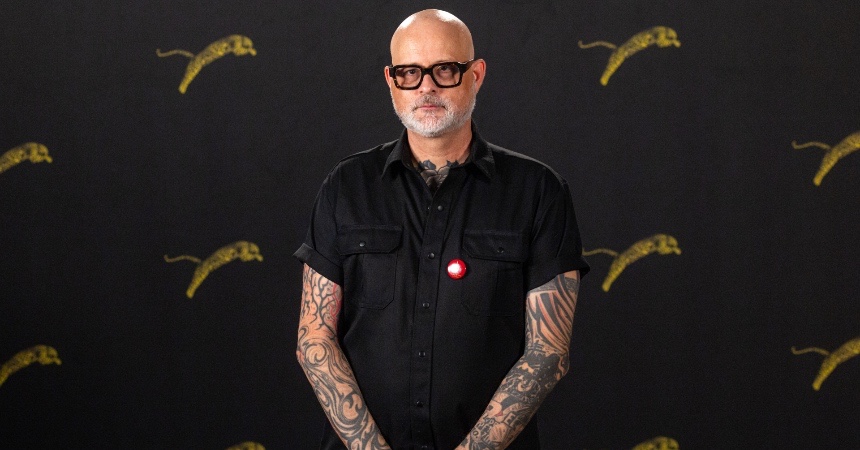
Twenty years after his debut feature Drifting States won the Golden Leopard at Locarno, prolific Québécois auteur and former film critic Denis Côté returns to the festival’s international competition with his 17th feature, Nobody’s Violence.
Shot on a mixture of Kodak and vintage ORWO 16mm stock, the film follows Mira, an enigmatic wanderer bound to strangers through mysterious death pacts, whose encounter with two forest dwellers and an unpredictable young man prompts her to reconsider her mechanical existence. Côté rejects the idea of a nihilistic, issue-driven drama about assisted dying, describing the film instead as a luminous and deliberately polarising work about finding a new life.
In discussion with Screen Anarchy, the director explains how its fragmented, underexposed imagery and Mira’s somnambulistic presence emerged from his experience of kidney failure while writing the screenplay in 2022, before receiving a transplant the following year. He also details the production discipline behind the film’s apparent freedom.
Made for CAD3.1 million from a 50-page script, it combines a controlled narrative spine with unrehearsed performances, scheduled improvisation and extended passages designed to “float” beyond conventional storytelling. Côté discusses refining his films through screenings with trusted colleagues while retaining final authorship, and previews an increasingly radical slate that includes a possibly unscripted film set in a mountain mansion and an 85-minute adaptation of Fuminori Nakamura’s The Gun, projects that reflect his determination to become freer, leaner and less commercial with age.
Screen Anarchy: You have spent three months showing the film to friends, collaborators and the team. What changes now that random cinephiles are finally seeing it?
Denis Côté: It is funny. For three months, everybody has been telling me how great the film is. That is a good sign, yes, but you want to arrive at a place where nobody cares. If they think it is shit, they will leave the cinema or write that it is shit.
Now it is the real game. There was a screening yesterday and another one this morning, so finally random cinephiles are seeing my film. That is fun.
What does it change for you if somebody walks out or says it is shit?
If you go on that Letterboxd cancer and read the stupid stuff people write, I am okay. I make a film every year. I can bounce to a new project. I was a film critic, and I respect that work. When it is negative, it is part of the game. Sometimes I like an intelligent negative review, because you can learn something about your work.
When people give you five stars, well, that was the point. That was the goal. I wanted to make a five-star film. All right, thank you for giving me five stars. I am happy you are giving me love. When it is negative, you read it and read it again, and it hurts, but you grow from negative experiences.
Nobody´s Violence is super-polarizing, and that is by design. In the first ten minutes, a girl kills an old woman while the husband is in the garden. When the woman is dead, she takes a bicycle and goes riding with the old man who has just lost his wife, and he is riding with the killer.
That is the contract. If you do not accept that proposition, leave the cinema, because the rest of the film will be like that.
It is not science fiction. It is not experimental. It is just a world outside the world. I love doing that. But I understand someone who asks, “What is that? Why are they dancing for five minutes?” I like those zones of liberty in the film, but I understand when people do not.
Honestly, based on the premise, I expected something much darker, a darker drama.
I am reading people who say it is nihilistic, that it is so dark. I think it is luminous. I think it is a film about life. The ending is full of light. Yes, it talks about assisted suicide, but mainly it is about a character fighting to find a new life. That is positive for me.
When we talked about Paul two years ago, I expected something quite controversial, but the documentary turned out to be almost wholesome. People were happily living in the cinema.
You are right, you are right. But I am not a social filmmaker. I am not there to give you a message. I am a cinephile filmmaker, and I am looking for zones of cinema, zones of liberty.
Even if I give you a 30-minute interview about assisted suicide, this is not the right film through which to discuss the subject. We can talk about it, but I am not going to make a controversial film about the idea of assisted suicide. That is not my kind of thing.
You have said that NOBODY'S VIOLENCE is not autobiographical, yet it was written during the worst period of your kidney insufficiency. How did your condition enter the film?
I received my transplant three years ago, in 2023, and I wrote the script in 2022, when I had very little energy. If you look carefully at the film´s protagonist Mira, she lives in a world where she has to do things she disagrees with. She looks a little robotic, very zombie-esque. That was me when I was sick.
Then she meets Pierrick and something opens in her heart. It is a bit like receiving a transplant. You arrive on the other side of the transplant and think, “Oh, this is my new life? Okay.” That is how I wrote Mira. She is floating in the old world and looking for the next one. So, yes, in this sense, it is autobiographical.
And the formal aspect, the rough editing, the dirty, low-resolution 16mm image?
That was how I looked at the world when I was sick. I had a lot of toxins in my brain. I would wake up in the morning and talk to you like this, it was as if I always had something in front of my eyes.
I told my director of photography, Vincent Biron, “I want Mira to live in a world where everything is underexposed 16mm.” He said, “Okay, I love it.”
We found an old German film stock from a company called ORWO and used a mixture of Kodak and ORWO. That is the special look of the film. The film is a memory, traces, fragments of my old life.
Why did you dedicate the film to your mother?
She died during the editing process. The dedication felt natural, but the film has nothing to do with her.
Yet there is a connection to medical aid in dying?
It is funny, because she had Alzheimer's and we asked whether she was allowed to have medical aid in dying. They said no, because she was at the beginning of Alzheimer's, and when you do not have all of your faculties, you cannot sign the papers. But it went very quickly, three months.
The other thing you need to know is where I live. Quebec is now the world champion of assisted suicide. Switzerland is there, Luxembourg, the Netherlands, and it is slowly coming to France, but in Canada it became legal seven or eight years ago. In Quebec particularly, it is the highest in the world, 8 per cent of deaths involve medical aid in dying.
So I live in that world. But I still wrote a script in which everything looks a little illegal. There is a parallel system, this girl works for very bizarre people, and I do not understand everything myself. It is fun to create that world that does not exist.
You mentioned elsewhere that the central section was inspired by the atmosphere of PACIFICTION. Now that I have seen the film, I understand what you meant. Who are those people in the middle?
It is a bit Pacifiction. Mira is just sitting there, looking at them wondering who are they? There is this guru-like guy. I love that moment. Nothing happens, and then they dance for five full minutes. It brings nothing to the narrative, but it makes the film float.
It becomes poetic, you do not know what you are watching. That is the kind of cinema I like, so of course it can frustrate a lot of people.
I was expecting some EYES WIDE SHUT imagery at the party, actually.
There is nothing. Then she is playing badminton, then she is boating, and then she is... I just love looking at that bunch of weirdos.
Was all of that in the script?
Yes. It was a 50-page script. At the dinner, for example, there were perhaps seven lines of dialogue. I told the actors, “We are going to shoot for seven full minutes. Please look as though you are eating. You will never know whether the camera is filming you. Talk together, but at some point I want you to say these lines.”
One actor would begin, the others would follow, and everything else was improvised. At one point, I stopped and said, “Okay, you want to open a casino somewhere because you are rich. Talk about the casino project.” The French actor went, “Action. Casino.” It worked. But you need a whole night to achieve that scene.
A whole night?
From about 9 p.m. to 2 a.m. The dinner was one night, the party outside was another, and the poker scene took two full nights. You need time to improvise all of that, and to handle the lighting and everything. It is written, but it is fun to have these parts where you can try something and explore.
You also need to be responsible. You tell the producers, “For the dinner scene, I want six takes of six minutes.” Fine. The assistant director can plan six takes of six minutes. If you simply say, “Hey, I want to shoot on film for three days,” that is stupid. You do not have the money. I think about my producers. I do not do stupid stuff.
Sometimes my assistant director asks, “She is going to be on the boat and then she will swim. How long do you need?” I say, “Can you give us two hours?” Two hours goes into the schedule. Then we shoot, and she says, “There are 30 minutes left.” Okay, okay, you can do it.
In the Anglo-Saxon, American world, everything is so tight. The dialogue is fixed, you cannot improvise. But now I am finding ways to improvise, and it is fun. The film is floating and free. With only 50 pages, you can try many things in the edit.
You did not rehearse?
No. They had the script, but we did not rehearse. I would say 20 per cent of the film is quite free, not 100 per cent.
Were there any major surprises in the editing room?
I would love to tell you, “Oh, we had 75 hours of material,” but I cannot. It was a pretty controlled film with a lot of liberty and open spaces. You have to make it look uncontrolled. The film sometimes looks very trashy. Visually, it feels all over the place, although there is still a thin narrative line.
I like that. It is Mira, Mira, Mira, then there is no story with these people in the middle. What is that? Then the story comes back. I like it. It is like walking a tightrope. I prefer that to my older films with tight scripts, where I was trying to convey a message or make sure the film touched you in the right way.
Of course, when Mira sees him in the bed at the end, it is tightly scripted and you are looking for a specific emotion. But when they play poker, I can think, “I am going to add some jazz music. Just play poker. We will film two or three hours of you playing poker.” It is fun. Fewer and fewer rules.
The older I get, the freer I will become. I do not want to become more commercial. I want to make films like that.
This is one of your larger films budget-wise?
Yes, CAD3.1 million, or EUR2.2 million. Where I live, that is still considered very low-budget.
And the next project will be smaller?
The next one should be very small. I think we will shoot in six months, probably with no script. I discovered a big mansion in the mountains. I do not know what will happen in the mansion.
I want a painter there. I want the mansion to be the main character, and I will see what I put inside it.
Will it be fiction?
I do not know. I am not sure.
What about other projects?
I have finished a script adapting Fuminori Nakamura's novel The Gun. A man sees a corpse in the street. Beside the corpse's head there is a revolver. He takes it, puts it in his jacket, and for roughly 170 pages he fantasizes about how he might use the gun. It is very minimalistic and full of intimacy. The man looks at the gun, he is completely obsessed with this object and does not know how he will use it.
That is a nice challenge, almost a one-man show, a single character. We have the rights, so I am very free to do what I want. I just finished the script. It is free as well, and only 56 pages. The film you just saw is 116 minutes, but with this one I would like to make an 85-minute film.
You feel films are getting too long?
A one-hour film feels so long now. All the big films at Cannes are two hours and 35 minutes. There is a trend, they want to make sure you feel it is a masterpiece.
You think that is the reason? I thought it had something to do with episodic storytelling and all those miniseries.
Maybe that as well. But you release a new film that is two hours and 40 minutes, and people think, “It is probably a masterpiece.” You know what? It is not. I miss those tight 80-minute films.
What would you say to Lav Diaz?
He has a different relationship to time. I mean narrative films that are very... I would not simply say too long, but sometimes you watch a film and feel you could cut it. You could cut the narrative, that is for sure. With someone like Lav Diaz, or filmmakers who are working on time, Albert Serra, for example, it is more experimental. It is not simply a story or a conventional narrative. That is different.
When you edit, do you show the film to people you trust?
Usually I invite ten or 12 people to watch a cut, not all at once, two people at most. I say, “Watch the cut. Please, I am listening.” I take notes. Then they leave, and I am alone with the editor. We might say, “What she said was very interesting. We should try it tomorrow.” Then we make a new cut. It is not a test screening. They are friends and people I trust, other filmmakers, people I respect, a writer, a famous actor. Ten or 12 people for every film.
So the final version develops through an iterative process?
That is it. I listen to people. I have a close relationship with the audience. I do not simply make the film I want and remain stuck in my head.
Sometimes you watch a film and feel the director did not listen to anybody. It is his or her vision, and that is it. Sometimes it is amazing. Sometimes it is okay to listen to people.
But where is the distinction in authorship then? Does it not become collaborative?
It is not collaborative. No. They watch a cut, it is not a community project. They watch it, say what they think, and then, thank you, bye-bye. I choose.
It is like giving someone a script and saying, “Would you read it? Take two weeks.” They come back and say, “I do not really like this scene. Maybe you could do this.” Thank you. That is a very normal process.
It surprises me a little, because you seem like a filmmaker with a clear vision who simply pursues it.
Yes, but I am not that strict. I have done this on all the films like Mademoiselle Kenopsia, Wilcox, all of them. Maybe Albert Serra does not invite anybody into the room. I am not sure. If you watch Dry Leaf, three hours of Dry Leaf, maybe Alexandre Koberidze did not listen to anybody. But maybe he did. You never know.
Did you connect with DRY LEAF?
Oh, I love it.
More than WHAT DO WE SEE WHEN WE LOOK AT THE SKY?
Equal, equal. I did not see his first film. But I am okay with these radical propositions. You never know whether they screened the film for friends. It also depends on people's personalities.
I do not imagine Pedro Costa inviting people to see his films, because when you meet him, he does not seem especially open to other people's opinions.
Me, I am totally open. Sometimes I call my father: “What do you think?” Tell me when you were bored. Tell me where you did not understand anything. But especially tell me if you were bored. I am very sensitive to that. I have heard that a lot about this film “I was never bored, but I am not sure what I was watching.” Thank you. I like that.
It is not about understanding. It is about feeling. But boring, I do not like boring.
At the beginning, you said you are not a social filmmaker. Was the story inspired by any real case? In Austria and Germany, there were nurses who killed patients who had asked them to do it, and they were later put on trial.
I had no precise point of departure beyond the fact that I was writing about my condition and the way I looked at the world. I felt as though I was floating around the idea of my own death. I did not think I would die, but I did not know what would come first, a transplant or dialysis. I was moving towards those things day by day.
I would go to sleep, wake up and everything hurt. Not dialysis yet. Not transplant yet. Another day. I need to move, let us go swimming. Then I would sleep again. I napped twice a day. The doctor would say, “You are at 12 per cent kidney function. How do you feel? We can start dialysis if you feel too bad.” Then I would go home.
And then someone offered me a kindey. The man was involved in the film industry. I had met him four times. One day, I did a Q&A with him, he was in Quebec City and I was in Montreal. I said, “Can I sit down? I do not have much energy.” He asked why, and I told him I barely had any kidney function left. We did the Q&A, and he went home and read everything he could about donating a kidney.
Seven months later, I was in Quebec City again, having lunch, and he was at the table. He said, “Enough. I am tired of seeing you like this. I am going to call your hospital and give you a kidney.” I could not believe it. I was very uncomfortable, but he said, “Please, let us do this. You need it.”
We called the hospital. They ran all the tests and said he was a perfect donor. I had not started dialysis. I was at 12 per cent. They gave us a transplant date four months later. I went down to 11 per cent, then ten. Terminal failure begins at 15.
On the day of the transplant, it was simply, “Hey, hi, how are you? Okay, let us do this.” He is a big guy. He gave me a kidney. He is a hero. I do not know why he did it. He is a hero, and we are still friends.
So there is something in Mira about what happened to me on the other side. But when I wrote the film, it was before the transplant. I am not supposed to tell that story in an interview to validate the film. The film is not better because it is my story. It is still Mira with those weirdos. But it is autobiographical from far away. We all write scripts while thinking and talking about ourselves.
Image courtesy of Locarno Film Festival/Ti-Press.