
Locarno 2026 Interview: O JACARÉ Filmmaker Basil da Cunha on Gangster Heroes

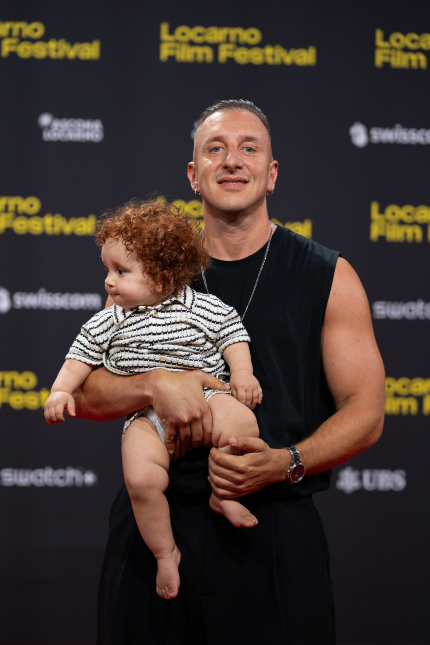
For almost two decades, Swiss-Portuguese filmmaker Basil da Cunha has made films with the residents of Reboleira, a predominantly Cape Verdean neighborhood on Lisbon’s outskirts.
His Locarno competition title O Jacaré turns the mysterious disappearance of stolen money into a bright, fast-moving ensemble caper in which rumor, suspicion and desire upset the community’s fragile balance.
Da Cunha sat down with Screen Anarchy to talk about gangster-movie heroes, a four-hour first cut, a two-year edit, and the film’s role as a final cinematic gathering before the neighborhood’s demolition.
Screen Anarchy: At the press conference, you explained that jacaré is neighborhood slang. What does it mean exactly, and why did it become the title?
Basil da Cunha: It is not exactly Machiavellian. It describes people who are crooked, hustlers, liars, smooth talkers, scammers.
In the film, the money is really a pretext for moving through the neighborhood and setting all these characters in motion. Everyone begins searching for it, suspecting everyone else, becoming afraid and criticizing one another. Everybody thinks the other person is their jacaré, or somebody else’s jacaré.
When money suddenly falls into an ecosystem with a fragile balance, it disrupts everything. It brings out emotions that were already there, and people’s dreams, but also something unhealthy: mistrust and fear. That atmosphere is the film.
The title also literally gives you the caiman wandering through the story. Where did that idea come from?
In these neighborhoods, gangsters often like to keep unusual exotic animals. We had already brought different animals into the earlier films, so this time we chose a caiman. The animal might remind you about The Big Lebowski, and that is one of my inspirations, the spirit of those guys who never manage to do anything the way it is supposed to be done.
The caiman was a difficult actor to direct. I did not know that crocodilians become tired very quickly. When one of them moves a meter, it is almost as if we had moved 150 meters, so it needs a long time to rest. That made the filming complicated, but the animal was very friendly and cooperative. Everything went well.
The social background is heavy, but the film is funny, rhythmic and almost buoyant. How did you find that tone?
Guilty compassion makes very heavy films. The neighborhood Reboleira in Lisbon is a joyful place. There is a force of life that is much more powerful than the drama, a way of living with drama and taking it philosophically. There is a phrase we use a lot in the neighborhood “Here there is no misery, only difficulties.” Very serious things can happen, but life continues.
Someone can shoot another person and, if he does not die, the next day they may have a drink together. It is different, it is not treated as tragedy forever. The social context is strong and difficult, yes, but so is that force of life. The film celebrates it. That is why it is joyful and pop, why it has punch and rhythm.
What genre films were you drawing on?
There are many influences. Scorsese and Goodfellas, certainly. Pulp Fiction and Tarantino. The Coen brothers. These are films from my childhood. I have always loved gangster films because they take ordinary people, people from the bottom, and give them extraordinary destinies. They become movie heroes while still resembling the people we live with every day. That is what I love.
At first, my ambition was also to make a real mosaic, an ensemble film with 25 characters, like Nashville or Short Cuts. Not in Altman’s visual style, he often observes from a distance, almost as if the characters were ants, but in the way many lives can form one portrait.
You have worked collectively in Reboleira for almost twenty years, across several generations. How did you build the cast this time?
There was no casting call. I wrote for them. Of course, between writing and shooting, one person may be in prison and another may have moved to a different country, so I have to adapt.
Many of them have already made several films with me. Alexandre Da Costa Fonseca has made three, Verónica Lii has made two. At that point they are professionals, even if they did not come through a conventional acting school.
Across these films, we have tried to make a portrait of the neighborhood through different genres and different generations of actors, all from the area, my generation, the one before and the one after. Each genre lets us explore and describe the same place differently.
For O Jacaré, I wanted to gather most of the people I had worked with before and bring in a new generation as well. It became a choral film, a kind of final dance.
How much room is there for improvisation when the screenplay has so many intersecting characters?
The script was very detailed and went through many versions. I write for the actors and for what I know they can bring, but what happens in front of the camera also belongs to them. They bring pieces of their lives and invent a great deal. The character is not necessarily close to who the actor really is. It is a mixture, something personal, something imagined, and something that only appears in the moment.
You mentioned the first cut ran close to four hours. How did a film conceived on that scale become the 92-minute version we see now?
I cut enormously. There were many more characters in the script and in the first version of the film. We considered making episodes, but it had not been written as a television series, and when we tried to divide it that way it did not really work.
The deeper problem began in production. There were many difficulties with the producers during preparation. We changed producers only three months before shooting, and after that things went much better, but the preparation had already suffered. There were also mistakes that were mine. We lost money and had to reduce the shooting schedule from sixteen weeks to seven.
Instead of removing scenes, I tried to combine several scenes into one. That was a very bad idea. A scene works when it has a point of view. When I put three or four scenes together, there was no longer a clear point of view, so the scenes did not work. I wanted to keep everything rather than accept that the money and time did not allow me to shoot everything. Those were bad choices, and the edit had to confront them.
How long did that editing process take?
Two years. Two years only for the editing, and a great deal of work, for a result that is still not perfect.
But that was the process, finding the film inside what we had, cutting away the structures that did not hold and recovering the rhythm and point of view.
You have called O JACARE one of the final films in this Reboleira cycle. Is the neighborhood being gentrified?
No. It is being destroyed. By the time filming ended, the neighborhood was practically empty.
We reanimated it for the film by bringing back actors who had already left. Important places and pillars of the community no longer exist. The kind of films we made there until now will not be possible tomorrow.
The neighborhood was built largely by Cape Verdean workers, often with materials they could recover from the factories where they worked, wood, cement, whatever was available, on muddy ground that interested nobody at the time. Families grew, second generations arrived, and small ecosystems developed, villages inside the city. Many residents paid for electricity and had regularized their situation, yet the treatment they received from the police and municipality was never the same as for other inhabitants.
Plans to demolish these neighborhoods existed before the Troika period and the financial crisis, economics and later Covid slowed them, but most have continued to disappear. There are inequalities and forms of repression that persist today.
So yes, the film is also a document. Before the place disappeared, I wanted to gather everybody for one last dance. The neighborhood has never been just a location, it is the heart of the films, and the films have become part of its memory.
If the place itself is disappearing, does that mean the filmmaking collective ends with it?
No. The cinema family we created will travel into the next films. It is bigger than the people who can sit around one table, and it does not depend only on those streets. The geography changes, but the relationships, the actors and the way of making films together continue.
Why are you so consistently drawn to gangsters, crime and people operating outside the law?
I like the idea of people from the bottom reversing the balance of power, taking a kind of social revenge. And I do not think these gangsters are more gangster than politicians or bankers, so I do not have a moral problem with them.
Crime lets me look at cinema and society from another angle. O Jacaré is an action comedy with gangsters, but they are all very likeable. They are friendly people.
The biographical series I am developing is different. It concerns a gangster who was killed about 20 years ago. Most people in Portugal do not know his story, but his name is famous in the neighborhoods. People described him as a monster. Monsters do not exist. What interests me is showing how he became what he became, and why society made him into a monster.
What has the research for that series been like?
It is not easy, because people lie a lot. They do not like precision.
But cinema lives through precision, where you put your hands, what you do, how you work. These crimes are still recent, so memories, loyalties and self-mythology complicate everything. You have to keep looking for the precise gesture inside stories that keep changing.
What other project are you working on?
It is a superhero film made with these same people in Lisbon, but the hero works in reverse. Instead of catching thieves, he catches police officers, because the enemy is the police.
Image courtesy of Locarno Film Festival/Ti-Press.



