Locarno 2026 Interview: OBJET A Filmmaker Ann Oren on Touch and the Ecstasy of Losing Control

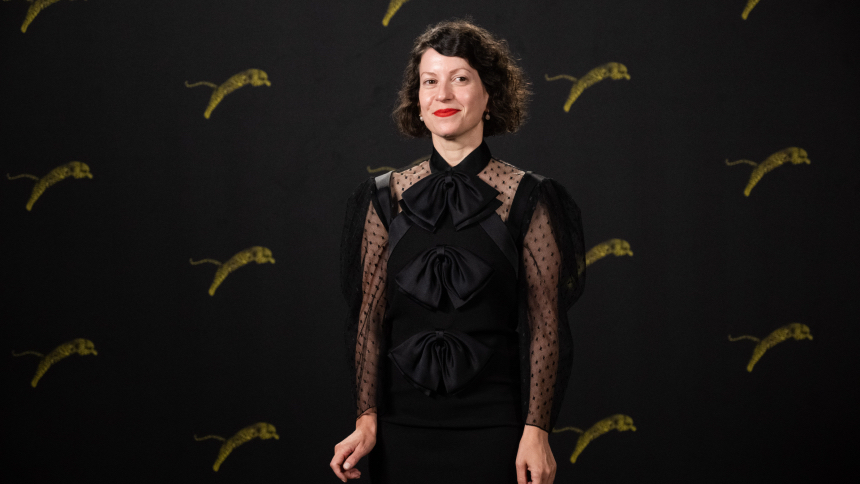
Berlin-based filmmaker and visual artist Ann Oren joins actors Aenne Schwarz and Louis Hofmann to discuss her second fiction feature, Objet a.
Visionary hand surgeons Ingeborg and Adam inhabit a tightly controlled relationship until an accident brings the enigmatic Gaia (Simone Bucio) into their lives and unsettles its balance.
At Locarno, the trio spoke to Screen Anarchy about Lacan, touch-starved digital culture, Jan Švankmajer, objects as characters, body horror, surgical preparation, and the dangerous promise of surrender.
Screen Anarchy: The title comes from Lacanian psychoanalysis. How does that idea connect to the film?
Ann Oren: That was an inspiration. For many years in New York, I went to a free Lacanian seminar, and I read a lot of Lacan’s texts. They’re very inspiring and sometimes difficult to understand, even when I speak to Lacanian analysts, they say, “It’s a bit difficult to explain.”.
Maybe they don’t understand it themselves. But it deals a lot with desire, with circling around desire, why do we want what we want? That is something my work has always dealt with. It is always a starting question, I just find new ways to ask it.
I thought Objet a would be a great title. The actors or viewers don’t have to understand exactly what it means. The film is very visceral, and the characters’ interactions come from their gut feelings, not from rationality. I liked that combination, a title that comes from psychoanalysis attached to irrational choices and desires.
Where did you shoot the film?
In Luxembourg and Frankfurt, Hesse and Luxembourg. The co-production support brought us there, but the locations also merged very easily into one place. I knew the couple would live in a very well-preserved old house.
We were scouting in Luxembourg, and in my hotel room there was a real-estate magazine on the bed. I saw a house and screamed, “This is exactly the house I imagined. Please, let’s try to get it”. We were very lucky, it was empty between tenants and available to us.
Aenne and Louis, what struck you when you first read Ann’s script?
Aenne Schwarz: It was a completely fantastic, genuine world. You enter it from the first moment and realize, this is new territory, and it belongs to someone. You are being given someone’s world. Yet what happens there is easy to relate to because it is so human and so close. That tension lets you give everything to the world even if you don’t completely know what it is.
Louis Hofmann: I was incredibly engaged with the story and the characters. It had a very particular humor, and the language gave us sentences that were fun to grab onto. I had seen Piaffe and was struck by Ann’s visual storytelling, this very specific cinematic language, and that fused beautifully with the script. It kept surprising me. The snail being the reason the car will not start is one example; the script was full of original ideas I didn’t see coming.
Aenne Schwarz: And the story is not told only through psychological coherence. The little objects, animals, wind and smells tell it with us. You have to follow those things through the labyrinth. Even the objects are characters.
The film’s deadpan humor and immaculate compositions may prompt comparisons with Yorgos Lanthimos. Is he an influence?
Ann Oren: No. He’s a great filmmaker and I like some of his films, especially the early work, but I would not name him as an influence. Maybe there is a cultural disobedience that we have in common.
My work is much more visceral, although he also works with the body, and I think my work is much more feminine. We live in the same world, so it makes sense that artists can come from different inspirations and arrive at similar attitudes.
Which filmmakers have shaped the way you look at the body?
Jan Švankmajer. I always return to him when I talk with production designers and cinematographers. I say “look at Conspirators of Pleasure”, which is one of my favorite films.
I also think about Buñuel, but with Buñuel it is more the attitude. He is much more elegant, always somehow bourgeois even when he criticizes the bourgeoisie. With Švankmajer, it is the use of sound, kinks and curiosities. I saw his films and something flipped in my head.
The relationship between Ingeborg and Adam can feel sadistic, or masochistic. How do you see it?
They are torturing themselves physically, but don’t we all torture ourselves a little bit all the time? In their case it is also about preoccupation with the other person. And it connects with what people now do for body optimization, biohacking, trying to look better or live longer.
I don’t see Adam as a literal biohacker, but there is a wider tendency toward control. For me, the important counterforce is allowing yourself to be reckless and to lose control. We have more and more tools for gaining control, and the more we try to control our bodies, the more disconnected we can become from the natural world of which we are part.
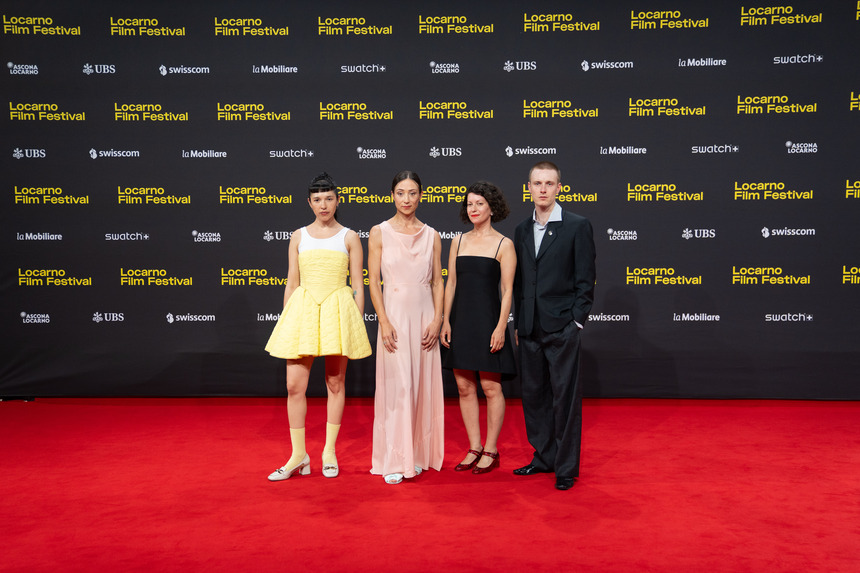
Simone Bucio, Aenne Schwarz, Ann Oren, Louis Hofmann (left to right)
Can you walk us through the creative process? Where did OBJET A begin?
It was not a straight line. It began with touch, that was the sense leading the film. I was thinking about how touch has been reduced. Things that used to be tactile, a record, a potential lover’s skin, even buying a subway ticket from a machine, are increasingly reduced to touching the aluminum surface of a screen.
Touch is a very good detector, it helps us make choices in everyday life. I imagined a hand that was almost zombie-like, hungry to touch something real. Then came Ingeborg. I thought I might create a couple who communicate through touching and being touched, living a very bubbled life and communicating through objects.
Working with objects lets you look at contemporary human tendencies and make them more absurd, because they are just objects. From there I did a lot of research into fetish and fungi.
The fungi arrive as a surprise. Why did they become so central?
Gaia embodies psilocybin fungi. You understand it more toward the end, it is in her smell and sweat, and she puts magic mushrooms in her armpits. Once she enters Ingeborg and Adam’s lives, the frames become looser. They act differently, strange, surreal things begin to happen.
Gaia is connected with the natural world, and in the end she takes them on a surreal journey that opens into psychedelic ecstasy. I wanted the film to begin with a great deal of control and move toward its loss. You gain something else when you lose control.
I shaped the dramaturgy of the trip sequence from my first experience with psychedelic mushrooms. The substance comes from nature and has been used in many societies for centuries. It becomes a way for the human characters to reconnect with the natural world through ecstasy.
Why do you think psychedelics are returning so strongly now?
We are obsessed with control, AI and technological devices that help us optimize our lives. We become stuck in that control and need something that can give us a temporary loss of ego and connect us with something larger than ourselves.
Georges Bataille describes ecstasy as somewhere between a divine experience and eroticism. That is also how eroticism morphs within the film. A book I recommend is Merlin Sheldrake’s Entangled Life.
Psychedelic mushrooms are only one part of the fungal world, and only a small fraction of fungal species is known to us. Fungi can be used in design, packaging and construction; some can help remediate toxic waste, and psilocybin is being studied for depression.
They may be a species from which we can learn. But even this is being instrumentalized for optimization. Pharmaceutical companies want the benefits of psilocybin without the psychedelic experience. Yet the psychedelic part is scary precisely because it makes you lose control and can bring your demons to you. In the larger picture that may be healing, but it can be very difficult, and it is not for everyone.
How do you approach eroticism without relying on conventional sexual imagery?
I am interested in desire and why we want what we want. Eroticism is part of that, but I don’t necessarily see the film’s imagery as erotic in itself.
It is an expression of desire, especially when what the characters desire is surreal. Every species desires something. Ours may be more complex than what a tree desires, but desire connects us to the natural world, and cinema can explore it in very exciting ways.
What inspired the film’s peep-booth exchange?
Chatroulette, a tactile translation of Chatroulette. The separation and the exchange of pictures simulate a screen. You can have a clean, smell-free, pure fantasy exchange with somebody, you don’t see the other person, you don’t get involved, and there is no risk. It is super-safe, but still fetishistic.
Through technology, a person can become a carefully selected set of images. That makes the body intensely fetishized.
Louis, how did you prepare to play Adam, a hand surgeon who is also devoted to controlling his body?
We watched operation videos together, and then I went down the YouTube rabbit hole, open stomachs, cancer surgeries. It was brutal and at one point I almost fell off my chair and vomited, so I tried to focus on the less bloody procedures.
I learned suturing, and having a physical task like that is always useful: it gives you a way into how the character spends his time. Then there was a lot of working out, which had never been my thing, six days a week, from zero to a hundred.
At some point it brought me closer to Adam’s feeling of control. I suffered with diet and the constant thinking about the body, looking at yourself, optimizing it, not eating what you want, becoming stressed because you missed your carbohydrates. Chicken, broccoli, and quinoa. That is not the lifestyle I want to live.
Aenne, what did the physical preparation involve for you?
I am not as talented as Louis with suturing. My hands told me I could not become a hand surgeon; the real surgeon on set practically wanted to take Louis home.
For me, the crutch was important. I had to learn how to walk with it and train the back muscles so I would not create problems for my hips. We sutured together, too, but I was happy that Ingeborg mostly gives the orders.
Ann, how much medical accuracy did you need before you could depart into fantasy?
During the writing and research, I spoke with many surgeons. To write the scenes, I needed to understand surgery, and I looked for open-minded surgeons because the film is not entirely realist. If someone insists that I stick only to the hard facts of how things are done, they will go crazy.
We had someone on set help prepare the operating table. Experts are excited to contribute their knowledge to a film, and they can appreciate the fantasy that goes on top of it.
Aenne, you said you love body horror. What draws you to the genre?
Horror sits at the center of human fear. Opening the body and looking inside is also a cinematic experience. It asks a philosophical question in a physical way. Isn’t it unbelievable that we have this tiny skin around us and all of that stuff is happening inside? It opens a whole universe.
I watched a lot of body horror when I was younger, Cronenberg, for example. Now I am becoming more sensitive to real body horror, but in the genre I felt somehow at home, as if it touched something true for me. When I encountered Ann’s script, I felt that this was what I had been waiting for. I wanted to work with this material and give myself to it.
What did you perform in the audition?
Aenne Schwarz: A monologue that is not in the finished film. Ingeborg tells Adam about the tram after she falls and hurts her ankle. She describes the sound and an erotic moment that almost makes her unconscious.
For me, she has sensitive fingers and incredibly sensitive eyes, her eyes get wet when she is excited. It was a confession about what had happened to her, and it marks the beginning of her being put into pieces, Gaia has taken the finger, then Ingeborg breaks her ankle, and everything goes in a different direction.
We also played the corset-reveal scene in the audition. One object is offered to another, and they enter an erotic moment together, then break apart again.
Are there many more scenes missing from the finished film?
Ann Oren: You will never know. I will leave it to your imagination. It is very important to leave things for the imagination.
Even at a time when audiences may be less fluent in reading art?
That is even more reason to invite them to use their imagination and to add ambiguity to films. Otherwise, there is no room for you as a viewer.
I am also interested in addressing the viewer’s body. We are almost being cancelled into blobs behind screens. I hope viewers consider their own bodies and experiences while watching the film.
Was the film difficult to shape in the edit?
No. I had a very good editor, Hansjörg Weißbrich. Of course, you try things, and some elements change in the edit, but we did not do reshoots. I am against reshoots, in a way. These are my ingredients, I am going to make a film out of them. I knew the kind of film I wanted and I had the material.
Then you see how it comes together, whether something feels odd for the mood or a character. It revolves around these three characters and their world. Editing is like sculpture: you keep working until you feel it is done.
What are you working on next?
Until now I have not had much free time to write, but I would like to start with the sense of taste. If Piaffe began with sound and Objet a with touch, the next film will begin with taste.
I cannot say more because I do not know yet. It will probably start with a year of writing, research and exploration before I pin myself down to characters or a story. I am not the kind of filmmaker with six scripts in a drawer. When I make a film, I am all in. It is my life for four years, and there is no room for anything else.
You also change through making the film. You begin in one place, learn new things and end somewhere else, and that somewhere else brings you to the next one.
Images courtesy of Locarno Film Festival/Ti-Press.