Karlovy Vary 2026 Interview: THE STORY OF DOCUMENTARY FILM - 1980s Director Mark Cousins on Cinema Canons, Generative AI, Docs in the Post-truth Age

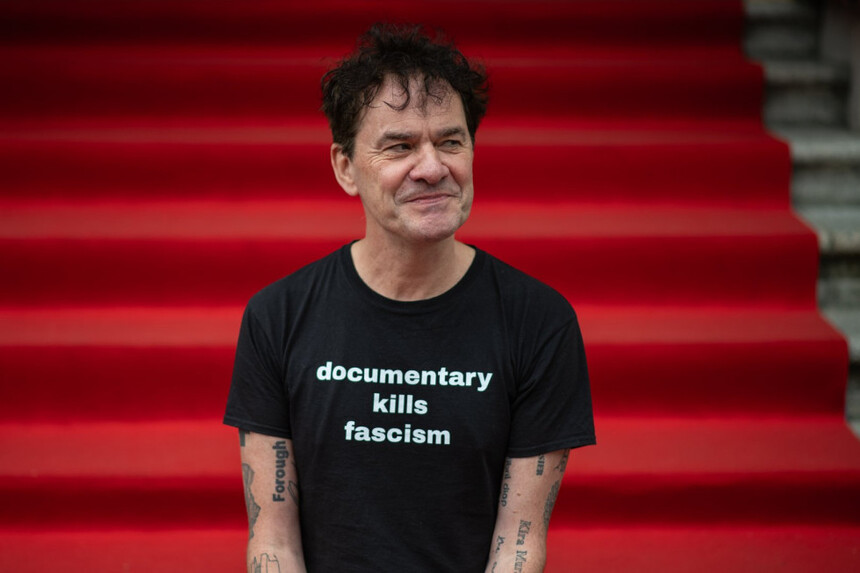
The documentarist Mark Cousins accompanied his latest work The Story of Documentary Film – 1980s, a part of his expansive new history of non-fiction cinema, at the 60th edition of the Karlovy Vary International Film Festival.
For Cousins, film history is never only about preserving the past. It is also an argument about what cinema is for, whose work enters the canon, and what kinds of images society needs at a particular political moment. His new cinematic cycle The Story of Documentary Film extends the global excavation of The Story of Film: An Odyssey.
Both were made, he says, in a spirit of “love and hate”: Love for cinema, and frustration with the narrow, frequently Eurocentric version of its history. Cousins began developing the documentary series six or seven years ago, as he watched politics shift to the right internationally. That drift made it urgent to revisit the branch of cinema most committed to looking outward.
“Documentary tries to describe life with some honesty,” he says. It addresses “human beings and their societies and their problems.” What attracts Cousins to nonfiction is its relative lack of narcissism.
Documentary filmmakers tend to be interested in “what’s out there,” rather than solely in projecting themselves onto the world. This also informs his skepticism about the emphasis film schools place on self-expression.
“What if that’s really not true?” he asks. “It’s not about self-expression. It’s about describing the world.” For Cousins, that world encompasses “mountains and the pyramids and pizza and other human beings and war and poverty and joy and dolphins.” Treating cinema primarily as self-expression, he argues, risks producing solipsism. Documentary proposes a different creative ethic: attention.
In The Story of Documentary Film – 1980s, the director structures the decade around two ideas: empathy and detection. The period is personally significant. Politically, it was the decade of Margaret Thatcher and Ronald Reagan, market individualism and the “greed is good” ethos. MTV was simultaneously transforming the speed and language of the moving image. Against widening social divisions, Cousins asks whether documentary could help viewers understand one another. Empathy, in his account, is a political and cinematic function.
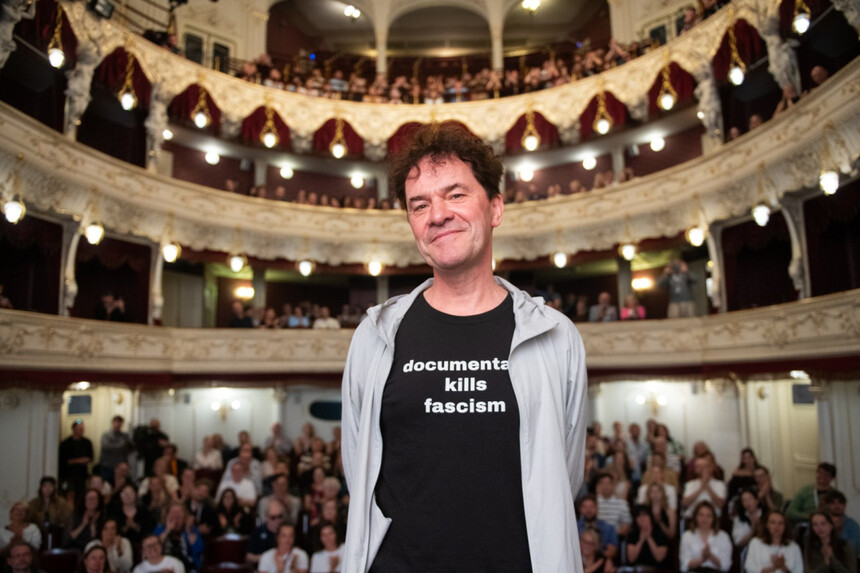
The film’s second movement invokes the detective. Cousins brings together Claude Lanzmann’s Shoah, Errol Morris, Kazuo Hara, Marcel Ophüls and the Hungarian film The Resolution. Despite their differences, the works share a basic gesture: a camera follows someone and asks what is out there, why people lie and how truth might be extracted from testimony and contradiction. The director introduces the section through Columbo, including an episode directed by Steven Spielberg. It is characteristic of his associative approach, which moves between cinema and television, art film and popular culture, to reveal unexpected formal connections.
Rather than presenting film history as a procession of movements and masterpieces, Cousins treats it as a field of collisions and echoes. That method can produce transitions from Jonathan Demme’s Stop Making Sense to Indian classical music and then to Taxi Driver. The juxtapositions are playful, but the underlying project is serious: to disrupt inherited hierarchies and make cinema’s history feel unsettled again.
Cousins accepts that every history is shaped by subjective choices. He rejects, however, the suggestion that his work is simply a personal canon.
His research begins with chronological and geographical grids mapping documentary production across regions and decades. Their blank spaces become questions. Does an apparent absence reflect historical reality, or his own lack of knowledge? Were there African filmmakers working in the 1930s whom he has overlooked? Are significant Egyptian documentarians of the 1950s absent from the accepted history?
His scientific background informs the process. Cousins studied physics and chemistry, disciplines in which a theory must be tested through attempts to disprove it. “That’s what I do all the time,” he says.
If he suspects there were no major Egyptian documentary filmmakers in a particular period, for example, he actively searches for evidence that would prove him wrong. The method is intended to expose his biases.
It has led him far beyond the traditional centers of documentary history. France, Germany, the United States and Canada remain important, but so do Japanese nonfiction, independent Chinese documentary and the exceptional Indian films of the 1970s.
“Indian docs of the 70s are some of the best ever made,” he says. His encounters with Iranian cinema were equally transformative, changing his understanding of both filmmaking and film history. For Cousins, revising the canon cannot mean adding a few underrepresented titles to an essentially Western narrative. It requires reconsidering the structure of that narrative itself.
Long-term relationships with archives have made the project’s scale possible. Following the international circulation of The Story of Film, cinematheques increasingly recognized that cooperating with Cousins could bring renewed attention to overlooked filmmakers. Some have digitized unavailable works specifically for his research.
The result is mutually beneficial: Cousins gains access to materials necessary for a credible global history, while films by figures such as Ukraine’s Kira Muratova or Bulgaria’s Binka Zhelyazkova return to international view. His challenge is then one of compression. From Fernando Solanas and Octavio Getino’s four-hour The Hour of the Furnaces, he may have to select only three minutes. Finding the right passage can take days. The goal is not to summarize the film, but to choose an excerpt powerful enough to send viewers back to it.
Cousins reduces documentary to a deceptively simple proposition: “Look what’s out there.” The form directs attention toward a world beyond the filmmaker. Its basic function, he argues, was established early: Documentary created a new consciousness by showing audiences how other people lived. That purpose remains constant, but the form must continue to change. Viewers need new ways of seeing, or they will feel they have seen the same film before.
Innovation can come through technique, but also through authorship. When filmmakers from formerly colonized societies began representing their own communities, they produced images fundamentally different from those created by visiting Europeans. The emergence of filmmakers in Mozambique and Guinea-Bissau did more than introduce local perspectives. It altered who possessed the authority to describe reality.
Among recent formal innovators, Cousins cites Myrid Carten’s A Want in Her, about the filmmaker’s mother and her alcoholism. Its cinematography turns a familiar subject into a destabilizing psychological space, using a camera moving along the ceiling and edges of the mother’s neglected home.
He also admires Andrey Paounov’s The Mosquito Problem and Other Stories, which repeatedly changes direction and subject. The most exciting documentaries, Cousins says, remain ahead of the audience.
That unpredictability matters in a market dominated by increasingly standardized nonfiction. Streamer-driven true crime, celebrity portraits and music documentaries often rely on recognizable cutting patterns, graphics, music cues and narrative beats. “You could do them in your sleep,” Cousins says. He does not dismiss these films outright. The problem is not accessibility, but repetition. Documentary must refresh its language as rigorously as its content.
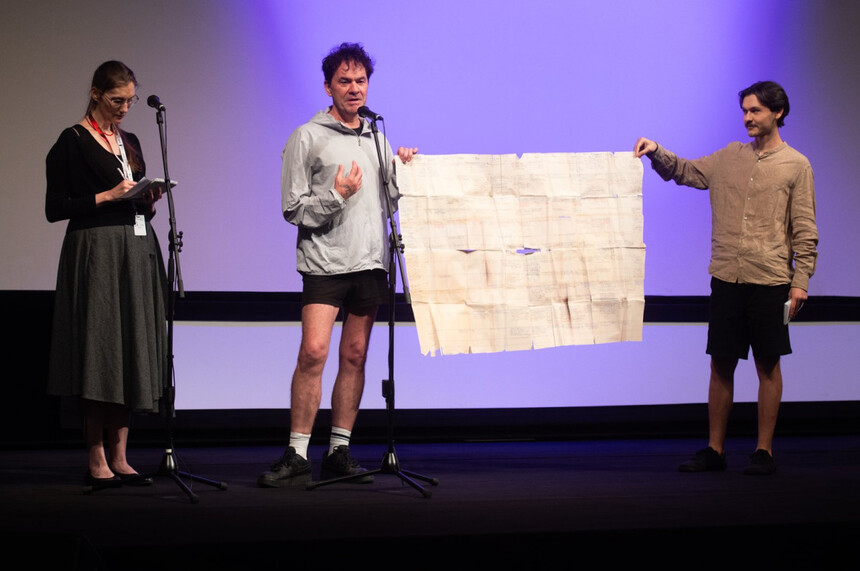
Hybrid forms are central to that renewal. Cousins traces their development partly to Iranian cinema of the 1990s, particularly Abbas Kiarostami, Mohsen Makhmalbaf and Samira Makhmalbaf. In The Apple, members of a family restaged aspects of their own experience. The purpose was not deception, but a more complex engagement with reality. Cousins calls such works “mirror docs”: films in which people perform their own experiences or those of others.
The category encompasses Clio Barnard’s The Arbor, Eduardo Coutinho’s cinema and Joshua Oppenheimer’s The Act of Killing. He provocatively adds RuPaul’s Drag Race to the list of cultural influences. Its use of lip-syncing, heightened identity and performed second selves has entered a wider visual vocabulary. Contemporary hybrid documentary, in Cousins’ reading, draws from Iranian art cinema and reality television alike.
Cousins is optimistic about documentary’s creative future, but far less confident about the consequences of generative artificial intelligence. Manipulated images and fictional scenes presented as reality are not new. What has changed is their sophistication, accessibility and near-undetectability.
“When I watch something now, like on social media, I just don’t know if it’s true or not anymore,” he says. The deeper risk is that audiences may cease to believe in the existence of a real image at all. Cousins believes documentary therefore needs an ethical code comparable to a medical Hippocratic oath.
AI may be used, he argues, but its presence must be declared when it appears. A film may temporarily mislead an audience for a defensible creative reason, but by its conclusion it must explain what was invented and why. Integrity has always been fundamental to documentary. AI makes that obligation more urgent. Cousins also calls for legislation requiring synthetic images to be clearly labelled, despite resistance from powerful technology companies. On this issue, he admits, he is pessimistic.
He is more hopeful about documentary’s political agency. Asked whether nonfiction cinema can fight fascism, Cousins describes it as a potential bulwark against the lies, scapegoating and restorative myths on which fascist politics depends. For more than a century, he says, documentary has been a “solidarity machine,” helping audiences understand lives beyond their own.
Films have changed legislation, improved material conditions and strengthened democratic debate. Cousins invokes John Grierson’s belief that a better-informed public would make better decisions at the ballot box. “That’s still true, isn’t it?”
He also rejects the idea that society has become entirely “post-truth.” Human lives remain full of truth: People suffer, love, lose, become ill and recover. What is endangered is the shared meaning of reality. “We will never be post-truth,” he says.
The role of culture, documentary included, is to restore that shared meaning and remind audiences what matters. This is the principal linking Cousins’ global canon-building, his enthusiasm for formal experimentation and his alarm over AI. Documentary must investigate power without reducing human complexity. It must resist formula, expose its own assumptions and continue to make neglected realities visible.
Images courtesy of Karlovy Vary Film Festival Servis.