DESPERATE LIVING 4K Review: Criterion Gets Classy With John Waters Great Underappreciated Masterpiece

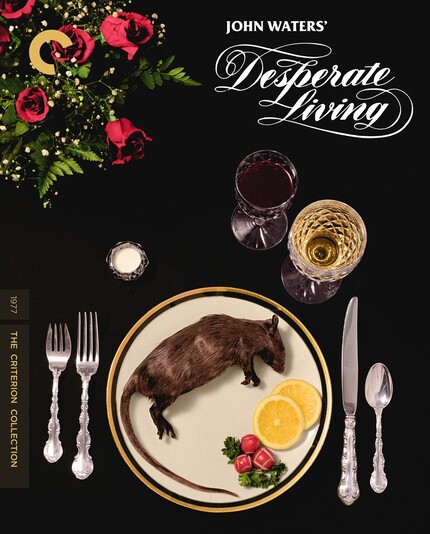
From outright disgrace to global cultural treasure, the recent octogenarian iconoclast filmmaker/raconteur John Waters has lived a dozen lives since he first picked up a camera as a teenager in the '60s. By the time Waters made 1977's Desperate Living, he had shocked the world with some of the first midnight movie miracles like 1972's Pink Flamingos and 1974's Female Trouble, both of which put Waters and his voluptuous drag queen muse, Divine on the map. However, as wild as those films are, there is an argument to be made that Desperate Living is the absurdist acme of his wild early years.
Peggy has completely lost touch with reality and her husband, Bosley, can't take it anymore. Just as he prepares to once again send her off to be institutionalized, Peggy employs her housemaid, Grizelda to protect her, and in this cast that means knocking off Bosley. Following this fit of murder lust, Peggy and Grizelda run off into the woods to avoid capture and stumble into Mortville, a home for degenerates and societal pariahs in search of a place to hide out. Little do they know that they'll be quickly absorbed into Mortville's never-ending cavalcade of depravity and political upheaval. Their safe space won't be safe for long.
The pair are soon taken in by butch lesbian Mole and her lover Muffy on a temporary basis, however, when their welcome wears out Peggy and Grizelda are moved to an outhouse where they are forced to get really, REALLY close. Before long they draw the attention of Queen Carlotta, a ruthless hypersexual despot who demands fealty from her subjects and amuses herself with their continual degradation. As the fugitives begin to tire of their position, palace intrigue and political shenanigans turn the kingdom upside down, leading to some of the most shockingly hilarious imagery of John Waters' career.
Waters' first feature film without Divine in the lead - and his only feature film not to star the drag queen from hell during the actor's lifetime - Desperate Living more than makes up for that absence with a collection of outcasts that easily rivals any of his other films. The rest of Waters' fabled Dreamland troupe is here to play, Mink Stole as Peggy, a housewife suffering from an interminable nervous breakdown; Susan Lowe as Mole, a butch lesbian maniac; Edith Massey as Queen Carlotta, the iron-fisted ruler of the shantytown hideaway for rejects; Mary Vivian Pearce as Princess Coo Coo, the Queen's willful daughter who needs taming, and various other characters from Waters oeuvre. New to the scene are Jean Hill as Grizelda, Peggy's housekeeper and protector who follows her to hell and back, and infamous gun moll/actress/stripper Liz Renay as Muffy, Mole's buxom hyper-femme love interest.
Divine's absence from Desperate Living, the actor was locked into a touring play at the time, has always made the film a bit of an underappreciated gem in Waters' oeuvre. I'm a Waters fanatic and Criterion's new 4K UHD release was actually my first viewing of the film for that exact reason. Having now experienced the film in this incredible new edition, I am kicking myself for the 46 years I've spent without it. Desperate Living marks a clear dividing line between the truly anarchic independent Waters films and the pseudo-mainstreaming of his absurdist worldview that started with the Tab Hunter starring Polyester a few years later. This is the last gasp at Waters' anything-goes style of gonzo filmmaking, and it's brilliant.
Waters' '80s and '90s output is certainly instantly recognizable as coming from the same voice, but with the addition of at least one mainstream Hollywood star in each of the following features, there was no way that he'd ever go this crazy again, even with his Dreamland cast and crew there, ready to do anything for cinema. Liz Renay had a career in exploitation films, but she was never the big mainstream star that Johnny Depp (Cry-Baby), Kathleen Turner (Serial Mom), Melanie Griffith (Cecil B. Demented), or even Eddie Furlong (Pecker) are, and so the films settled down.
Desperate Living has the energy of a punk rock explosion on screen. Outrageous characters wearing outrageous outfits (or often nothing at all) doing outrageous, disgusting things all for our enjoyment and Waters' amusement. It's incredible and nauseating all at the same time. Bliss.
The Disc:
Desperate Living jumps from DVD to 4K UHD/Blu-ray with Criterion's new dual format release. The 4K UHD disc is presented in HDR (not Dolby Vision) with an incredible amount of detail that can definitively be crowned the finest visual presentation of the film to date. Thanks to the 4K restoration we can see every outrageous detail of Vincent Peranio's incredible no-budget sets, including a few that we maybe didn't want to see (there is a lot of puke in this movie), not to mention the amazing costuming work from another Waters' regular, Van Smith. The uncompressed mono audio track is as clear as it's ever been, you'll likely hear dialogue and sound design details that you've missed for decades. There is no better way to watch the film.
Criterion have also assembled a handful of insightful new extras to partner with a couple of archival features that really help put the film in perspective. Reappearing from the film's previous DVD releases are a Waters/Renay audio commentary track; the speakers recorded their tracks separately and were edited together to present a pretty seamless flow of information that moves between Waters' production notes and recollections and Renay's obvious affection for the film and its filmmaker as well as plenty of personal anecdotes from both that help round out the experience. The nature of the track is not conversational because of the way it was recorded, but it's also far from the kind of dry lecturing that often comes from solo audio commentaries. Definitely worth checking out. It is worth noting the both the film and the commentary have subtitles.
Another feature that I believe is archival is an interview with art director Vincent Peranio that takes place at his Baltimore home. This is a very interesting interview that also serves as a kind of walk through Dreamland history as Peranio worked on all of Waters films and his home serves as a kind of prop museum. Very enjoyable.
New features include a conversation between Waters' and programmer Christina Cacioppo which spans about 20 minutes and gives off a very jovial vibe. Cacioppo is obviously a fan and Waters is as charming as ever in this wide-ranging talk that discusses not only Desperate Living but also the circumstances around it and Waters' career up to this point. There's also an audio-only conversation between the Dreamland ladies of Desperate Living, Mink Stole (Peggy), Susan Lowe (Mole), and Mary Vivian Pearce (Princess Coo-Coo) who talk about their experiences on the film and the effect it had on their daily lives at the time as well as its lasting legacy. It's clear they are all still friends with wonderful memories of this insane film, a joyful listen.
Finally, we have writing from trans essayist Grace Byron who explores the transgender themes and history surrounding Desperate Living. It's an excellent thematic deep dive that puts the film and the character of Mole into context. I do wish there was another essay that explored some of the other themes of the film, as this one is laser focused on this single issue and after listening to the commentary, it's only one part of what Waters was trying to say with the film. However, Criterion doesn't generally do multiple essays on a single release, and this essay is a very good one.
There is very little more that I could possibly want from a release of Desperate Living, this is a definite winner and highly recommended.