THE SUPER MARIO GALAXY MOVIE: Well, What Did We Expect?

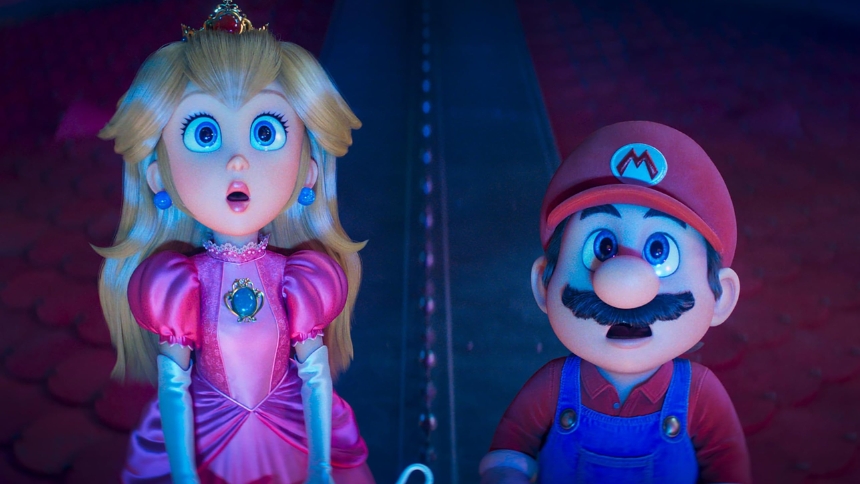
At the very center of the scepticism towards big-screen videogame adaptations is the Super Mario Bros. franchise.
One of the first pieces of interactive visual media to have a rich, almost-intangibly large and strange world, Shigeru Miyamoto's 1985 platformer Super Mario Bros. is a combination of disparate images within a borderline impressionistic storyline, bearing more in common with an improvised bedtime story than a meaningful fable.
Firstly, let's describe what it is: a squat, moustachioed plumber by the name of Mario must run, leap and stomp his way past a series of mushroom-related foes in a quest to save the mushroom realm's princess (Peach, crucially and inexplicably named after a fruit, not a fungus) from a forced marriage to a beastly tortoise (King Koopa, somewhat more sensically related to Japanese folklore's shelled 'kappa' creatures).
Phrasing it like that, it's a quasi-chivalric tale, hinging on the exploits of an unlikely knight in shining overalls to save the damsel in distress, dressed up in psychedelia and diverse cultural references that do not hang together with rhyme or reason.
Yet despite that, the experience of playing the thing enraptured millions, launching a beloved and ever-expanding gaming franchise over many genres, disciplines and decades. From karting to golf, medicine to space exploration, Super Mario Bros.' colorful collection of characters could be dropped into many elaborate formats and remain as gripping and engaging a gaming experience as it was when eight whole bits of Mario simply moved from side to side.
With that level of beloved success had to come germination between mediums. Lending itself stylistically well to the world of anime, Nintendo wasted no time in collaborating with Grouper Productions to produce the hour-long animated adventure Super Mario Bros.: The Great Mission to Rescue Princess Peach!, a zippy and (reasonably) faithful outing for Mario and Luigi to go on a quest for power-ups in order to save Princess Peach.
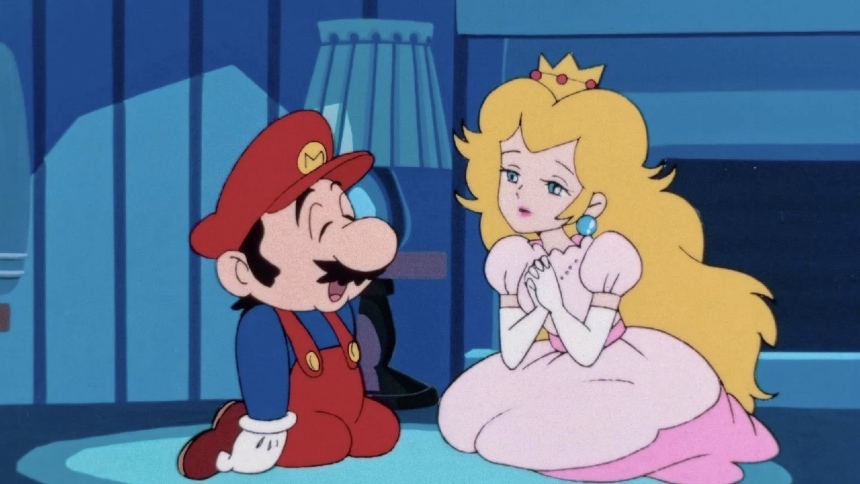
Granted, a few liberties are apparent to the initiated; taller, greener brother Luigi's voracious greed for gold is a far cry from the meek loveability inherent in the character, and the addition of a frighteningly blank love interest for Peach called Prince Haru is a classic case of failed spin-off bait.
That film did not see much life outside of its initial theatrical run, nor outside of Japan, having instead become a deep-cut curio for fans to discover through unofficial restorations. Neither here nor there with its cultural footprint, it paved the way for something very different, standing in stark contrast to Hollywood's later attempt to bring Mario to the silver screen. In 1993, audiences were presented with Super Mario Bros., a nightmarish and hugely expensive live-action take on the Mario universe loathed by loyalists and critics alike.
Starring Bob Hoskins and John Leguizamo at their career peaks as Mario and Luigi, respectively, they remain blue collar Italian-Americans with an expertise in drain-rodding sent into a bizarre alternate dimension where villainous reptiles rule the world. That is essentially where the similarities to the source material begin and end, however, with each unexplained facet of Miyamoto's original vision being bent over backwards to make some sort of sense when brought to life by flesh-and-blood people.
Lore about meteor-related multiverses and highly-evolved dinosaurs is instantly piled on, burying the story in a deluge of abrasive comedy and tough-to-swallow sci-fi concepts, ranging from a cretaceous take on NYC called Dinohattan to a sentient royal fungus that turns out to be one of the lead character's dads. A scenery-chewing Dennis Hopper's gelled-hair, long-tongued Trump-esque King Koopa is emblematic of the film's failures; it looks sort of familiar to the human eye, but in trying to process it, something along the way is lost in the synaptic journey to our critical brain.
Its attempts at being recognizable and logical make the experience so much more unrecognizable and illogical, turning what was a diverting cocktail of chalk-and-cheese elements for the enjoyment of children into a manic hellscape for everyone aged 1 to 100.
It's no surprise that the world of Super Mario Bros. took a long hiatus from the cinematic medium. Thirty years passed, with Miyamoto quietly and carefully gatekeeping his brand for the right studio with the right vision at the right time. Universal's Illumination division seemed to be it; their slick and profitable work with the Despicable Me/Minions universe appeared to be a good match.
So began the production of The Super Mario Bros. Movie, a 3D animated reclamation of a character that had been twisted by its run-in with the real world. The plot remains the same: Mario and Luigi are sucked into a pipe that spits them out in the Mushroom Kingdom, where Koopa king Bowser is making designs to snatch the hand of Princess Peach. Cue the music, sights, sounds and plot beats everyone is familiar with.
For all this effort was extremely safe, there was the sense that it finally got Mario 'right'. Jack Black's bombastic voice work as Bowser was matched only by how good Donkey Kong sounded with Seth Rogen's 'heh heh heh' stoner laugh, and it's tough to imagine Luigi not having Charlie Day's voice going forward. And for all the derision Chris Pratt got for voicing the big red man at its center, his tones were the ideal neutral presence required for a video-game protagonist; we've literally all been Mario before, and this particular cross-generic voice (Pratt is synonymous with populist comedy and action) is the perfect amalgam of everyone's.
As a work of narrative, there's precious little to say about it. Like A Minecraft Movie after it, it's a film built for the fans, structured around the assumed logic of the game itself. Mario's journey is told at such a pace that there's absolutely no point in trying to parse reason from its physics, geography or quantum mechanics, instead simply asking you to raise a smile whenever a familiar face or setting turns up.
Confused by how the politics of the Mushroom Kingdom rub up against the kingdom of the Kongs? Doesn't matter! Here's a Mario Kart action sequence set on Rainbow Road to distract you. And it's over in 92 minutes, including credits and bonus scenes for those still sitting in the theatre! It's a top-drawer exercise in key-jangling, brain-rot at its core but very true to the tree it grew from.
Nearly a billion and a half dollars and three years later, the inevitable sequel drops, this time drawing from a particularly beloved piece of Mario property: Super Mario Galaxy. The Super Mario Galaxy Movie is almost identical to its predecessor in failing to catch up the uninitiated, expecting you to know who magical space princess Rosalina is, how her starship castle works and why it's important that bratty little Bowser Jr. wants to steal her power.
Add to that a plethora of extended universe cameos (at least three playable characters from Super Smash Bros. show up) and surgically remove any semblance of moral messaging (at least the first film had something vague about teamwork ... what's here is much more evasive), and you've got a double-stacked product that promises even bigger products to come, sporting vibrant spectacle that is kinetically told through a clothesline of images we've seen in other mediums ... and nothing else.
At the time of writing this article, The Super Mario Galaxy Movie sits atop the 2026 box office on a tidy three quarters of a billion dollars; not bad numbers at all. Yet, the reaction to The Super Mario Galaxy Movie has been somewhat more muted than that of the first.
Perhaps it's diminishing returns, or maybe it's a classic case of biting off more than a film can chew, or even that audiences are expecting more from big-screen entertainment accessible to three year-olds, but there's no denying that comparisons to, say, Star Wars: The Rise of Skywalker aren't charitable. The critical discourse has been one of exhaustion, begging this collage of bells and whistles to be weightier, smaller, or be about anything at all.
To that, it's tempting to say, "...what did you expect?" The Super Mario Bros. Movie (2023) proved that following the money line is perhaps the only way for translating a property as wackadoo as Miyamoto's original, and now technology has finally caught up between videogame production and filmmaking, it's entirely possible to just make a Mario movie the way it "should" look. Illumination's helming of the brand is extremely on-brand, having a wealth of licensed imagery and musical stings to weave into a feature-length lights show, dropping in something most people watching the film will know about every couple of minutes.
The echoes of the 1993 debacle have been practically drowned by the cash-ringing successes of the Universal reboot, and there's the sense that videogame cinema will stay to course with being reverent of what came before. Next month sees the hyper-violent return of Mortal Kombat, which has finally embraced its R rating and Johnny Cage as a lead character, and soon after, YouTube sensation Kane Parsons is bringing his Backrooms universe (which has inspired its own low-fi gaming scene) to cinemas. Risks like Super Mario Bros. (1993) seemingly need not be taken again because the promise of getting exactly what you already know is very, very profitable.
What the box office boom of The Super Mario Galaxy Movie truly shows is that tales of Mario, Luigi, Peach and Bowser are not beholden to the same rules that many other films are. It doesn't matter that it doesn't make sense, because, really, it's never made sense. The toy commercial quality of the Mario brand has always been unapologetic and prevalent; going back to The Great Mission to Rescue Princess Peach!, you may be unsurprised to find two Mario-branded instant ramen advertisements floating in between scenes.
When viewed as stories outside of narrative, it can be much easier to digest the odd world of Mario we've just come to accept as coherent through 40 years of cultural exposure. There can be poetry in color and meaning in nonsense, this is true, and maybe there's little of either in the Mushroom Kingdom and beyond. An unintuitive story about a tiny small businessman fighting an evil tortoise touched people nearly half a century ago, and people are still paying money to see the reskinned version of that today. It's a question of expectation and delivery, and when the two factors remain the same as time sidescrolls by, the profitable equation remains the same.
We may never see a fumble like 1993's Super Mario Bros. ever again, a picture where, even after three decades of picking apart what went wrong, it was borderline impossible to know what to expect from such a strange venture. Today, when Nintendo and Universal discovered the exact brick to hit over and over for infinite gold coins, it was easy to figure out how their latest entry could have gone as soon as its title was announced.
A project that is faithful and frivolous to the end, expecting anything more from The Super Mario Galaxy Movie is like eating a blue mushroom: deflating. If there's anything to be learned from this cheerful and developmentally de-riching experience, the best course of action is just to keep thoughtlessly running and jumping for joy alongside the colourful juggernaut, leaving all good sense and critical faculties stomped flat.