
LEE CRONIN'S THE MUMMY Review: An Old Monster, A New Nightmare, Courtesy of James Wan and Jason Blum

The "Dark Universe," Universal’s misguided, over-hyped, subsequently discarded attempt to create a Marvel-style shared universe centered on its classic monsters, may have been done and dusted after the failure of the Tom Cruise-led Mummy reboot nine years ago, but as even casual horror fans know, cinematic monsters never really die, at least not onscreen. They quietly slip into suspended animation, sometimes for a few years, sometimes longer, but they always come back in one form or another.
While the "Dark Universe" smolders in a cinematic ashbin, Universal's Mummy will be back next year, albeit as the third sequel to the 1999 action-adventure take co-starring Oscar winners Brendan Fraser and Rachel Weisz, and not as a standalone, supernatural horror film in the Boris Karloff or Christopher Lee mode.
The absence of a new Mummy entry in the Universal Monsters tradition left a perfect opening for Warner Bros. to give a new take a chance, Lee Cronin’s The Mummy. Presumably titled to avoid potential confusion, Lee Cronin’s The Mummy isn’t your great-grandfather’s mummy. It’s not your grandfather or even your father’s mummy, for that matter.
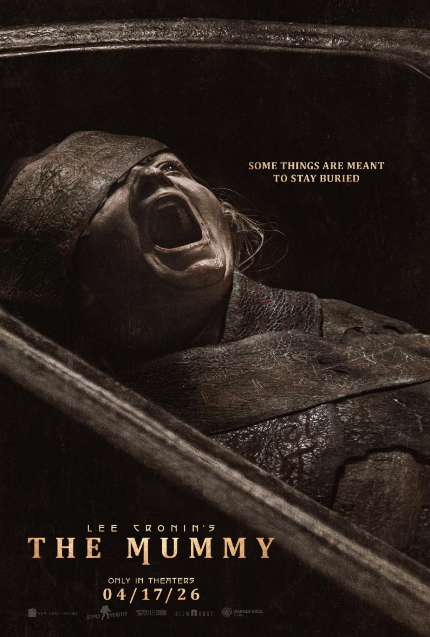
Instead, it’s a gory, ghoulish, and grotesque take, heavy on R-rated body horror and light on the foot-dragging, lumbering, stumbling mummies of the Karloff or Lee eras. It’s less a mummy movie than an Exorcist-style possession flick, centered as it is on a woefully unprepared, misguided family and their attempts to save their possessed demon-child.
Undermined by an overindulgent running time, Lee Cronin’s The Mummy opens in Cairo, Egypt, as an American family led by Charlie Cannon (Jack Reynor), an American reporter for a fictious cable news channel and his wife, Larissa (Laia Costa), experience the highest highs and the lowest lows on the same day: Just as Charlie receives word that he’s received a prestigious, high-level anchor job back in the States, their daughter, Katie (Emily Mitchell), disappears, kidnapped by person or persons or persons unknown and, after an investigation by local authorities goes nowhere, presumed dead.
Eight years later and still devastated, Charlie, Larissa, and their two surviving children, Sebastián (Shylo Molina) and Maud Cannon (Billie Roy), have relocated to New Mexico and a semblance of normality with Larissa’s religiously pious mother, Carmen Santiago (Veronica Falcón). Still hoping against hope for Katie’s safe return, Charlie and Larissa set aside a room for her.
In Monkey Paw-like fashion, though, when Katie does return to her family, the victim of years of abuse, neglect, and starvation, she’s anything but the daughter and sister they once knew and loved. Near catatonic, mute, and prone to flailing fits, Katie shouldn’t be with her family, but institutionalized, where her needs could be met regularly by a trained staff.
But for Larissa, more than Charlie, leaving Katie in the care of strangers isn’t an option. Driven by guilt, grief, and shame, Larissa successfully lobbies to bring Katie back home with them from Egypt, where, with Larissa’s tender loving care (she’s a trained nurse), Katie will eventually return to them both in mind and in spirit.
Every film asks for a suspension of disbelief, but even that disbelief has its limits, and the suspension of disbelief needed to rationalize Katie's return to the Cannon home might be one suspension too many. It’s the first of several logic-defying decisions that will leave discerning audiences bewildered, frustrated, and quite possibly, annoyed at Cronin’s dubious decision to set aside plausibility altogether and hope (that word again) that audiences interested more in the usual shocks of the genre either won’t care or will and shrug their shoulders anyway.
While far from fatal, the family’s continued defiance of narrative logic, especially once a partially revived Katie begins to act out violently, becomes increasingly difficult to ignore. Charlie adds a few locks and bolts to Katie’s room, adds the same level of minimal protection to the crawlspace surrounding their home, but still gives in to Larissa when she refuses to institutionalize Katie or get additional help. Even when they tie down Katie, it’s only temporary, and it’s only to her wheelchair when she needs a haircut, or her overgrown toenails clipped (a cringe-inducing moment if there ever was one).
Structurally, Lee Cronin’s The Mummy suffers from another, not altogether unrelated issue: Cronin splits the narrative between the Cannon family and their struggles in New Mexico, an obsessed Charlie digging into the wrappings found on Katie’s body, and a young detective, Dalia Zaki (May Calamawy), investigating Katie’s disappearance in Egypt. A first name turns into a last name turns into a location turns into a gruesome discovery, including an old-school videotape echoing J-Horror’s ur-text, Ringu, and the curse behind Katie’s condition. Said curse may or may not have a “cure” of sorts, possibly even a resolution that doesn’t end badly for everyone involved.
Given Cronin’s involvement in writing and directing the last Evil Dead entry, Evil Dead Rise, and its narrative, visual, and gore-related similarities, audiences might be surprised that Lee Cronin’s The Mummy doesn’t unfold in the same universe or even an adjacent one. It’s meant to be one of one, at least until weekend grosses come in and the studios decide on a sequel. Given the nature of the curse, it’s certainly ripe for franchise-making, but that’s an entirely different question aside from whether Lee Cronin’s The Mummy stands on its own as a worthy genre entry or not.
The answer to that question is, at best, a qualified maybe. Cronin certainly knows how to generate maximum discomfort from the audience on the other side of the screen. Through the usual stock-in-trade of horror filmmakers, Cronin delivers a mix of shocks, scares, and squirms, the last thanks to disgustingly realistic gore effects. Between Katie’s mottled, paper-like skin, asymmetrical features, and unhygienic appearance, not to mention (but we’ll mention it, anyway), pitch-black, funerary humor, Cronin has all but assured himself a spot in the horror hall of fame monster-wise.
Cronin proves himself adept at mixing practical effects and CGI, limiting the latter to moments where an alternative isn’t readily available. For that much, horror fans can and should rejoice. More discerning genre fans, however, will see a flawed film that, with one or two (or three) structural adjustments, could have turned into an all-timer and future genre standout.
Lee Cronin’s The Mummy opens Friday, April 17, only in movie theaters, via Warner Bros. Visit their official site for locations and showtimes.
Lee Cronin's the Mummy
Director(s)
- Lee Cronin
Writer(s)
- Lee Cronin
Cast
- Jack Reynor
- Laia Costa
- May Calamawy

Do you feel this content is inappropriate or infringes upon your rights? Click here to report it, or see our DMCA policy.


