Sundance 2026 Review: TELL ME EVERYTHING Traces a Closeted Husband and Father Against His Family
Moshe Rosenthal’s second feature probes a fractured father–son relationship set against the turbulent years of the AIDS crisis.

It is sometimes truly shuddering to realise that someone you trust and love most harbours a buried secret, one that can irrevocably transform how you see them once it is revealed.
Far from offering condemnation, Israeli filmmaker Moshe Rosenthal invests the emotional complexity of a closeted man in Tell Me Everything, who maintains a respectable image as both husband and father, while living a life split in two.
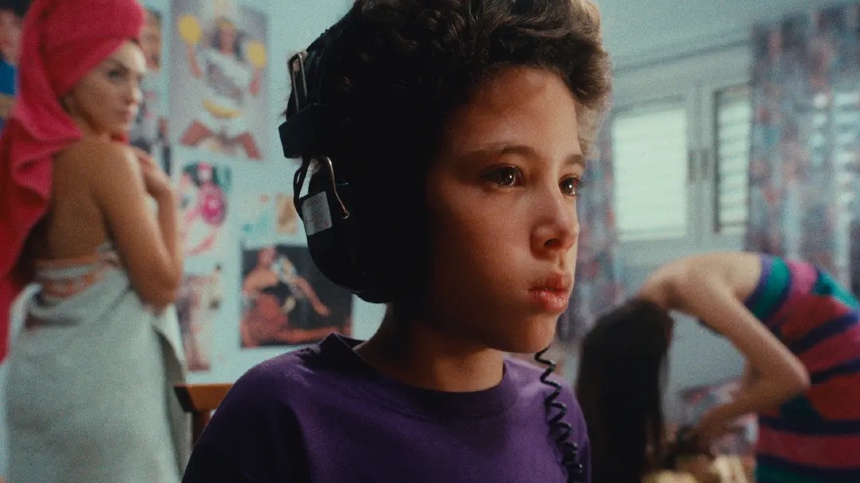
The film opens in 1987, when AIDS is spreading across the US and rumours paint it as highly contagious, particularly among homosexual men; Rock Hudson is cited in a TV report as a cautionary example. Twelve-year-old Boaz (Yair Mazor) lives with his parents, Meir (Assi Cohen) and Bella (Keren Tzur), alongside his two older sisters (Mor Dimri and Neta Orbach). Though the household is often shaken by heated arguments caused by Meir's failing furniture business, the family appears outwardly intact until Boaz uncovers a truth lurking beneath his father's dependable smile.
At a swimming pool, Boaz unexpectedly witnesses his father engaging in an intimate encounter with another man. From that fleeting moment on, misgiving and detestation take root. Through the lens of a child's imagination, Meir becomes a threat, someone who might be carrying an infectious virus capable of destroying the whole family.
The secret does not remain hidden for long. After Boaz confides in his sisters, they follow Meir one night to a secluded forest where gay men gather in secrecy. Fully aware of her husband's sexuality, Bella responds with silence that signals the family's formal collapse. What follows is a determined effort to erase Meir's existence, rendering him an unspoken, symbolic dead figure no longer acknowledged as part of the family.
By 1996, Boaz (Ido Tako) is an awkward young adult working at a gas station, struggling to support both his psychology studies and his now-lonely mother. His sisters have married and moved away, leaving mother and son living together. Years spent in an all-female household seem to shape his emotional development, edging him toward a subtle Oedipal tension. The absence of a father figure continues to hover over him, manifesting as unresolved trauma and internalised homophobia.
These emotions surface violently when Boaz encounters a femme boy and spits at them in a burst of anger and disgust. Yet contradiction lies at the heart of his behaviour: unable to pay his bills and haunted by an unspoken longing to see his father again, Boaz ventures into the forest himself. There, he meets an elderly man who asks only for a hug in exchange for money. In this brief encounter, Boaz releases years of suppressed emotions toward his absent father.
Rosenthal bathes the film in a retro texture, using mosaic imagery and pop music to heighten the atmosphere of the 1980s. One of the film's most striking moments occurs when adult Boaz is struck back in a park. Editor Dafi Farbman cuts to a powerful flashback: Boaz's bar mitzvah, where he coldly rejects Meir, who has come to celebrate but waits outside the house, hopeful and excluded. Set against a rhythmic Greek dance, the moment reframes earlier cruelty as a tragic misalignment of fate rather than simple malice.
Despite these strengths, Tell Me Everything deliberately restrains its dramatic escalation. Key emotional conflicts are repeatedly held back just as they approach full intensity, and several transitions feel abrupt, weakening narrative cohesion. Dramaturgically, the film remains so guarded to the very end, denying itself a final emotional release that might have transformed its accumulated tension into a more resonant catharsis, despite a brief and shallow reconciliation.
Told largely from a young boy's perspective, Tell Me Everything constructs a father figure filtered through memory, fear and misunderstanding. Though it lacks the climactic force one might expect from such material, the film offers a sensitive examination of a father-son relationship shadowed by the AIDS epidemic. It ultimately serves as a quiet reminder to those who remain closeted: when there is someone to love and protect, identity is not something borne alone, but something that can -- and perhaps must -- be shared with those we trust most
The film premiered at the 2026 Sundance Film Festival.