Rotterdam 2026 Review: PROVIDENCE AND THE GUITAR Falls Silent on the 21st Century
Directed by Portugal's João Nicolau, the film enjoyed its world premiere as the opening night selection of the International Film Festival Rotterdam (IFFR).

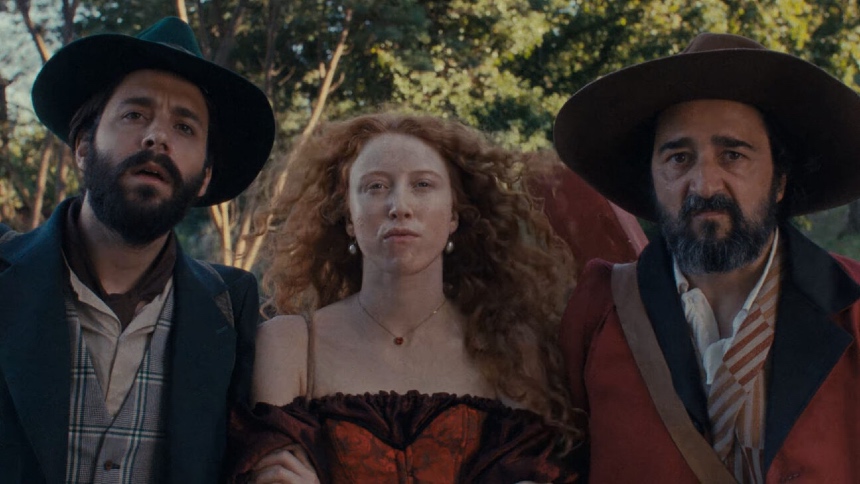
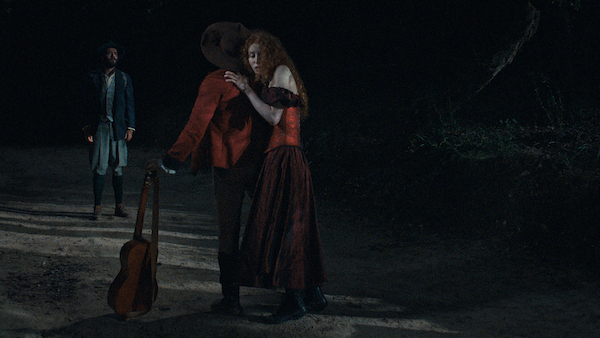
The travelling variety performers Leon (Isac Graça) and Elvira Bertelhini (Jenna Thiam) try to obtain permission to monetize their new theatre piece with a performance in a small town in centralized nineteenth-century France.
A local police commander obstructs them. They are not discouraged and, with the help of a local café owner, persist. Partly out of aversion to the free-spirited nature of their act, the commander takes revenge by shutting down their performance.
They are locked out of their lodging and wander through the night. Along the way they meet a painter and his wife, who live on the edge of subsistence, rival theatre performers, and -- an oddity within this group of romantically inclined bohemians -- a student who plans to become a banker.
So far this follows the film adaptation of Robert Louis Stevenson's 1878 story Providence and the Guitar set in a bureaucratic France. João Nicolau's film, A Providência e a Guitarra, loosely relocates the story -- language is decisive -- to an extended day and night in nineteenth-century Portugal.
Through flashforwards, A Providência e a Guitarra adds a contemporary layer. In the twenty-first century, Leon and Elvira appear as pop musicians. Like their nineteenth-century predecessors, they seem to struggle, though it remains unclear with what. As a result, these passages remain largely incidental: they add little and stay vague both in content and in form.
The twenty-four hours that the Bertelhinis spend in and around a rural town in the nineteenth century function as a pars pro toto for the free-spirited bohemian lifestyle celebrated by Stevenson and thousands of his contemporaries. It represents a sensibility of Sturm und Drang, translated into art as experiment and as a "new beginning." This romantic impulse also lies at the root of modernism and of the twentieth-century ideologies that sought to change everything.
Sturm und Drang belongs to all eras, but -- emerging from the Enlightenment and German Romanticism -- it found its full expression in the bourgeois societies of the last two centuries. Through the flashforward passages in Providence, this sensibility is also projected onto our own time.
The revolt of the 1960s, with modernity, fashionable Marxism, hippie culture, and marijuana as counterforces, still fitted well within the nineteenth-century romantic model. From the 1970s and 1980s onward, however, more and more people -- politicians, artists, and intellectuals -- began to realize that the romantic bohemian oppositions between vocation and humanism on the one hand and money and capitalism on the other were eroding.
Because the film focuses entirely on the nineteenth-century conflict between freedom and poverty versus money and compromise, this very contemporary problem remains out of view: the inflation of freedom and of artistic identity ("Beuys: Jeder Mensch ist ein Künstler").
The flashforwards lack sufficient form and substance to compensate for this omission.
The choice made by the young people in the film is one of unconditional freedom without compromise. The irony is that this is precisely the choice partly made by today's elderly -- the generation of '68 and the punk generation.
Many young artists today realize that this choice is a false one. Being an artist is not a way of life, but a way of thinking, acting, and doing that does not necessarily have to be ideological. When it does become a way of life, this is either coincidental or -- as many Iranian filmmakers currently experience -- the result of political circumstances.
It is worthwhile that Providence and the Guitar / A Providência e a Guitarra provokes such reflections, but the central question the film raises is outdated. Not so much in its content, but because it fails to find a contemporary counterpart. As easily as Providence and the Guitar finds words through Stevenson to interrogate the nineteenth century, so struck dumb the film remains about the twenty-first century. That is a missed opportunity.
The film premiered at the 2026 International Film Festival Rotterdam.