Tallinn 2025 Review: THINK OF ENGLAND Dramatizes Britain's Attempt to Boost Morale with State-Mandated Porn Films
Richard Hawkins' film moves from period workplace comedy, rooted in the absurdities of producing a pornographic film for the war effort, toward a psychological drama shaped by mounting instability.


British filmmaker Richard Hawkins returns after a two-decade hiatus with Think of England, a period drama built around a wartime assignment that is both practical and quietly destabilizing. A small group of civilians and conscripts is dispatched to a remote Orkney outpost to produce pornographic films, commissioned to boost morale on the eve of the Normandy landings.
Hawkins presents the premise without sensationalism and frames it as an extension of the Ministry of Information’s propagandistic logic. The film is based on an actual wartime initiative and carries clear relevance for the present, particularly in its examination of propaganda and entrenched masculinity.
Hawkins again works within confined spaces and small ensembles to explore shifting allegiances. The Nissen hut that houses the fictional film unit functions as a controlled environment where collaboration is required yet constantly renegotiated.
Holly Spurring (Natalie Quarry), a dancer and girl-next-door figure conscripted to act, navigates the demands placed on her body while attempting to retain a measure of agency. Corporal Evans (Jack Bandeira), a damaged former film star, becomes an embodiment of the violence embedded within the mission.
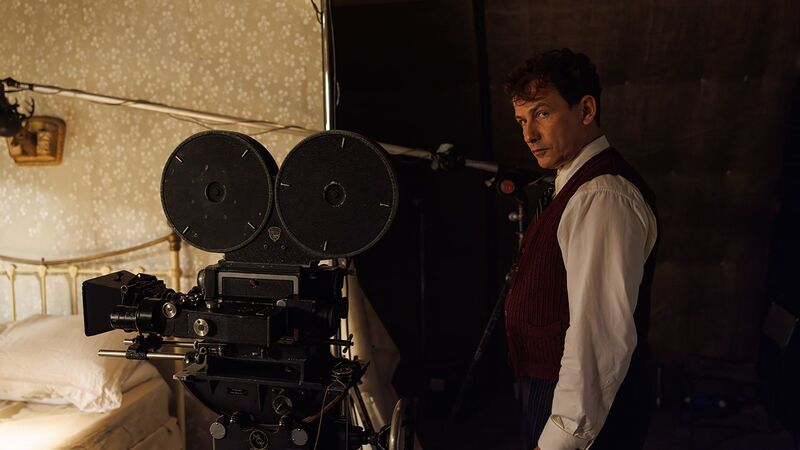
Captain Clune (John McCrea) supervises the clandestine production, although his command style suggests a background in bureaucracy, rather than frontline experience. The filmmaking crew includes costume designer and makeup artist Agnes Dupré (Ronnie Ancona), young sound recordist Clifford (Ollie Maddigan), and German expressionist director Max Meyer (Ben Bela Böhm), hired to direct the state-approved material on the strength of his prewar credits with Marlene Dietrich.
Evans emerges as a volatile counterweight to Clune. His suppressed impulses quickly surface, creating pressure within the group and jeopardizing the operation. Each of the six participants has been coerced into the assignment for different reasons.
Hawkins, who co-wrote the script with Geoffrey Freeman, shapes the film as an ensemble chamber piece, most of it staged within a large barn doubling as a studio. The participants’ individual fates become enmeshed on set. Clune attempts to project authority and highlight the mission’s contribution to the Allied cause.
Spurring hopes to use the assignment as a professional turning point. Meyer, a Jewish refugee, is also attempting to rebuild his life, although not in artistic terms.
Agnes Dupré and Clifford, initially supporting figures, come into fuller focus in the final act when the situation unravels. While most of the group attempts to cooperate, Evans proves increasingly difficult. His sadistic outbursts threaten not only the mission but the safety of the others.
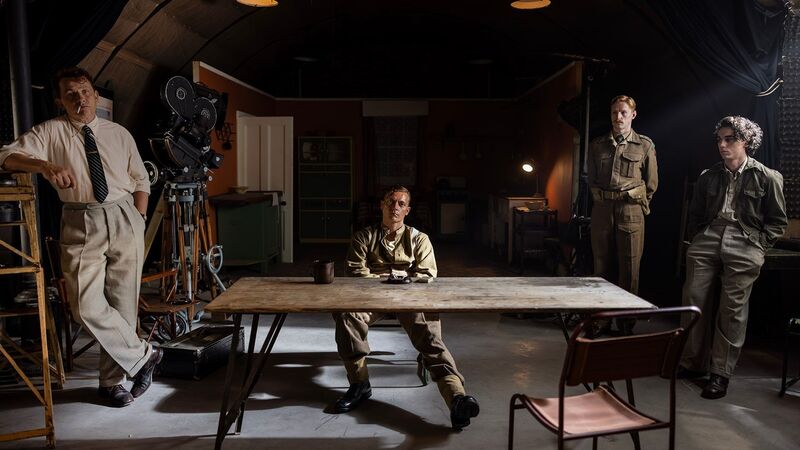
Marketed as a satirical drama, Think of England resists that categorization. It begins in the register of a WWII workplace comedy, with discussions of nudity, choreography and technical logistics situated within a military context. The humor largely arises from the use of period social conventions in service of a pornographic premise. Yet the film gradually shifts toward psychological drama once Hawkins engages more directly with Evans’s PTSD-inflected instability.
The darker turn occupies much of the second half. The chamber structure might arguably be more effective on stage, where the pressure-cooker dynamic could retain tighter focus. Hawkins introduces a parallel plotline in which Evans periodically goes AWOL to torture a captured German soldier who has arrived on the island.
This subplot feels extraneous and diverts attention from the internal tensions on the set as the group attempts to complete the films. The middle section lacks definition and momentum until the story enters an action-driven final act filled with revelations, some tipping into melodrama.
The material is compelling, yet the execution remains uneven. A different sensibility perhaps closer to Martin McDonagh’s approach might have yielded a sharper result, although Hawkins’s intentions are clear and consistent but the film is overlong for the substance that it presents.
Think of England opens with an intriguing promise and a WesAndersonian aesthetic, yet the suggested satire never fully develops, as the comical premise is gradually overshadowed by Evans’s PTSD and his drift toward instability. The final revelation about how the mission concludes plays less as a joke than as a pointed reflection on incel psychology in military.
The film’s most comical touch arrives in the end credits, which outline the later fates of each participant, ranging from unlikely careers in pornography to a future linked to the German AfD, offering a juicy coda to the group’s experience.
Think of England won the Best Production Design Award at the 29th Tallinn Black Nights Film Festival.
Think of England