Tallinn 2025 Review: BLINDSIGHT Retools the Amnesia Narrative Through Immersive Experience and Storytelling Rug Pulling
Adrian Sitaru´s latest work employs first person immersion to build a narrative puzzle that shifts into the register of a 'Black Mirror' episode, revealing a film with far more layers than its early realism and family drama implied.


Romanian auteur Adrian Sitaru returns after a longer hiatus with the feature Blindsight. His work has long examined moral uncertainty, and the tension between personal ethics and social pressures.
Across features such as Best Intentions and Illegitimate, he often puts characters in situations where ordinary behavior becomes ideologically charged. The Fixer signaled a temporary departure from the tone of his earlier films. While Blindsight does not continue that trajectory, it still marks a shift, moving away from the concerns associated with the New Romanian Wave and toward current trends in globalized filmmaking.
Blindsight unfolds largely from the first person perspective of Laura (Ioana Flora), who suffers from amnesia. The story opens during a family discussion at her grandmother’s birthday, where Laura, her husband Ovidiu (Bogdan Albulescu), their thirteen year old son Andrei, her sister Simona (Cosmina Stratan) and Simona’s soon-to-be-husband Sabin (András Buzási) debate a planned trip to Turkey by open sea.
The goal is for Andrei to receive treatment for his congenital blindsight before losing his vision entirely. Laura, struggling to grasp the situation, hesitates in ways that unsettle the expected mother-child bond, which heightens the tension around a decision the family considers nonnegotiable. In addition to amnesia, she is dealing with depression following the accident that caused it. Matters escalate after Ovidiu reveals that they are all implicated in a robbery to finance the procedure.
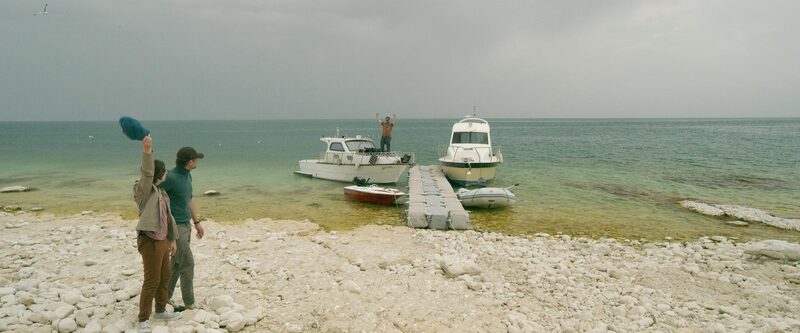
The extended opening scene takes place entirely in a garden gazebo. Everything is seen through Laura’s eyes, including her blinking, which functions as a form of concealed editing that introduces jumps within the conversation.
Sitaru employs an unreliable narrator to build a puzzle narrative in which the blink edits signal memory lapses and blind spots in Laura’s perception. A few blinks later, the group is on a bleak beach preparing for a semi illicit sea crossing.
Sabin attempts to reassure the others about the legality of the trip by bringing along a cage of live minks intended to placate potential border police. This underplayed comedy threads through the film, which evolves into a melancholic tragicomic road movie shaped by Laura’s shifting cognitive capacities. Early obstacles include an overloaded boat that nearly leads to the family dog Leggy being cast overboard, one of several moments that verge on sitcom territory, albeit with lighter shades of Yorgos Lanthimos' sadistic humor.
The journey into Turkey continues through mountains, an old monastery and peripheral villages. Laura grows increasingly detached, reacting unpredictably to her ailing son, her husband and another traveler they pick up on the road, Katerina (Virginia Rusu).
Notably, Katerina is the only character with whom the first person viewpoint occasionally shifts, allowing brief external glimpses of Laura that reveal her confusion and hesitation. Various signs point to an as yet undiagnosed condition that shapes her behavior.
Sitaru avoids the usual clichés attached to amnesia storytelling. A submerged trauma gradually surfaces and may clarify Laura’s state of mind. The puzzle structure is interrupted at times by extradiegetic computer glitches that seem incongruous for what initially appears to be a tragicomic story about a family seeking medical treatment for a child.
These moments quietly prepare the ground for later turns. Blindsight eventually introduces twists closer to speculative fiction than the family drama it first appears to be.
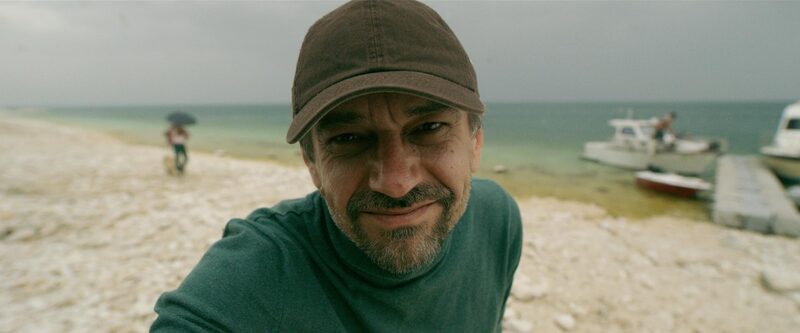
The film diverges from Sitaru’s earlier work, even as it retains a strain of tragicomedy and dark humor. Its structural and formal choices, particularly the fragmentation tied to Laura’s fractured memory and reconfigured identity, give the narrative momentum through an incremental destabilization rather than a climactic revelation.
Adrian Silișteanu’s cinematography remains immersive, which makes the rare perspective shift to Katerina feel deliberately disorienting. Editor Alex Pintică ensures smooth transitions. Although many scenes unfold in long takes, the more dynamic moments rely on blink edits and memory lapses to create cuts and time jumps.
Sitaru’s latest film moves further from the formalism of New Romanian Cinema and is more unfluenced by videogame aesthetics and its narrative practices. While the tragicomic tone, melancholic traces and darker humor remain, Blindsight appears to be desgined for global audience. Once its concealed genre layer is revealed, the film invites reassessment and seems poised for discovery on VOD platforms.
In effect, Blindsight functions as a Romanian take on a Black Mirror episode in feature length form. Sitaru is less openly cynical than Charlie Brooker, yet maintains empathy for his conflicted protagonist, and the central subject ultimately exceeds the psychological and social framework established into a story that is both touching and quietly devastating.
Adrian Sitaru won the Best Director Award in the Rebel With a Cause Competition at the 29th edition of the Tallinn Black Nights Film Festival.