New York 2025 Review: THE FENCE, Commercial Colonialism, Filled With Sensuality and Lyricism
Matt Dillon, Tom Blyth and Isaach De Bankolé star in Claire Denis' new film.

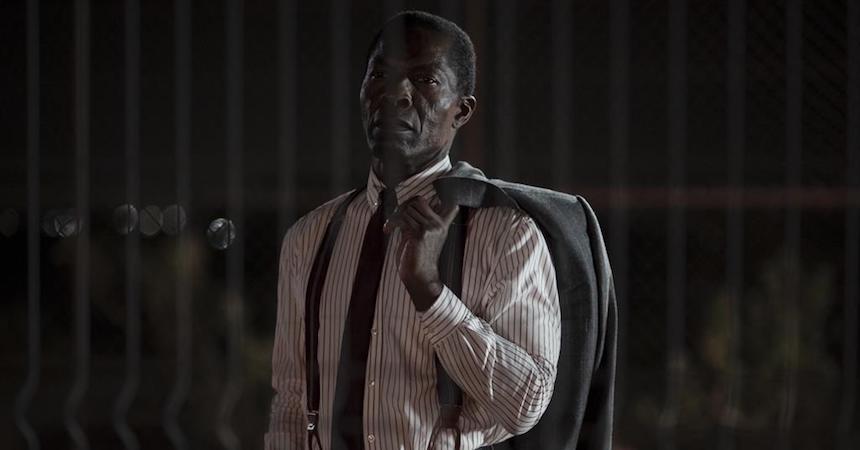
Taking place in one night, Claire Denis's new film The Fence charts both familiar and new territories for the 77-year old master filmmaker. Set in a fenced and heavily guarded industrial factory in an unnamed Western African country, The Fence once again invokes Denis's continued interests in post-colonial Africa (due to her upbringing in Cameroon) then and now.
Matt Dillon plays Horn, a grizzled foreman of the factory, who is in charge of the workers. Except for his young lieutenant Carl (Tom Blyth), all workers and guards in the compound are Black. Earlier in the day, a Black worker died in an accident. And the victim's brother Alboury (Isaach De Bankolé) appears outside the fence, to claim his brother's body.
But Horn has a lot on his plate: it's the eve of the handover, a Chinese company is taking over the ownership in coming days, and his newly wedded young wife Leonie (Mia McKenna-Bruce) is soon arriving from Britain. He tries to wave off the grieving brother by offering money, also utters thinly veiled threats of violence, but Alboury won't budge from the spot until he gets the body of his brother back.
Through several tension-filled exchanges between Horn and Alboury, we gather that Horn is deliberately delaying the release of the body, that the death wasn't really an accident and hot-headed Carl was directly responsible for the death. It becomes pretty clear that Horn is not only covering for his company, but also protecting Carl, that there is something more than a boss-worker relationship between them.
To make matters worse. Leonie arrives in her high heels with big luggages. At first naive and innocent, Leonie catches on quickly with the tension filled surroundings. Something is not right: it's not only no air conditioning and a shared bathroom, but the fenced off compound doesn't feel safe, despite her husband's repeated assurance.
From her debut film Chocolat, Beau Travail to White Material, Denis examined the colonization and its aftermath of the African continent by white Europeans. Entitlement, guilt, violence and eroticism were all there. Then she made films depicting the African diaspora experience in No Fear, No Die, I Can't Sleep and 35 Shots of Rum with her trademark grace and sensuality.
With The Fence, (shot by veteran French cinematographer Eric Gautier, their third collaboration after Both Sides of the Blade and Stars at Noon), the political message here is much more blunt. In the beginning of the film, there's a surreal sequence of a vicious dog biting the flesh off of a human with his brain exposed.
The film is based on Bernard-Marie Koltès's play Black Battles with Dogs. Bankolé addresses the audience directly, breaking the fourth wall, “Every White man’s dream.”
Matt Dillon, who became a European cinema darling recently, is here working with Denis for the first time. He makes a perfect white American company man.
Tom Blyth is great as a volatile young man, and so is McKenna-Bruce as a quick witted gold digger thrown into the tense situation that she has no business to be part of. But it’s Denis’ frequent collaborator De Bankolé’s towering presence that makes the mark as the grieving brother of the deceased, who knows that the death wasn’t an accident. His weathered face and dignified stare speaks volumes alone.
The rich minerals needed for everything from smart phones and computers to nuclear weapons attract global conglomerates. This time, the African continent in the 21st century is under commercial colonialism. Appeasing the local population is not the company policy.
With the primary actors engaging in long dialog as if it is a stage play, the dialog in The Fence seems a little stilted and on the nose. But it makes the point come across more clearly. It’s a film that is more direct in messaging, while retaining the sensuality and lyricism Denis is known for.
The Fence plays as part of the New York Film Festival on October 5, October 6, October 9 and October 11. For more info, please click here.
Dustin Chang is a freelance writer. His musings and opnions on everything cinema and beyond can be found at www.dustinchang.com