
Toronto 2025 Review: THE WIZARD OF THE KREMLIN Whispers the Secrets of Russkiy-Mir

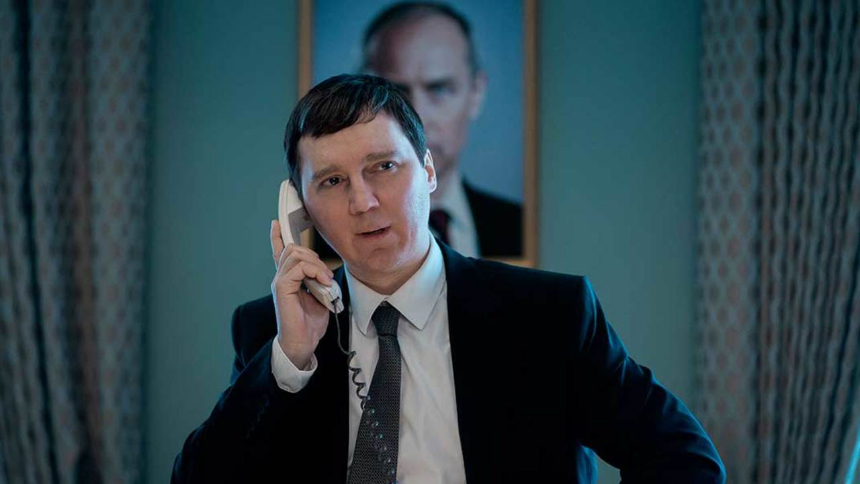
Vadim Baranov was an artist among politicians, and a politician among artists during the tumultuous times of the late 20th century and early 21st century Russia. The son of a high ranking Soviet academic (who burned out and faded away with the Soviet Union) he came of age during the collapse of the USSR working as an avant garde theatre director and writer, alongside the rise of the gangster-oligarchs, at a time where everything in Moscow was both collapsing and being rebuilt at the same time.
Played by Paul Dano, an actor who frequently takes parts in which his characters have the crap kicked out of them, his slick demeanour, with a measured understatement here, is a different kind of flavour. It is a welcome one. He is a cool customer. You might want to punch him in the face, as an audience member, but the The Wizard of The Kremlin is his story (itself a rough analog of the real-life Vladislav Surkov) as told, by him, to an American political writer Rowland (Jeffrey Wright) at a snowy rural country estate, where Baranov has retired early.
He could be an unreliable narrator. In fact, he probably is. Power dynamics reminiscent of Errol Morris interviewing John le Carré in The Pigeon Tunnel ensue as Baranov quickly establishes control of the conversation by showing Rowland some political trophies. These include a historically significant letter to Stalin, and his impressive library, where Baranov makes a point of saying that he does not collect books, he reads them. Baranov’s daughter plays, out of frame, somewhere else in the home, heard, but not seen.
Adapted from award-winning novel by political essayist Giuliano da Empoli by Olivier Assayas, the director himself is no stranger to lengthy epics (Carlos, Wasp Network), long-form journalism (he worked for Cahiers du Cinéma before making movies) and complicated relationships (he was married to filmmaker Mia Hansen-Løve, as well as international superstar Maggie Chung). His film is very much a tell-and-show kind of affair. It essays the rise of new money and new media in Russia. It provides the context for which the stage was set for Vladimir Putin to fill the vacuum of power left behind from an increasingly drunk and frail Boris Yelchin government, and firmly bend Russia to where it is in now.
While I have not read Empoli’s novel, I have no doubts it is dense, rich in minute detail, and analytical. The film, even at nearly 3 hours in length, plays as more of a prestige magazine piece. How could it not? Adapting short stories or novellas into films is challenging enough, and covering nearly 40 years - from the tail end of Perestroika to moment before Covid-19 - is a daunting task. This is far from a knock against the film, or even a criticism against violating one of the cardinal rules of cinema storytelling (“show don’t tell”). The Wizard of The Kremlin is intentional as it settles nicely into the subdued cynicism and inevitable downward spiral into apathy that is often a hallmark of Russian society. Particularly so, when framed from those containing Russian imperial expansion.
Over the course of Baranov’s story, Rowland often interjects with the western point of view on of key incidents, including the sinking of the Kursk, The Sochi Olympics, the Orange Revolution at the Maidan in Ukraine, and the sniping of protesters by the ‘little green men’ that followed in the ensuing decade. Baranov speaks in pithy truisms and calculated irony, as Assayas cuts rapidly across time in a mixture of real media footage, and lengthy flashbacks.
Baranov outlines his own fall from a young idealist on Russia’s newfound chaotic freedom, to an architect of the restoration of “Vertical Power” with Vladimir Putin, and the rise of a new kind of addictive and idiotic propaganda which is a mixture of news panels, reality TV, and weaponized emotional trash that follows the Russian thesis that “There is no bloodier dictator than the people themselves.”
Putin is essayed here by Jude Law. The actor has been undergoing a kind of chameleon renaissance (see also his Nick Offerman-esqe FBI-man in The Order). At the turn of the century, a time when the ex-KGB, former FSB-operative still had thin brown-blonde hair, Law’s expressive eyes and contained body language offers a burning charisma. His portrayal is not exactly the leaning back in a chair, with dead shark-like eyes, that I have observed from his appearances in western media (recently opportunistically mugging on the red carpet and podium with Trump in Alaska), but Law gives a kind of verisimilitude for this story. After all, Baranov’s mandate from the newly formed TV Network is to stop making up stories and start inventing reality.
Played by Paul Dano, an actor who frequently takes parts in which his characters have the crap kicked out of them, his slick demeanour, with a measured understatement here, is a different kind of flavour. It is a welcome one. He is a cool customer. You might want to punch him in the face, as an audience member, but the The Wizard of The Kremlin is his story (itself a rough analog of the real-life Vladislav Surkov) as told, by him, to an American political writer Rowland (Jeffrey Wright) at a snowy rural country estate, where Baranov has retired early.
He could be an unreliable narrator. In fact, he probably is. Power dynamics reminiscent of Errol Morris interviewing John le Carré in The Pigeon Tunnel ensue as Baranov quickly establishes control of the conversation by showing Rowland some political trophies. These include a historically significant letter to Stalin, and his impressive library, where Baranov makes a point of saying that he does not collect books, he reads them. Baranov’s daughter plays, out of frame, somewhere else in the home, heard, but not seen.
Adapted from award-winning novel by political essayist Giuliano da Empoli by Olivier Assayas, the director himself is no stranger to lengthy epics (Carlos, Wasp Network), long-form journalism (he worked for Cahiers du Cinéma before making movies) and complicated relationships (he was married to filmmaker Mia Hansen-Løve, as well as international superstar Maggie Chung). His film is very much a tell-and-show kind of affair. It essays the rise of new money and new media in Russia. It provides the context for which the stage was set for Vladimir Putin to fill the vacuum of power left behind from an increasingly drunk and frail Boris Yelchin government, and firmly bend Russia to where it is in now.
While I have not read Empoli’s novel, I have no doubts it is dense, rich in minute detail, and analytical. The film, even at nearly 3 hours in length, plays as more of a prestige magazine piece. How could it not? Adapting short stories or novellas into films is challenging enough, and covering nearly 40 years - from the tail end of Perestroika to moment before Covid-19 - is a daunting task. This is far from a knock against the film, or even a criticism against violating one of the cardinal rules of cinema storytelling (“show don’t tell”). The Wizard of The Kremlin is intentional as it settles nicely into the subdued cynicism and inevitable downward spiral into apathy that is often a hallmark of Russian society. Particularly so, when framed from those containing Russian imperial expansion.
Over the course of Baranov’s story, Rowland often interjects with the western point of view on of key incidents, including the sinking of the Kursk, The Sochi Olympics, the Orange Revolution at the Maidan in Ukraine, and the sniping of protesters by the ‘little green men’ that followed in the ensuing decade. Baranov speaks in pithy truisms and calculated irony, as Assayas cuts rapidly across time in a mixture of real media footage, and lengthy flashbacks.
Baranov outlines his own fall from a young idealist on Russia’s newfound chaotic freedom, to an architect of the restoration of “Vertical Power” with Vladimir Putin, and the rise of a new kind of addictive and idiotic propaganda which is a mixture of news panels, reality TV, and weaponized emotional trash that follows the Russian thesis that “There is no bloodier dictator than the people themselves.”
Putin is essayed here by Jude Law. The actor has been undergoing a kind of chameleon renaissance (see also his Nick Offerman-esqe FBI-man in The Order). At the turn of the century, a time when the ex-KGB, former FSB-operative still had thin brown-blonde hair, Law’s expressive eyes and contained body language offers a burning charisma. His portrayal is not exactly the leaning back in a chair, with dead shark-like eyes, that I have observed from his appearances in western media (recently opportunistically mugging on the red carpet and podium with Trump in Alaska), but Law gives a kind of verisimilitude for this story. After all, Baranov’s mandate from the newly formed TV Network is to stop making up stories and start inventing reality.
Scattered among the historical travelogue, is Baranov’s on-again, off-again relationship with an artist turned conspicuous consumer and occasional social climber, Ksenia, whom he spots belting out a punk song at a theatre party while walking a barking, naked man on a chain. He later meets her on a yacht off the coast of Cote d’Azur. Monkey-branching from billionaire banker to fossil fuel oligarch before coming full circle to the new political zeitgeist with Baranov. In America, money begets power, in Russia, power begets money. The Wizard of The Kremlin is a film about how power cannot be controlled, but can be managed - for a time.
There is something deeply fascinating to me about the push-pull of the American-European point of view, and the Russkiy-Mir point of view, which Assays is juggling here, with care that is sublte enough to be overlooked.
A telling exchange from Rowland to his host, asking about what secrets Baranov knew in regards to the many defenestrations, assassinations, and corruption he threaded his media and political own career through that particular needle (including Yevgeny Prigozhin’s Internet Research Agency, which makes a cameo) and found voluntary retirement in the country with Ksenia and his daughter The response: “If this is a bonafide secret, thank god nobody shared it with me.” Assayas whispers secrets into the audience’s ear in a sly way. In Moscow, things can go pretty well, but when they go badly, they go really bad.
There is something deeply fascinating to me about the push-pull of the American-European point of view, and the Russkiy-Mir point of view, which Assays is juggling here, with care that is sublte enough to be overlooked.
A telling exchange from Rowland to his host, asking about what secrets Baranov knew in regards to the many defenestrations, assassinations, and corruption he threaded his media and political own career through that particular needle (including Yevgeny Prigozhin’s Internet Research Agency, which makes a cameo) and found voluntary retirement in the country with Ksenia and his daughter The response: “If this is a bonafide secret, thank god nobody shared it with me.” Assayas whispers secrets into the audience’s ear in a sly way. In Moscow, things can go pretty well, but when they go badly, they go really bad.
The Wizard of the Kremlin
Director(s)
- Olivier Assayas
Writer(s)
- Olivier Assayas
- Emmanuel Carrère
- Giuliano Da Empoli
Cast
- Paul Dano
- Alicia Vikander
- Tom Sturridge

Do you feel this content is inappropriate or infringes upon your rights? Click here to report it, or see our DMCA policy.


