Toronto 2025 Review: LEVERS, Perhaps the Unknown Will Save the World

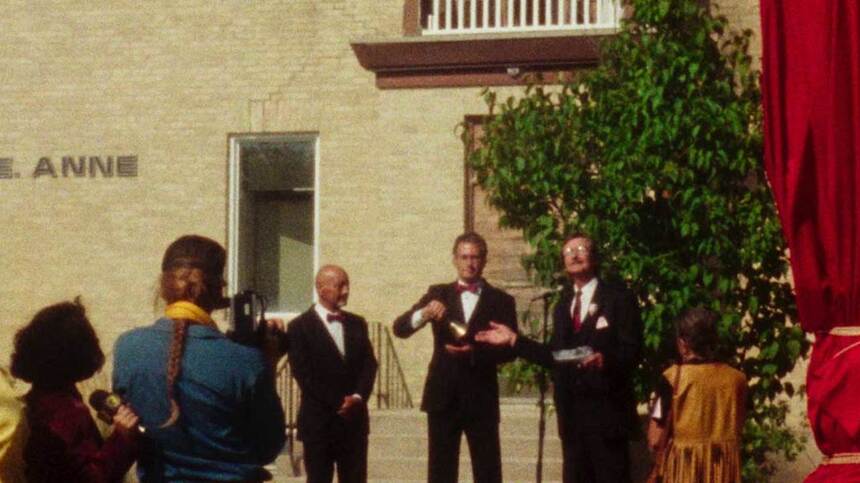
A community gathers to celebrate the unveiling of a public sculpture. The artist is thanked, the significance recognized, the head of the local arts council praised for her efforts in making this moment happen. But it seems a moment of surreal calm, which turns out to be prophetic. Some time later, a great bang shakes the land, and the sun disappears for a day. And when it returns across the earth, something has shifted.
Rhayne Vermette, whose first feature Ste. Anne, an experimental drama set in her home province of Manitoba that won Best Canadian Feature at TIFF in 2021, returns to the festival with another strange odyssey in Levers. There must be something in the water or wind in that province that creates filmmakers that tap into the holy weird of human consciousness, as Vermette uses this unfathomable cosmic event as a metaphor for all that might seem unfathomable, but ultimately eerily possible.
The film begins with a quote from musician and philosopher Sun Ra, on the future and how it will be shaped. In essence, we do not know. In a world, especially right now, that seems to be coming apart (or more accurately, being torn apart) at the seams, we might think we can choose a few different ways civilization as we know it might end. And we're all waiting for that blast, and what Vermette presents us with is truly terrifying: an Earth only lit by artificial light (no moon or no stars, it would seem, can penetrate this dark). And while in this story it only lasts a day, even the news report that the people of the community watch, when announcing the sun finally rising off the coast of Australia, speaks of the event as if the planet was in darkness for an unspeakable time.
And yet, the community of this unnamed corner of Manitoba seems unfazed — at least at first. After all, as a northern community, there are used to darkness, cold, and snow that can last for days. As an indigenous community, they have already experienced an apocalypse that forever changed their civilization. So at first it seems like they adjust quickly to both the lack of sun, and its return. But cracks seem to form in the psyche of the people, seen in individuals at first, but then as it spreads, in everyone and everything, like a slow-moving fog.
The story is set in 1982: he cold war is in its last years, but the danger still exists; the world is on the brink of the AIDS crisis. But what stands out in how this is presented, is in the technology while they are electronic devices aplenty, there is still that analog feel: electric typewriters, intercoms with big buttons to push, beige kitchen wall telephones with grey button, the kind you could 'rent' or buy cheap from Bell Canada.
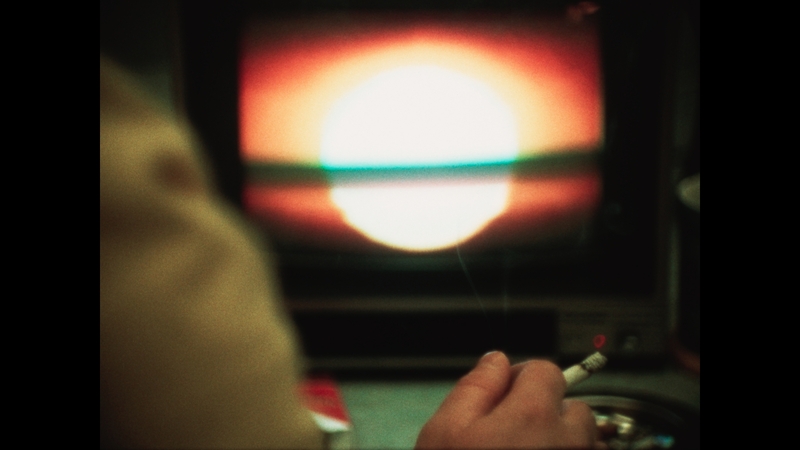
All of this emphasizes that existence, even if somewhat automated still requires a certain level of physical labour. Even the tube television requires the turning of a dial to watch or change a channel. Adding to this, the film is interspersed with tarot card-like drawings ('the sculptor', 'the river', 'the sun'), indicating, perhaps not the main focus of the following scene, but something that provokes it. Again, these images, made to look hand-drawn (likely coming from hand-drawn work) speak to labour and craft, the work of being alive, the efforts that come from love and need to keep us not just surviving, not just existing, but growing and evolving.
Vermette and her team (for the cast and crew wore many hats, as the credits attest) made this with (apparently broken) Bolex cameras, in-camera FX, sound-only takes, and a production budget of under 500K. It's not just the medium that's the message, but the method as well, cannot be separated from the story. regular readers will sense a pattern in my love for this kind of print film that adds texture, that speaks to the kind of close physical labour of 'smaller' projects and how they can contain such a wide universe in a seeming small space.
But then if we can say a single person is a world, so is a community a universe, and the land they inhabit as living as they are. There are strange lights now, not just in the sky but in the air. The civil servant is trying to discover what has happened to an important project; the sculptor has reached a state of desperate ennui. As it's never discovered why the sun disappeared for the day, it's never known exactly what is happening in this community, as if the sun's absence has left the universe slightly out of alignment, and humans (and possibly animals) have not yet adjusted. As each chapter unfolds, the deck slowly reveals itself as a puzzle in which the pieces could fit in a variety of ways: it's just not clear which way is what is necessary at this moment.
Levers is something of an enigma, but that is what suits its slippery, hazy narrative that asks us to question how to look and move through the world when we must rethink how we encounter it. Mostly, it looks to a communuity to understand how that realignment must take place, with the knowledge that the unknown is upon us, and a different (or perhaps renewed) kind of labour is necessary to carry through it.
Levers
Director(s)
- Rhayne Vermette
Writer(s)
- Rhayne Vermette
Cast
- Val Vint
- Andrina Turenne