Toronto 2025 Review: HEDDA, Bringing Lust Back to Period Drama
Tessa Thompson, Nina Hoss, and Imogen Poots Star in Nia DaCosta's Adaptation of the Norwegian Drama

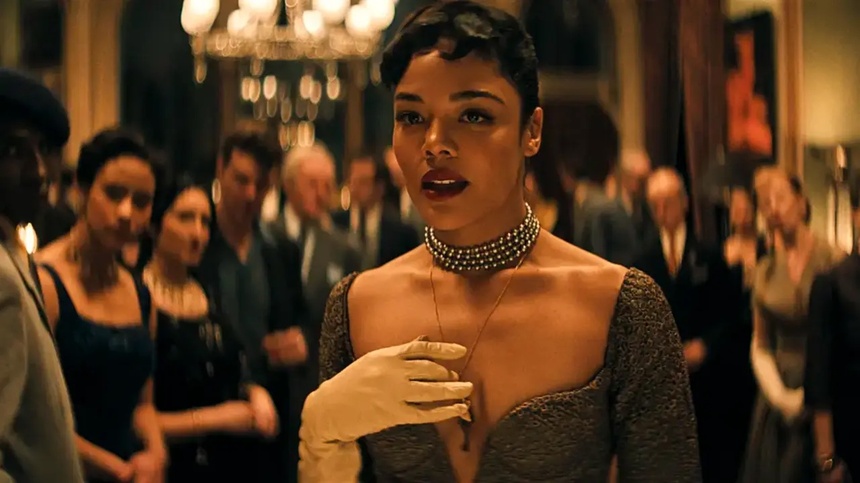
Back in my teenage theatre kids days at an arts high school, there was rarely a more coveted role for a girl student than Hedda Gabler. The eponymously-named play by Norwegian writer Henrik Ibsen featured this fantastic character: strong, independent, forced to begin shrinking in on herself by a marriage of convenience and a society that still limited exactly how much a woman could express herself. It's a mainstay of theatre companies around the world, given how the subject matter still resonates.
It's not hard to understand why Nia DaCosta (Little Woods, The Marvels, Candyman) would be attracted to this work, given its importance in drama history and the roles it offers for at least three women. But DaCosta smartly ups that ante: she moves it from Norway on the eve of the turn of the century, to England post-WWII, and makes Hedda's love interest a woman as well. So now we have an era where women were starting to make inroads in intellectual professions, and many women would, if not be open then at least not completely hide away, the love that dare not speak its name. Hedda finds energy, anger, and, yes, a whole lot of horniness, to this drawing room drama.
The plot remains more or less the same as the play. Hedda (Tessa Thompson) has recently married George (Tom Bateman), it seems more to secure a certain kind of lifestyle than out of love. George has ambitions as an academic and author, and he and Hedda through a wile and extravagent party with money they do not have, in order than he might impress his superiors. But into this soirée walks Eileen Lovborg (Nina Hoss), who has her own academic and literary ambitions, and as it turns out, was once Hedda's lover. Eileen and her new protégé/lover Thea (Imogen Poots) have co-written a book on sexuality, and Eileen has brought her only copy to try and upstage George and win a coveted position for herself.
The film opens on two different moment with Hedda: she is being interrogated by the police regarding a shooting in her home, and she comes out of a swimming pond on her property, dropping stones at her feet. We won't know until later in the film, in which order these moments occured, but it proverbially wets our appetite for how Hedda came to this point. We then see her preparing for the party, checking on food and drink as overseen by her faithful housekeeper Bertie (Kathryn Hunter, who as always, steals the few scenes she's in), and assuring her husband that he, and this party, will be exactly what propels them into the high society of which Hedda desperately wants to be a part.
Since Hedda looks divine, and she’s invited all the best people to her lavish home for a flawless evening and fun and frivolity, of course, something will go wrong. The first fly in the ointment is the arrival of Thea, looking for Eileen. Thea is mousy and bland compared to the sensual perfection that is Hedda, and Hedda makes sure to emphasize that by putting her into an evening gown that ill suits her. Then, just as the party is really getting started, that’s when Eileen arrives. Tall and glamorous, she might physically tower over Hedda, but it’s clear that the latter was in control of that relationship, and the sparks between them could burn down the world.
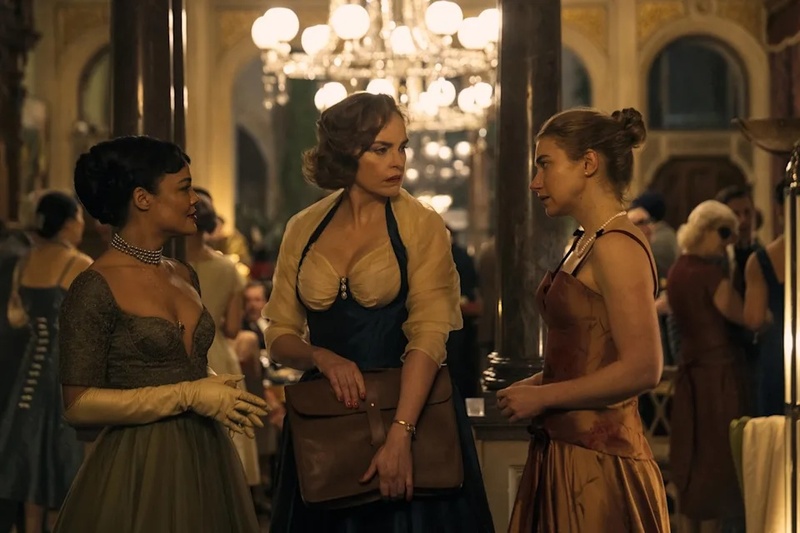
Hedda, the daughter of a famous General, likely used to a certain life that gave her monetary satisfaction and allowed her to pursue love and sexual relationships she wanted, now must use her very strong feminine wiles to help retain a certain standing, and keep her husband’s reputation growing. She must always be a few steps ahead of those who would stand in her way. While she has chosen the role of wife, Eileen has chosen to follow her career. Even though women have suffrage, more women were going to university at that point, Eileen knows she has to prove herself constantly, has to not only match these men, but outsmart them; even if it means that George, and by extension Hedda, will suffer as Eileen succeeds.
DaCosta keeps the plot and characters moving like quickly-played game of chess between equally matched players: intense, more than a little (read: very) erotic, and even though it should only end in a stalemate, in the end there must be a winner. Even if we can guess the next move, it’s an enjoyable guess, as we wait with tingling anticipation to see what Hedda will do to thwart Eileen, or vice versa, or if they will end the tension between in the best way they know how.
While it could go without saying that the cinematography by Sean Bobbit (12 Years a Slave) is gorgeous, as to be expected of a period film, it should be said. It’s not just about making the film look good, it emphasizes both the grandeur of the space and the tightness of the tension between the characters, making us feel like we might be a guest at this party, champagne in hand, eavesdropping on these scandalous conversations. This is matched by production designer Cara Brower (Us) making the furnishings and decor not just period-specific, but showing how Hedda has gone to so much trouble to make it seem like she is far richer than she is.
Thomson doesn't just light up the screen, she devours it, either as Hedda quietly plays her proverbial pawns or rooks, or with a desperate appetite. To this is matched a score by composer Hildur Guðnadóttir that is attuned to Hedda's various movements, as she changes her strategy moment by moment. Hoss plays Eileen as the kind of early-era power lesbian who knows her own worth, is not afraid to show who she is, but also knows who she is could be struck down on a man's whim, and her own lust for Hedda could still overcome her better judgement. As they circle each other, as George begins to fumble his opportunity, as the party gets wilder, as Hedda gets more desperate that her plan to be at the top of the social hierarchy starts to fall apart, she's pushed into a corner from which only a very inadvisable action might save her.
A sultry and vibrant story of repression and desire, DaCosta smoothly and smartly brings Hedda into the 20th century and shows how its story of women's ambition and men's power still reflects and resonates.
Hedda
Director(s)
- Nia DaCosta
Writer(s)
- Nia DaCosta
- Henrik Ibsen
Cast
- Imogen Poots
- Tessa Thompson
- Tom Bateman