Toronto 2025 Interview: TO THE VICTORY!, Valentyn Vasyanovych Talks Dystopian Comedy, Wartime Filmmaking, His Lead Role

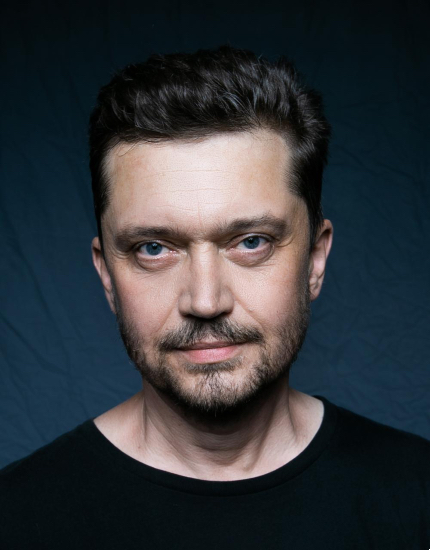
Ukrainian auteur Valentyn Vasyanovych once again turns the camera inward, this time quite literally in his latest work To the Victory!.
After Atlantis and Reflection, as well as his work as producer and cinematographer on Myroslav Slaboshpytskiy’s The Tribe, Vasyanovych extends the his ongoing exploration of dystopian futures and war, while introducing an unexpected meta-layer: Vasyanovych himself takes on the lead role.
Set in a near future Ukraine where the war has formally ended but the psychological aftershocks remain, To the Victory! follows a filmmaker stranded between personal loss and national trauma. His wife and daughter have built a new life in Vienna, while he lingers in Kyiv, restless and uncertain, clinging to the belief that things will eventually improve.
Blending scripted structure with improvisational freedom, the film oscillates between melancholy and absurdity, what Vasyanovych calls a comedy about “old fools” struggling with intimacy, masculinity, and survival in a country without women.
Shot with a skeleton crew of six to eight people, the film was realized through a patchwork of Ukrainian emergency funding, personal investment, and Lithuanian co-production. For Vasyanovych and his collaborators, the project became both creative act and psychological lifeline, offering a way to keep working, keep observing, and keep imagining futures, even as reality remained uncertain.
In conversation with Screen Anarchy, Vasyanovych reflects on stepping in front of the camera, the improvised evolution of the script, the fragile networks of financing that made the film possible, and the surprising tenderness that can surface in a country marked by absence.
Screen Anarchy: I was quite surprised myself to suddenly find Valentyn in front of the camera in the main role instead of behind it.
Valentyn Vasyanovich: The idea was to make a kind of meta-film. For me it was strange to step in front of the camera, an unusual place, but I enjoyed it very much. It gave me a lot of pleasure.
What was your initial idea?
Honestly, I don’t really remember what the very first idea was. I think it came when I noticed how my friends and relatives were coming together, and also falling apart. I began to observe divorces, families of close friends breaking down. That was probably the seed of it.
At first, you wanted to work with a professional actor in the leading role. Why did that change?
Yes, initially we had a professional actor in mind. But he was enlisted in the Armed Forces. During his training, we still had time to meet and do some work, but eventually he disappeared for long periods of time. I realized that under these conditions, we wouldn’t be able to shoot the film. So I decided to take the risk and step into the role myself.
Just for context, if you are serving in the army in Ukraine, you only get 15 days of leave per year, which you naturally spend with your family. Shooting a film is simply impossible. That’s why I took responsibility for playing the main character myself.
Was the film based on a written script, or more on improvisation?
The main structure was written in a script, because when we applied for funding, the funds required it. So I was forced to write it. That wasn’t a bad thing, the script gave us a framework.
But many of the best scenes were born on set, when I realized what was missing in the story. For example, our “sex-research” scene with Volodya appeared that way. Of course, some scenes also didn’t make it into the final edit, which is a normal process.
You mentioned financial challenges. Did that lead to the co-production with Lithuania?
I wouldn’t call it just challenges. It was a disaster. The whole European system is built on co-production: both sides must bring something. If you bring nothing, it doesn’t work.
We got some financing from the Ukrainian State Film Agency’s emergency support fund, we invested some of our own money. But we were still short. So I turned to my old friend Marija Razgutė in Lithuania. She spoke with the Lithuanian Film Centre, and they found the project interesting.
Some scenes were shot in Lithuania, for example, the Q&A scene in the cinema hall was filmed there remotely. Some post-production was also done there. We basically gathered peanuts from different sources just to finish the film. It was hard.
You decided to keep working on the film even under such circumstances. Why was that important for you?
For me, it’s a kind of psychological support. When you can focus on something other than what is happening around you, it helps a lot emotionally. It also gave me the chance to spend time with my friends, communicating on a professional level. If you do nothing, it becomes very difficult psychologically.
Even though Ukrainian state film support was not available, we had European funds. And honestly, in this situation, that might even be a good thing. Because if you receive state money during wartime, you face a wave of criticism from society. People will always say, “Don’t fund culture, send everything to the army.” So in this case, it was almost better that our project was financed by European funds.
The project was also important for the crew?
Yes, of course. For the whole crew, it was a form of psychological support. Instead of sitting at home endlessly checking Telegram channels for news, people could meet, communicate, share what was happening in their lives. It was a big support.
And another thing, we are proud. I think this is probably the only Ukrainian arthouse fiction film made during the war without state support. It’s an almost impossible task. Of course, some commercial films are produced, comedies, horror films, but in terms of arthouse, this is rare. So we’re proud we managed to do it without government money.
You are known as a cinematographer. Do you think directing and screenwriting came as a result of the situation in Ukraine, or would you have gone down that path anyway?
No, it’s not because of the war. I just enjoy it. This is the most important part of my life. I like to control the process as much as possible. When you work alone, with some help, you can often achieve better results.
If you try to pass on your visual ideas to someone else, you risk losing part of the meaning. But when you look for the images yourself, even bypassing the rational analysis, you can reach your vision more directly.
I enjoy every stage of production and get great satisfaction from it. That said, on this film I worked with a cinematographer, Mykhailo Lubarsky, who is a good friend. It was easier and more pleasant to share the work with him.
So it’s not just about limited resources, but about creative control?
Exactly. It’s natural for me to want to create, direct, and shoot. But with Mykhailo it was wonderful to share, because he has his own vision and contribution, and I trusted him completely.
The film feels like fiction, but also has a strong autobiographical tension. How do you see it yourself, as a personal story or purely fictional?
It’s not exactly autobiographical in a direct sense. The story is partly drawn from me, partly from my friend Volodya, and partly from others. I collected emotional experiences from myself, my friends, and my close circle. It’s not autobiographical in the strictest sense, especially because the film takes place in the future.
What inspired me to begin was my friend Volodya, who had lost his family. At that same time, my own family was abroad. I started to think in that direction, imagining what could happen if separation lasted for a long time.
In a way, it was speculation on what the future might look like?
Yes, exactly. Volodya’s family lived in Spain, and because he stayed in Kyiv, they didn’t see each other for years. That’s why his family broke apart. I’m very close to him, so I went through that with him. And since my family was also abroad at that moment, I imagined a possible future where we would be apart for a long time.
Luckily, my family has come back, and everything is fine now in real life. But it was possible, and I know many other families for whom it did happen.
The film has a dystopian setting. Were you consciously working with genre elements?
Actually, I tried to make something light and funny. In fact, I was making a comedy about adults who sometimes behave like teenagers. I wanted to tell a dramatic story, but in a way that would make people smile at the struggles of these “old fools.” That was the idea from the start, a comedy set in difficult circumstances.
And of course, there’s a strong bromance aspect in the film. It even suggests intimacy in a country with no women left. Was that intentional?
Yes, it’s true. The characters say in the film that this is a country without women. And that raises interesting questions. When men are not competing for women, they can behave differently, more openly, with more tenderness toward each other. It becomes a kind of social experiment.
That’s fascinating, because instead of toxic masculinity, which you might expect in a war zone, the film shows vulnerability and insecurity.
I can say from my own experiences at the frontline, it’s not always about toxic masculinity. Of course, it’s present, but there’s also space for tenderness and for real friendships. People are just people.
How big was your film crew?
Between six and eight people, depending on the scene. Many of them also appeared in the film as actors.
Everyone had several roles, both technical and creative?
Yes. If you look at the credits, you’ll see, for example, that Mykhailo Lyubarsky is listed not only as DoP, but also as best boy, gaffer, electrician, and so on. That’s how it is when you have a skeleton crew, very little money, and you still want to make a real film.
Was that just a matter of necessity, like guerrilla shooting, or did you want to keep an intimate atmosphere?
I really liked the intimacy. We had a lot of time for preparation, we weren’t in a hurry. Of course, with a bigger budget we could have had a bigger crew and paid people properly, which would have been good. But I like this approach. It’s very interesting, and I think I’ll keep working this way on other projects too.