New York 2025 Review: AFTER THE HUNT, Psychological Drama Aims at Everything at Once, Misses All the Targets
Julia Roberts, Andew Garfield, Ayo Edibiri, Michael Stuhlberg, and Chloe Sevigny star in Luca Guadagnino's new drama.

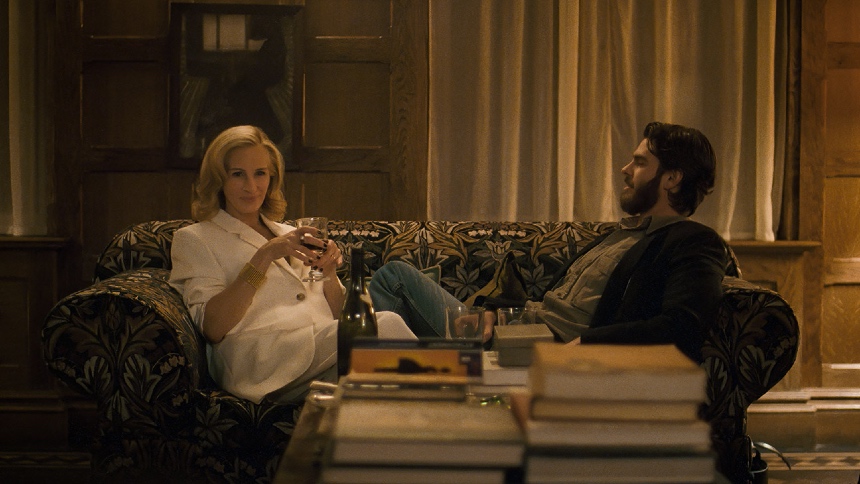
Alma (Julia Roberts) is a long-standing philosophy professor at Yale University, with the coveted tenure just within her grasp.
Her close friend, another professor, Hank (Andrew Garfield), might also be up for tenure; still, the presumed professional rivalry doesn’t stand in the way of him openly pining after her and her pining for his attention. Another one of Alma’s loyal admirers is her student Maggie (Ayo Edebiri), who is writing a dissertation on ethics under her supervision.
During one of Alma’s house parties, Maggie discovers her mentor’s dark secret from the past hidden under the sink next to extra toilet paper, and later leaves with inebriated Hank in tow. Maggie doesn’t come to class the next day, but appears on Alma’s step, distressed and accusing Hank of assaulting her.
In the aftermath, Alma has to come up with both a personal and public stance, which she struggles to do. On the fringes, Alma’s psychiatrist husband (Michael Stuhlbarg) and her university colleague, Kim (Chloë Sevigny), offer insightful commentary, which would honestly work better if it weren’t spoken so directly.
After the Hunt might be the first film by Luca Guadagnino that actually suffers from the air of provocativity that surrounds it. Before landing at the 63rd New York Film Festival as its opening film, it had its premiere at the Venice Film Festival, where it received mixed to negative reactions, some of which proved more interesting and complex than the movie itself. The film is also somewhat lauded by the opponents of the #MeToo movement for supposedly satirizing it, which, judging by the director’s comments and what we actually see on screen, doesn’t seem to be the intention at all.
What was the intention really is the biggest question here, and After the Hunt does its best to skirt it, just as it does with every other major topic that Nora Garrett’s screenplay introduces. By trying to pack as much as possible into the story – sexual harassment, the self-serving and fluid morals of academia, social and class divide, privilege, quests for self-identity, the inherent ideological gap between generations, and more – the script actually fails to say anything significant about any of it.
Ironically enough, the film that could’ve had the words “it’s complicated” as its tagline, shies away from any sort of real nuance, as when Stuhlbarg’s character talks about the merits of building a relationship on the need to feel someone’s unconditional adoration, or when Sevigny’s Kim theorizes that, while it doesn’t make it any less real, trauma can be utilized as a sort of an identity affirmation. Instead, much like David Mamet’s Oleanna, which After the Hunt is often compared to, the film tends to take a complicated matter and oversimplify it.
Where Oleanna only showed one side of the “he said–she said” dynamic, Guadagnino’s film never reveals what did or didn’t happen the night Hank came up to Maggie’s apartment for a nightcap at all. The script justifies it by reminding the audience that this is a post-truth world, and the event itself supposedly doesn’t matter as much as the reactions to it do, which mostly comes off as a cave-in and the authors’ declaration that they are largely preoccupied with other things as well.
For all the painstakingly recreated details of Yale (filmed in London), the movie actually seems to be set in an alternative reality where all the major questions regarding sexualized violence and power imbalance have been resolved, and everyone always automatically rallies in support of a presumed victim, which doesn’t correspond with our actual reality. The world of After the Hunt is also vividly theatrical, with everything perfectly detailed, choreographed, and timed, like when Julia Roberts throws her phone across the room and Chloë Sevigny immediately comes in to offer a drink.
Seemingly trying to overcompensate for this, Guadagnino makes a series of dubious creative decisions. This includes the Woody Allen-inspired opening credits (certainly a choice, considering the film’s topic), insistent close-ups of nervously clasped hands and faces of the actors directly addressing the camera, the oppressive clock ticking in the background, and Trent Reznor’s and Atticus Ross’ trademark suspenseful modulations that often cause unintentional comedic effect.
That same score also tries to pass After the Hunt as a thriller, which it doesn’t appear to be. More than anything, Guadagnino’s latest is a character study that is most coherent when it speaks about the black holes of obsessions.
That desperate desire for something or someone that makes already unpleasant people commit to even more unpleasant behavior and eventually threatens to swallow them whole. The question of whether we needed almost two and a half hours of omissions and dancing around stuff to be reminded of that is yet another one that stays unanswered.