
Busan 2025 Review: GOOD NEWS, Ambitious and Jangly Period Political Satire Channels DR. STRANGELOVE

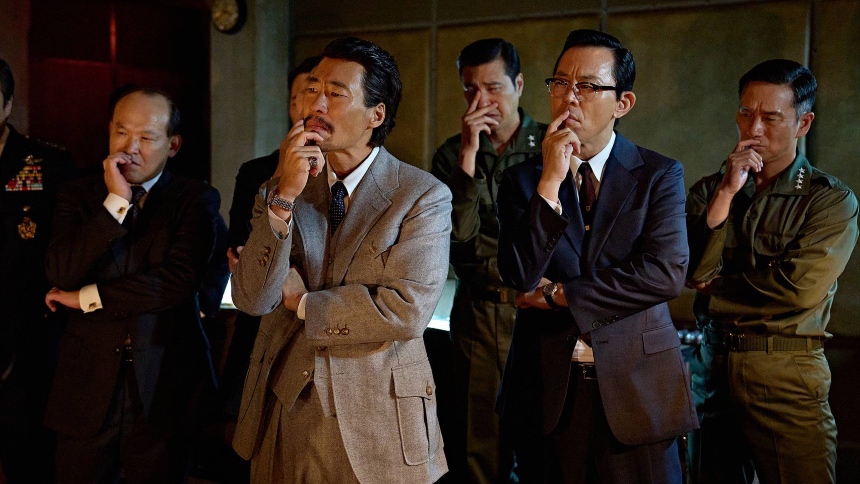
Following Kill Boksoon, director Byun Sung-hyun teams up once again with Netflix for Good News, a high-concept and ambitious black comedy that pulls a few pages straight out of the Dr. Strangelove playbook.
Very loosely based on a fascinating real-life story, the film is set in 1970 and concerns a commercial airliner that has been hijacked by Japanese terrorists who divert it to Pyongyang, hoping to join their communist brethren in the hermit kingdom.
South Korean Air Force lieutenant Seo Go-myung (Hong Kyung, Hear Me: Our Summer) is recruited by a wily political operative known only as Nobody (played by Kill Boksoon's Sul Kyung-gu) for his daring plan to trick the hijackers into landing the plane in Gimpo Airport in Seoul, which they dress up to look like North Korea.
Good News is heavy on heightened comedy and style, featuring a mix of the kind of large-canvas institution skewering Japanese ensemble energy we recognise from films like Shin Godzilla, and the more character-based and dramatic style of Korean satire seen in Parasite and Cobweb.
This is the fourth time that Sul has teamed with Byun and, given the stellar roles he's had a chance to play for him so far -- a charismatic gangster in The Merciless and an idealistic politician in the period-set election drama Kingmaker -- it's easy to see why he keeps coming back to the well for more.
The enigmatic and smirking 'Nobody' is the most colourful character yet to emerge from this fruitful partnership. Sul exudes shiftiness and craftiness through his shuffling gait and an overly familiar way of speaking and dealing with people, which disarms and unsettles the political and military figures he slyly manipulates.
Matching Sul's energy and then some is Ryoo Seung-bum -- marking a rare film foray in six years after the caper sequel Tazza: One Eyed Jack -- as the thin-skinned and thick-skulled director of the KCIA, a gloriously elastic caricature which echoes at least one of Peter Sellers' characters in Stanley Kubrick's aforementioned satire.
Opposite the stylised heavyweights, the much younger Hong, a promising new star who has acquitted himself well on the big and small screen of late -- the wonderful indie A Distant Place being a particular highlight -- is left with the heavy lifting as the straight arrow of the ensemble. Go-myung is a character who gets in over his head in a dizzying geopolitical fracas and tries to keep his moral compass straight and his nose dry, if not his feet -- thanks to a running gag in which he constantly slips on the same patch of freshly painted tarmac.
The film's ample verve and ambition ably carry most of the film, but at close to 140 minutes, the high-pitched energy is difficult to sustain, and it begins to sag around a couple of corners in the more measured second half, when the characters are all stuck in the same place, after having moved around so breathlessly earlier on.
Byun's bravura directing style, sharp and confident, elevates much of the film, whereas another director may have struggled to steer it away from gimmicky parody. However, every so often he also steps forward when the event might be best served by him taking a small step back.
Case in point is a terrific showdown between Go-myung and his radar operator counterpart in the North. The tense and thrilling scene works beautifully on its own, but Byun garnishes it with a The Good, the Bad and the Ugly pastiche that feels a tad unnecessary.
But that's where the bad news stops for Good News, a richly entertaining and unabashedly commercial satire that keeps its finger on the pulse -- the gags are all in service of a larger picture about stifling social structures and ideologically bankrupt political apparatus, propped up by hypocrisy and hierarchy, always on the verge of collapse.



