
Busan 2025 Review: NO OTHER CHOICE, Park Chan-wook's Delirious Dark Comedy Is a Twisted Delight

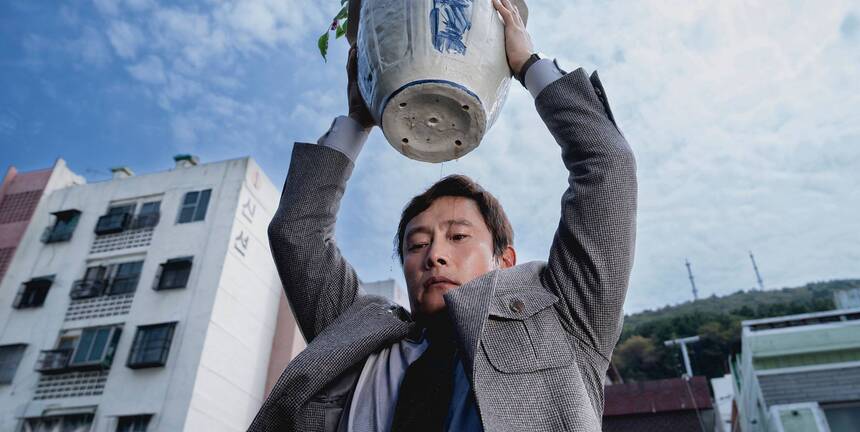
After losing his job of 25 years, an increasingly frustrated family man is driven to the brink in his efforts to protect his comfortable life in Park Chan-wook’s outrageous black comedy, No Other Choice. After debuting at Venice the film made its domestic debut on opening night of the 30th Busan International Film Festival, with the director and stars Lee Byung-hun and Son Yejin in attendance.
After making his name with violent and stylish thrillers like Sympathy for Mr. Vengeance and Oldboy, before turning his hand to lavish romances such as The Handmaiden and Decision to Leave, Park proves he is equally adept at handling comedy, without sacrificing any of the rich artistry that has become emblematic of his style. No Other Choice parades a ravishing visual aesthetic, through brightly coloured production design, vivid cinematography and intricately layered editing, all of which serve to underscore the escalating absurdity of this increasingly frantic comedy of errors.
Lee plays Man-su, who has been working at the same paper factory for most of his professional life. When word comes down the pipe that he is to be replaced by a machine, he is initially confident that he will find a new position within a couple of months. His beautiful wife, Miri (Son) and two children are sympathetic and supportive, but as the months tick by, a replacement role fails to materialise and before Man-su realises, more than a year has passed and he is now in danger of losing his gorgeous house.
At his wits end, and ridiculed by a prospective employer in his latest unsuccessful interview, Man-su identifies the three other most qualified candidates in his field - played here by Lee Sung-min, Park Hee-soon, and Cha Seung-won - and hatches a fiendish scheme to, quite literally, take out the competition. What ensues is an increasingly shocking and hilarious farce, as Man-su entangles himself in lies and pushes himself to the very limits of decency.
As gorgeous as Park’s film is to look at, the real pleasure of No Other Choice is in its richly textured screenplay, co-written by Park and three credited collaborators, most notably Lee Kyoungmi, director of 2016’s The Truth Beneath. Not only does it stage a series of ridiculous altercations between Man-su and his intended victims, but it underpins his desperation with a palpable sadness, while making a number of profound and timely observations about the fragility of masculinity and humanity’s impending obsolescence in the face of technological innovation.
Adapted from American author Donald E. Westlake’s 1997 novel The Axe, No Other Choice has a universality and accessibility to its story, while the protagonist’s predicament is one to which everyone can relate to all too easily. It is not just Man-su, after all, whose head is on the chopping black. At a moment in time when artificial intelligence threatens so many of our livelihoods in so many different industries, Man-su’s willingness to seek out potentially homicidal solutions in order to safeguard his livelihood and provide for his family has never seemed more reasonable or sympathetic.
An obvious comparison would be to label No Other Choice as “Park Chan-wook’s Parasite” and it is easy to see why, as both films focus on a family unit driven to desperate measures in order to protect or improve their domestic situation, but Park is too confident and distinctive a filmmaker to be eclipsed by such an oversimplification. That is not to say Park’s is the better film. Bong Joon-ho’s 2019 Oscar winner is a modern-day masterpiece that deserved every ounce of its near universal acclaim.
No Other Choice is able to step beyond its similarities to that film, however, through its numerous stylistic flourishes. Chief among these would have to be Park’s audacious use of music. How he employs both Cho Young -wuk’s vibrant score, as well as a number of expertly chosen needle drops from wildly varying genres, elevates an already exhilarating experience to something approaching perfection.
One particularly memorable moment sees a ferociously intense stand off at gunpoint between Man-su, Boom-mo (Lee), and Boom-mo’s wife (the always wonderful Yeom Hye-ran) escalate to a histrionic, ear-shattering cacophony, not just because of the life and death stakes in play, but because the music on Boom-mo’s stereo has become so loud that the characters have to scream at the top of their lungs just to be heard over the thunderous music. It is a moment that is sure to linger as one of the year’s funniest sequences.
There are a few niggling reservations that impede No Other Choice from achieving true greatness. At times, Park’s opulent directorial flair is in danger of smothering some of the screenplay’s more subtle nuances. It takes the film around half an hour to really find its feet and establish its tone and rhythm. Less patient viewers may have time to become frustrated by this apparent period of narrative indecision. However, once Man-su resolves to take his destiny into his own hands, the film really hits its stride and there is no stopping the juggernaut of escalating mayhem.
Lee Byung-hun is at his absolute best. Man-su is not an especially charming individual and, needless to say, that his actions are somewhat questionable regardless of how sympathetic his situation becomes. Nevertheless, Lee’s natural charisma and flair for comedy - a muscle he is given rare opportunity to flex like this - ensures that the audience is always in his corner. Son Yejin is equally wonderful as his unwaveringly supportive wife. It would have been easier, one suspects, for Miri to become something of an antagonist, to berate Man-su for his inability to give her the life to which she has become accustomed or provide for their two children and dogs, but she does not. She is also willing to make sacrifices and do what it takes to keep the family together, even when that means getting her hands dirty too.
Ultimately, No Other Choice proves once again that Park Chan-wook is one of world cinema’s most talented and versatile filmmakers, every bit as capable at making us laugh as making as wince in pain. This is a film that will almost certainly reward repeat viewings, as the fullness of its opulent style and intricate plotting are almost too rich to be absorbed in a single sitting. Whether an established fan or newcomer to Park’s oeuvre, viewers will find almost too much here to enjoy, while those already compiling their list of the year’s best films will have, well…no other choice.

Do you feel this content is inappropriate or infringes upon your rights? Click here to report it, or see our DMCA policy.
More about No Other Choice
- Now Streaming: Baltasar Kormákur's APEX Pits Charlize Theron vs. Taron Egerton
- Now Playing: THE TESTAMENT OF ANN LEE Shakes, NO OTHER CHOICE Rattles, MARTY SUPREME Rolls
- Playback: Park Chan-wook, Pushed to the Limit, from JOINT SECURITY AREA to NO OTHER CHOICE
- NO OTHER CHOICE Review: It's Murderously Hard to Find a Good Job Nowadays
- Opening This Week: ANACONDA Bites, NO OTHER CHOICE Hunts Jobs, THE PLAGUE Plunges Into Terror


