Locarno 2025 Review: IRKALLA: GILGAMESH'S DREAM Confronts Iraq's Haunted Present Through Myth, Memory and Children as Collateral Damage
Director Mohamed Jabarah Al-Daradji constructs a fragmented, myth-infused portrait of post-ISIS Baghdad, where the traumas of a lost generation unfold through the eyes of a silent child wandering between memory, violence, and ancient legend.

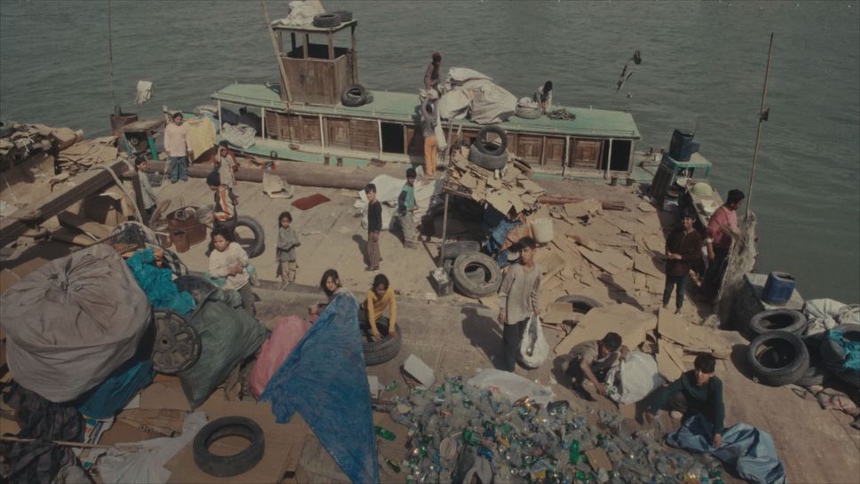
Director Mohamed Jabarah Al-Daradji´s latest film, Irkalla: Gilgamesh’s Dream, unfolds against the backdrop of the 2019 uprising in Baghdad.
Amid smoke, chants, and the noise of tuk-tuks, a 9-year-old boy named Chum-Chum (Youssef Husham Al-Thahab) walks the city’s fractured streets with a singular belief, that the Tigris hides a gateway to Irkalla, the ancient underworld. He is homeless, diabetic, and nearly mute, yet determined to revive the parents he lost to war.
Guided by fragments of the Epic of Gilgamesh, glimpsed in an animated series in his mobile classroom run by a grieving woman named Maryam (Samar Kazem Jaw), Chum-Chum’s mythic quest collides with grim political reality when his teen friend and protector Moody (Hussein Raad Zuwayr) becomes entangled in militia violence. Irkalla: Gilgamesh’s Dream converges on memory and myth, where the personal and the historical refuse separation, and where the underworld is not a distant realm but the city itself.
Mohamed Jabarah Al-Daradji returns to the streets of Baghdad in his latest film. Since his early work in the mid-2000s, his cinema has functioned less as narrative construction and more as diagnostic intervention, a medium through which unhealed national wounds are exposed. From Ahlaam and Son of Babylon to In the Sands of Babylon, Al-Daradji has built a body of work rooted in post-invasion Iraq, dealing first with the psychological aftermath of dictatorship and later with the long tail of occupation and sectarian trauma.
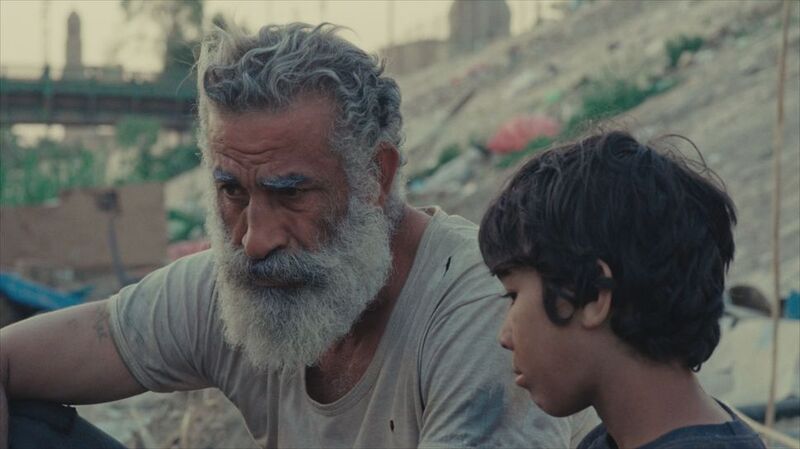
Irkalla: Gilgamesh’s Dream marks a formal departure while deepening that thematic continuity. If his earlier films were firmly situated in the documentary-fiction hybrid mode, this new work moves toward symbolic layering without relinquishing the raw immediacy of the street.
The myth of Gilgamesh functions not as a loose intertext but as structural scaffolding. Just as Gilgamesh journeys to the underworld seeking to reclaim a lost friend, Chum-Chum seeks to restore his parents, while Baghdad itself teeters between ruin and reinvention.
The camera, operated by three directors of photography, Nikzat Saed, Salam Salman, and Al-Daradji himself, captures the lives of orphans left behind by violence, framing their world as a dystopian narrative. Initially, the city is presented as a post-apocalyptic landscape, where small children scavenge for survival amid an absence of adults. However, this perspective shifts as Al-Daradji gradually reveals that Irkalla: Gilgamesh’s Dream is, at its core, a social drama rather than a post-apocalyptic science fiction film.
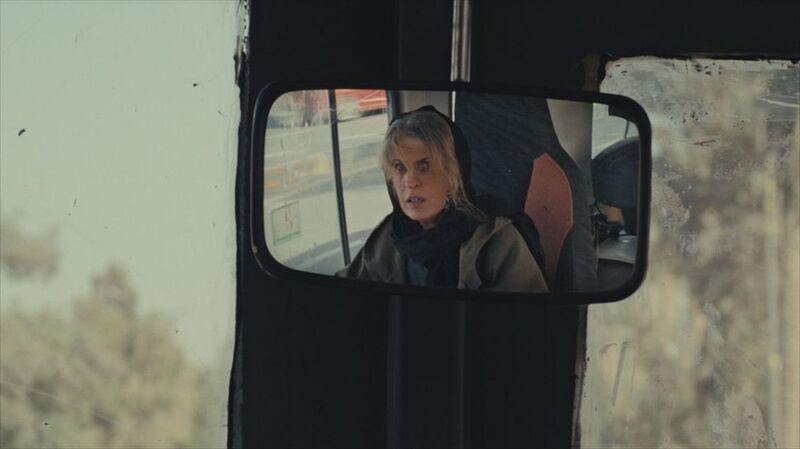
The children have limited contact with adults, most of whom are themselves deeply scarred by the violence inflicted first by ISIS and later by militias. Among the few adult figures close to Chum-Chum, Moody, and their ragtag group of orphaned peers is Maryam, a woman who runs an improvised school out of a battered bus.
Her ad hoc lessons offer the children a rare sense of structure and normalcy amid the chaos. Often dismissed as unstable, Maryam, who lost her entire family to ISIS, functions as more than a caretaker. Her presence shifts the story from a solitary hero’s journey to a generational continuum, reframing the ancient Gilgamesh-Enkidu relationship through the lens of intergenerational trauma and social roles rather than individual friendship alone.
While portraying a deeply traumatized society, Al-Daradji extends the narrative into the political realm, gradually unveiling the uprising in Baghdad’s city center and the insidious role of militias who exploit and recruit street children for their own purposes.
Initially, Moody’s involvement with the militia is depicted as a desperate but understandable decision, motivated by his desire to obtain forged passports for himself, Chum-Chum, and his sister Sarah (Lujain Star Naimat), who has been forced to work in a nightclub. However, as violence escalates and personal tragedies accumulate, both Chum-Chum and Moody become disillusioned with the dream of escape to Holland.
While the children are initially shielded from the riots unfolding on Baghdad’s streets, they are eventually drawn into the heart of the unrest. Al-Daradji carefully reconstructs these protests with a blend of documentary precision and narrative intent, capturing the charged atmosphere and chaotic encounters. Although Irkalla: Gilgamesh’s Dream is told through the eyes of orphaned children, the director does not shy away from depicting the brutal realities of life in a conflict-ridden city.
Maryam’s journey through Baghdad in a double-decker bus, teaching English amid crumbling infrastructure and dusty chaos, may carry moments of dark absurdity, but the larger picture remains stark. Al-Daradji confronts the full extent of societal decay: children sleeping in trash-strewn alleyways, minors trafficked into brothels, and countless others caught as collateral in an unending cycle of violence. Chum-Chum, portrayed as a dreamer still partially untouched by the trauma around him, is ultimately left to navigate the streets alone, his future uncertain, his survival shaped by forces beyond his control.
Al-Daradji blends social drama with elements of the thriller genre, incorporating action-driven sequences in which the children are caught in the chaos of street riots and crossfire. Irkalla: Gilgamesh’s Dream presents a disorienting mix of post-apocalyptic aesthetics and social realism, reflecting not a speculative future but the lived reality of a country marked by successive waves of conflict.
The film shifts fluidly between intimate character study, societal critique, and kinetic urgency, offering more than genre hybridity, it delivers a sobering commentary on Iraq’s lost generation. Through its fragmented form and tonal contrasts, the film suggests that narrative coherence is no longer possible in a place where childhood itself has been systematically dismantled.
Irkalla Hulm Jijiljamish
Director(s)
- Mohamed Al Daradji
Writer(s)
- Mohamed Al Daradji
- Karim Traïdia
Cast
- Ameer Jabarah
- Samar Kazem Jawad
- Hussein Raad Zuwayr