Locarno 2025 Review: FANTASY Merges Coming of Age and Social Drama on Identity Through a Music Video Aesthetics
Slovenian director Kukla creates an intimate exploration of gender fluidity and self-discovery within the framework of a coming-of-age tale set in the contemporary Balkans in her fiction debut.

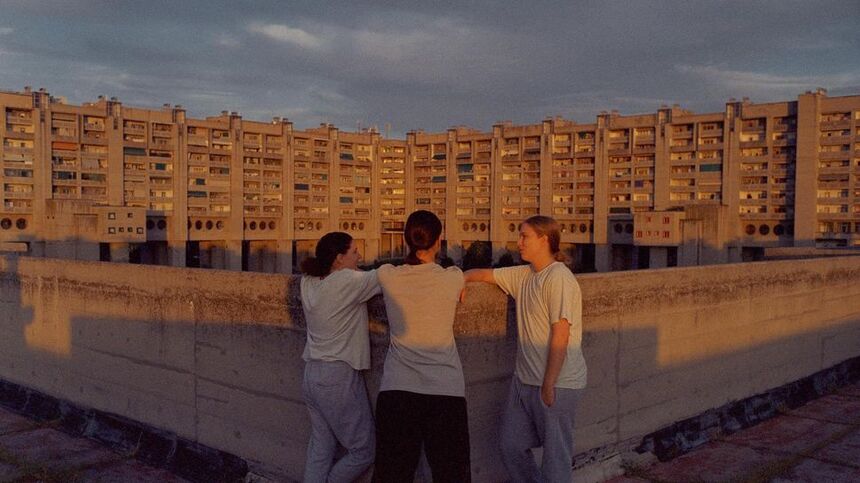
In the feature debut Fantasy by Slovenian director Kukla, three young women, Mihrije (Sarah Al Saleh), Sina (Mina Milovanović), and Jasna (Mia Skrbinac), navigate the rigid social frameworks of their Balkan surroundings with the defiance of tomboys, uninterested in conforming to what’s expected of them.
Their adolescent world of unspectacular rebellion is disrupted by the arrival of Fantasy (Alina Juhart), a transgender woman whose quiet confidence reframes not only their individual identities but the very coordinates of their inner lives. What begins as a tentative friendship soon becomes an uncharted journey across gender, desire, and self-determination, traversing both literal and symbolic landscapes.
Set against the backdrop of Slovenia and North Macedonia, Fantasy draws from Kukla’s long gestation of the material to offer a layered inquiry into transformation, personal, visual, cultural.
Kukla’s trajectory from short films to feature-length storytelling is marked by a consistent thematic core and a gradually maturing formal language. Her 2020 short Sisters, recipient of the Grand Prix at Clermont-Ferrand, served as a proof of concept for Fantasy. The same actresses appear in both works, and their performances evolve through a long-standing collaboration that blurs the boundary between acting and personal embodiment.
Kukla’s process-oriented development foregrounds co-creation over direction, with rehearsals functioning more as affective bonding than dramaturgical preparation. This porous authorship invites the cast to inhabit rather than perform, a dynamic that informs the film’s register of realism, even as it strays toward magical motifs.

Kukla’s visual style, indebted to her background in music video direction, avoids ornamentalism. Instead, it channels fantasy through symbolic gradations: a palette that shifts from the grey of concrete housing blocks to shades of lilac, mirroring the interior movement of the protagonists.
Rather than imposing formal devices for their own sake, Kukla’s approach is driven by narrative logic and emotional tonality. Fantasy is visually articulate without being mannered. A deliberate visual repetition, such as the static angle of Jasna’s mother Adina, encodes psychological hierarchies rather than architectural ones.
What separates Fantasy from other works exploring gender and adolescence in the post-Yugoslav space is its refusal of both overt polemic and conventional realism. While social realism is a default idiom in much of the region’s cinema, Kukla incorporates elements of magical realism not as aesthetic deviation, but as a way of articulating inner transformation.
These are not fantastical flourishes layered atop the narrative but a formal strategy to mirror the way identity shifts, subtly, incompletely, often unnoticed by others. In one sequence, Fantasy lip-syncs to a Balkan turbo folk ballad, a gesture that is both camp performance and a quiet form of protest. The song, once a background to the melodrama of women as victims, becomes a tool for reclaiming emotional agency.
The film’s multilingualism -- Slovenian, Albanian, Serbian, Bosnian, Macedonian -- functions as a structural metaphor for the fragmented but intertwined histories of the characters and the region. Kukla, herself a second-generation immigrant raised in Slovenia by Macedonian parents, incorporates this linguistic fluidity not as a comment on diversity, but as lived texture.
The characters’ linguistic shifts often mark emotional proximity or distance, underscoring the socio-political layering of language in the Balkans. This refusal to fix identity, to a gender, a nation, a single self, is central to the film’s thematic architecture.
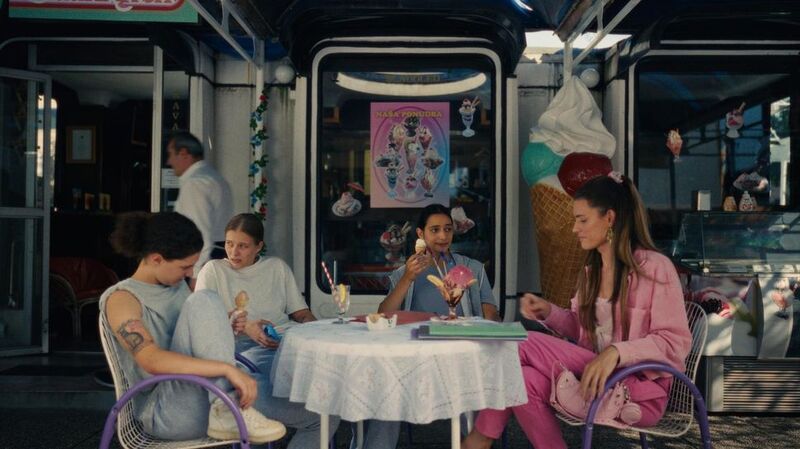
Fantasy unfolds less as a linear storyline than as an emotional topography in the film's episodic format. The three friends do not embark on a classic arc of conflict and resolution. Rather, their proximity to Fantasy provokes a slow dislocation from inherited roles and expected trajectories.
The stakes are not in plot reversals but in the subtle destabilization of internal certainties. Kukla’s interest lies in the latent, desires unspoken, identities unfixed, and societal expectations quietly eroded.
Fantasy does not present identity as an arrival point but as a condition of flux. The film draws from Jungian concepts of the anima and animus, though not explicitly, particularly in Kukla’s depiction of gender not as a binary opposition but as a continuous re-negotiation.
Each of the young protagonists is caught between external projections and internal hesitations. Sina, for instance, enacts her father's expectations of masculinity while quietly yearning for a space unmarked by such scripts. Fantasy, by contrast, moves outside these binary codings altogether, and her presence becomes catalytic.
Importantly, Kukla resists framing Fantasy as a messianic figure; she disrupts but does not resolve. Fantasy is less about transition in a medical or juridical sense and more about the permeability of identity itself, its susceptibility to presence, to desire, to gaze.
Kukla merges coming-of-age and social drama without relying on the conventional tropes of either genre, crafting instead a story of self-discovery and identity formation among young adults navigating a patriarchal Balkan environment. Embracing an urban aesthetic that departs from the dominant mode of Eastern European social realism, the film adopts a visual and narrative language shaped by Kukla’s background in music videos.
The use of magical realism adds texture and vibrancy to the post-communist landscape, infusing the film with a dynamic rhythm that speaks to younger audiences while maintaining the weight of the social issues it explores.
Fantasy
Director(s)
- Kukla Kesherovic
Cast
- Sarah Al Saleh
- Alina Juhart
- Mina Milovanovic