Locarno 2025 Review: DON'T LET THE SUN Envisions a Sociological Dystopia of Emotional Surrogacy and Climatic Disconnection

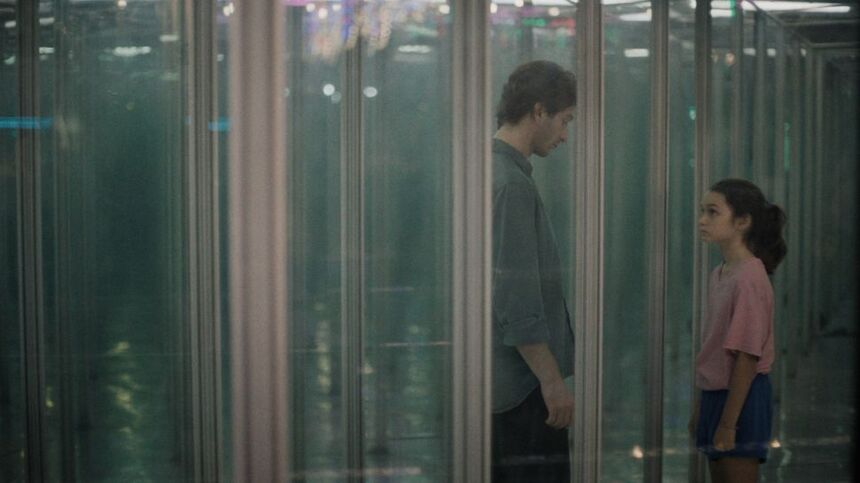
Swiss filmmaker Jacqueline Zünd takes on a near future dystopian story with a social in her move to fiction filmmaking, Don’t Let the Sun.
Society no longer lives in daylight due to the overheating by an uninhabitable climate and adapts to a nocturnal functioning. Within this regulated darkness, Jonah (Levan Gelbakhiani), a professional “emotional surrogate,” is hired to play the role of a father to a withdrawn young girl.
What begins as a performance, a service rendered in a transactional age, gradually destabilizes as a connection begins to form. The story arc is built around routine, disconnection, and the fragility of affective labor. As Jonah, whose services are provided through social services bureau, moves through a series of rented relationships, his identity slowly erodes under the weight of emotional repression, until his boundaries between role and self begin to blur.
The documentarist Jacqueline Zünd brings her formal minimalism and anthropological curiosity into fiction filmmaking without abandoning her documentary sensibility. Don’t Let the Sun retains her signature compositional austerity and atmospheric pacing. The film does not aim for spectacle or dramatization; rather, it leans into the observational.
Don’t Let the Sun consolidates concerns present throughout Zünd’s previous nonfiction work. In Goodnight Nobody, she portrayed insomniacs drifting through the night, isolated, searching for meaning in a world out of sync. In Almost There, the director focused on aging men navigating existential uncertainty, while Where We Belong followed children caught in the relational disarray of divorce.
Each film, while addressing a specific social group, articulated a larger inquiry into detachment, liminality, and the residual effects of emotional fracture. These themes coalesce in Don’t Let the Sun, where Zünd extrapolates an entire society structured around emotional disengagement and displaced intimacy.
The film draws from Brutalist architecture to map internal states onto concrete surfaces. Shot largely in Milan’s Gallaratese district and Genoa’s “Le Lavatrici,” the settings underscore a kind of emotional brutalism: exposed, repetitive, and deliberately impersonal. The structures are not post-apocalyptic, but rather suspended in a future adjacent to the present.
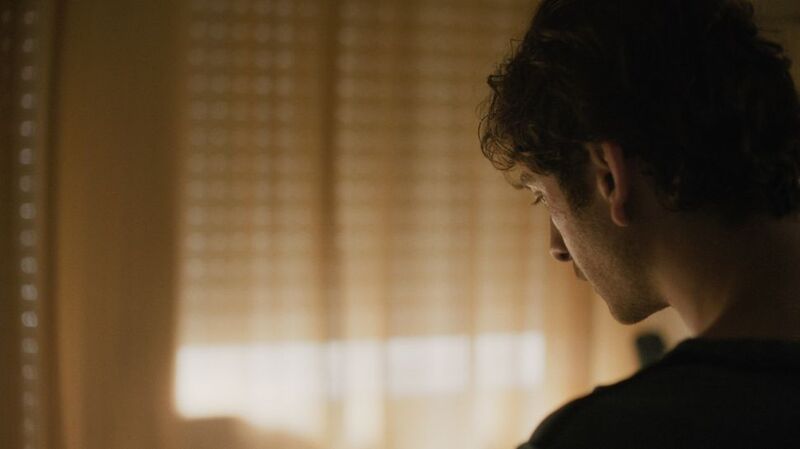
There are no visual cues to excess or decay, eschewing the post-apocalyptic tropes, just the sense that something has quietly been given up. The city's geography, empty streets, public spaces devoid of daily rhythm, produces a kind of functional melancholy. The camera, handled by longtime collaborator Nikolai von Graevenitz, maintains a detached proximity, offering wide static frames that foreground spatial alienation in addition to fixed composed tableaux.
The storytelling refrains from imposing cause-effect logic. Rather than plot progression, we witness Jonah's episodic encounters with various clients, each demanding a different emotional performance. The distinctions between personal and professional blur without resolution. Zünd does not frame this ambiguity as a dilemma but rather a condition, in a world where authentic emotional risk has been outsourced, the performative becomes the primary mode of connection.
Dialogue is minimal by design. Zünd has noted that the oppressive heat of this world suppresses even speech, and Gelbakhiani communicates largely through posture and gesture. His performance avoids psychological cues or melodramatic signals. He is, for the most part, unreadable, an actor playing an actor whose internal self remains uncertain even to himself.
His scenes with Maria Pia Pepe, a first-time performer playing the young Nika, unfold slowly and asymmetrically. There are no cathartic breakthroughs. Instead, the film relies on temporal proximity to suggest a tentative form of relational presence. Whether this constitutes “real” intimacy is left unresolved.
The script, co-written with Arne Kohlweyer, is structured episodically but never signals clear transitions. There is no origin story, no expository world-building. The viewer is not invited to decode but to observe. This approach resists both genre classification and narrative expectations.
Though Don’t Let the Sun is ostensibly a speculative fiction film, it does not foreground its speculative elements. The futuristic setting is not used for allegorical distance but rather as a way to examine the present, especially our contemporary crisis of emotional legibility and mediated connection.
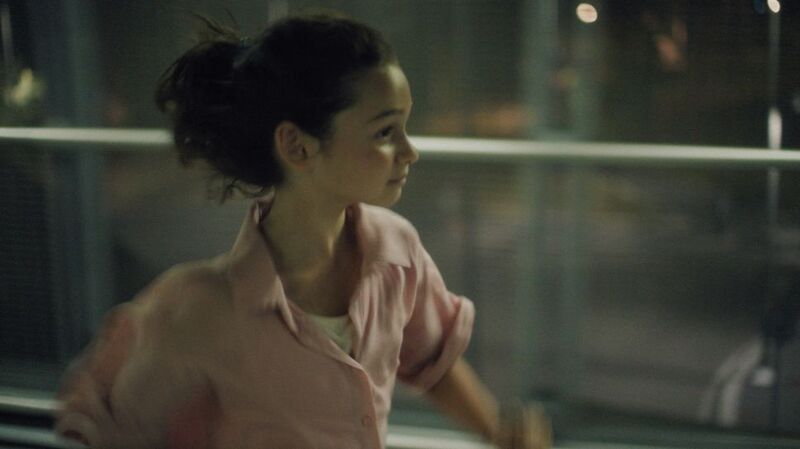
There are references to film history, most explicitly Claire Denis’ Beau Travail, particularly in the scenes depicting nocturnal fight clubs, where Jonah’s need for physical expression surfaces in a context of ritualized violence. These sequences evoke intimacy as estrangement, echoing Denis’ explorations of desire and alienation through choreography.
However, Zünd’s approach remains idiosyncratic. Her affinity for physical architecture, quiet tableaux, and sparse human interaction aligns more closely with the contemplative cinema of Tsai Ming-liang or early Naomi Kawase than with science fiction.
Don’t Let the Sun proposes a world where transactional intimacy is normalized, where emotional labor has been formalized into a service economy, and where the heat, both literal and metaphorical, renders vulnerability unsustainable. Rather than dramatize these conditions, Zünd treats them as givens, then explores their textures. The film’s merit lies not in resolution but in its ability to sustain ambiguity.
Ultimately, Don’t Let the Sun represents a conceptual culmination of Zünd’s previous work. It integrates her longstanding focus on affective dislocation into a formally precise narrative space. By transitioning to fiction, she does not abandon the observational ethic of her documentaries but rather transposes it.
The result is a film that is structurally reserved, emotionally muted, and quietly provocative. Don’t Let the Sun is a sociological dystopia tackled in a storytelling minimalism underlined by Zünd´s documentary approach to construction of images.
Don't Let the Sun
Director(s)
- Jacqueline Zünd
Writer(s)
- Arne Kohlweyer
- Jacqueline Zünd
Cast
- Levan Gelbakhiani
- Karidja Touré
- Agnese Claisse