Locarno 2025 Industry: Story Lab Showcases New Projects Merging Place, Politics, and Hybrid Storytelling

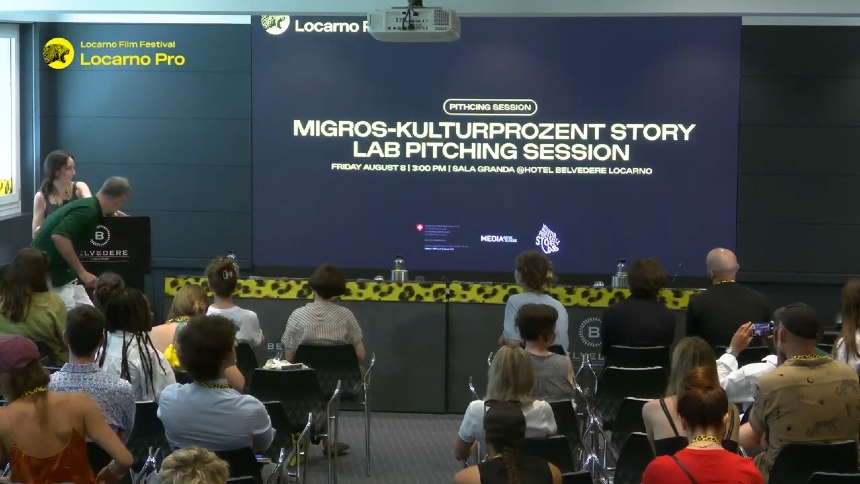
At the 78th edition of the Locarno Film Festival, the Migros Culture Percentage Story Lab once again demonstrated its knack for unearthing distinctive voices across cinema, hybrid formats, and immersive storytelling.
Partnering for the fourth time with Locarno’s BaseCamp, the Lab brought together emerging and established creators to pitch projects that stretch from intimate domestic dramas to speculative sci-fi and politically charged documentaries.
Launched in 2019, the Story Lab is unique in its cross-format remit, supporting not just film and series but also VR and games, with a focus on development-stage support, coaching, and networking. The emphasis, as host Alan Alpenfeldt underlined, is on creating “free spaces to experiment” and to foster exchanges both within and beyond the industry.
For producers, sales agents, and co-pro partners, the session provided a valuable scouting ground: early-stage projects with space to shape, a diverse geographical spread, and a clear openness to cross-border collaboration.
-thumb-800x450-99603.jpeg)
Many of the projects use place as protagonist, revealing how environments shape lives and social systems. In Prato Pernice, Valentina Shazivari lingers on the semi-public spaces of a Locarno apartment complex where her father has worked as caretaker for over twenty years. Through carefully staged yet porous scenes performed by non-professional actors, the film becomes a quiet study of routine, ownership, and the fragility of communal order.
Noé Parr’s The Mine Screamed 22,000 Times similarly grounds itself in a landscape, the Swedish city of Kiruna, which is literally being relocated as the iron mine beneath it destabilises the ground. With documentary patience and essayistic sharpness, Parr captures the surreal spectacle of entire buildings being moved intact across the Arctic, a paradoxical monument to ecological collapse.
The question of how stories shape belief was at the centre of Spirits We Didn’t Ask For, pitched by Swiss-Argentinian duo Jonathan Jäcki and Tobias Kubli. Set in Capilla del Monte, Argentina, a hub of UFO tourism, the hybrid documentary investigates the enduring appeal of conspiracy myths. Using interviews, reenactments, and essayistic fragments, the film revisits the Eurocentric pseudo-histories popularised by Erich von Däniken, asking what happens when fiction becomes identity in today’s post-truth societies.
Other filmmakers turned to speculative frames to confront urgent social questions. South African director Zamo Mwaquanasi’s Newborns imagines a future where humanity survives through cloned workers, sterile and forbidden to have children, until one girl becomes pregnant and must flee those who view her body only as an experiment. By rooting dystopia in contemporary debates over reproductive rights and bodily autonomy, the project insists on the political stakes of imagining the future.
Camille Dumont’s The Landing returns to the present to explore another controlled environment: a newly built Swiss federal asylum centre. Juxtaposing the polished, idyllic architectural renderings with the stark realities of confinement, Dumont exposes the dissonance between designed images of inclusion and lived experiences of exclusion.
-thumb-800x450-99606.jpeg)
Several projects sought to make invisible labour and intimate lives visible. In Saison, Stefania Burlam highlights the seasonal agricultural workers who harvest Switzerland’s fields each year, often at the cost of their own health and family life. Shot on real locations during harvests and performed by non-professional actors, the film blends fiction and documentary realism into a sensorial, poetic portrait of work, asking: which bodies are granted the right to rest?
Meanwhile, Tatiana Honegger’s Oya Nora and Olivia Frey’s Haiga bring the focus to family. Honegger’s project unfolds over a single day in the Zurich Oberland, following two sisters whose strained bond exposes deeper generational patterns of expectation and identity. Frey’s film takes the form of a hybrid road movie, in which two half-siblings journey across Europe to scatter their mother’s ashes, a story rooted in the director’s own loss, but resonating with a universal longing for home and belonging.
History, too, was a strong undercurrent. In his animated thriller The Discord, Jonathan Laskar revisits the shadows of the Algerian War of Independence. Following a jazz musician who uncovers a devastating family secret, the film weaves together themes of exile, betrayal, and collective trauma. Music becomes both narrative driver and a medium of memory, offering reconciliation where violence once fractured lives.
-thumb-800x450-99609.jpeg)
Across these projects, the trends are unmistakable: filmmakers are blurring fiction and documentary to tackle pressing social realities, anchoring global questions in specific, resonant places. They are confronting the politics of space, of labour, of the body, and of narrative itself. For international producers and partners, the Story Lab once again highlighted why early engagement is crucial: most of the projects are in development, seeking co-producers and allies in Switzerland, France, and beyond.
If one theme defined this year’s session, it was the insistence that storytelling is never neutral. Whether through the lens of a Swedish mining town, an Argentinian UFO myth, or a Swiss asparagus field, these filmmakers are mapping not only cinematic terrain but also the contradictions of our contemporary world, contradictions that demand to be seen, questioned, and reimagined.