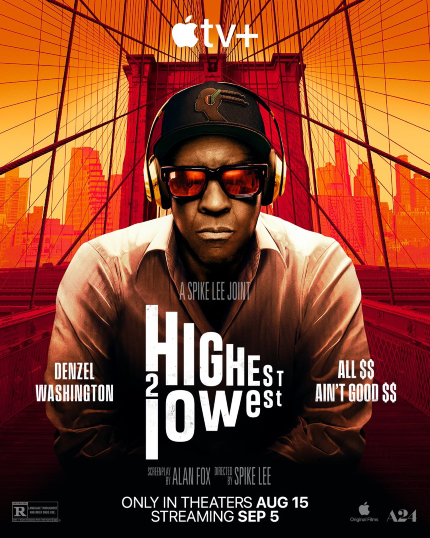
Spike Lee (Inside Man, Malcolm X, Mo’Better Blues) and Denzel Washington’s (Gladiator II, TheEqualizer series, The Tragedy of Macbeth) first collaboration in almost 20 years and their fifth overall, Highest 2 Lowest, masterfully reinterprets and reimagines Akira Kurosawa’s seminal 1963 crime-thriller, High and Low (TengokutoJigoku), for the twenty-first century.
High and Low, Kurosawa's adaptation of Ed McBain’s 1959 crime novel, King’s Ransom, inarguably remains both cornerstone not just of 20th-century Japanese cinema and a key, trope-setting entry in the police procedural sub-genre. Deeply textured visually, narratively, and thematically, High and Low reflected contemporary concerns related to Japan’s post-war economic boom and growing inequality. Given its subject matter, High and Low always seemed ripe for re-adaptation and reinterpretation, especially from another point of view, preferably an entirely different country and a different set of social, cultural, and political values.
In updating Kurosawa's 62-year-old masterpiece, Lee brilliantly re-focuses High and Low’s central dilemma from Toshiro Mifune's business executive, Kingo Gondo, and the ethical, moral, and philosophical concerns (duty, obligation, honor within a post-war Japanese context) that define and drive his postwar worldview to Washington's self-made music business mogul, David King, and the potentially fatal reputational harm not paying the ransom would face in a social media-driven, terminally online world if he refuses to pay the ransom.
From his immaculately curated, art-filled Brooklyn penthouse, his personal Fortress of Fortitude and the embodiment of the American Dream (Black Capitalist Edition), King looks out over the city where he made his first moves as a music producer and later founded Stackin' Hits. King, however, wants more. Not “more” in terms of wealth, power, or even fame (he has all three in abundance) and certainly not in terms of his wife, Pam (Ilfenesh Hadera), or his son, Trey (Aubrey Joseph), but “more” defined as continued relevance. Retirement represents a slow-motion stroll toward his inevitable demise, an acknowledgement of his mortality, and his redundancy to a world where he longer matters as a creative force or influence.
If filmography is autobiography (and it is), then King doubles as a stand-in for Lee, at 68 closer to the end of a brilliant, acclaim-filled career as a filmmaker than the beginning. King’s search for renewal and relevance must have resonated with Lee as he revised Alan Fox's original screenplay to reflect his own preferences for character, dialogue, and plot development. Lee's active involvement began after he completed work on Da 5 Bloods five years ago.
Struggling against his pending obsolescence, King makes an impetuous, possibly self-destructive, move to regain control over Stackin' Hits from the merger that will leave him considerably richer, but effectively powerless. Impulsively deciding to purchase a controlling interest in his company from one of his partners, thus giving him the ability to block the merger, gives King the clear-eyed, renewed sense of purpose missing from his life.
King’s precarious professional and professional predicament serves as a backdrop for the story proper: At a summer basketball camp, kidnappers inadvertently snatch Kyle (Elijah Wright), the son of King’s longtime driver and confidante, Paul Christopher (Jeffrey Wright), instead of the similarly aged Trey. Assuming they have Trey, the kidnappers call King and demand a $17.5M ransom for his safe return, almost the exact amount King needs to purchase his partner’s shares in the music label.
As New York’s finest swoops into the King family’s penthouse in a performative show of force by law enforcement to Howard Drossin’s old-school, symphonic score, paying the ransom for the return of King’s son isn’t in dispute: For King’s son, the music mogul is willing to sacrifice everything, including the world.
But when Trey suddenly reappears, dazed and confused, but unharmed, it’s clear the kidnappers snatched Kyle by mistake. Without financial resources of his own, Paul can only leverage his friendship with King, along with the not unexpected ideals of honor, duty, and responsibility to obtain his son’s release.
Unfolding inexorably at a slow burn, Highest 2 Lowest, markedly increases the already intense pressure on King. Faced with not just financial ruin, but accepting the irrelevance he’s desperate to reject, King finds himself at a figurative crossroads. Narratively, Highest 2 Lowest pivots into specific 21st-century concerns and a cultural landscape dominated by social media. One misstep, one misjudged social media post, can destroy reputations, careers, and lives.
King’s recognition of the potentially disastrous real-world consequences if he refuses to pay the ransom drives both his final decision and the consequences that follow. Where Highest 2 Lowest spends most of the first half locked into high-rise offices and King’s penthouse defined by dialogue, the second half turns the camera to the streets below, a New York City subway crammed with boisterous Yankees fans, the late Eddie Palmieri performing at the yearly Puerto Rican Day Parade, the cramped, working-class neighborhood where King spent his childhood and early adulthood, and a face-to-face with the kidnapper, the latter aggrieved, resentful, and bitter at his marginalized invisibility.
Highest 2 Lowest opens Friday, August 15, only in movie theaters, via A24 Films. It will begin streaming September 5, exclusively via AppleTV+.
Highest 2 Lowest
Director(s)
Spike Lee
Writer(s)
Evan Hunter
Akira Kurosawa
Hideo Oguni
Cast
Denzel Washington
Jeffrey Wright
Ilfenesh Hadera
Do you feel this content is inappropriate or infringes upon your rights? Click here to report it, or see our DMCA policy.