
Karlovy Vary 2025 Review: RENOVATION Confronts a Quarter-Life Crisis in the Shadow of Post-Soviet Inheritance
Lithuanian director Gabrielė Urbonaitė delivers a quietly introspective study of personal dissonance shaped by post-Soviet space, intergenerational memory, and the subtle fractures beneath a seemingly stable life in her feature debut.

The feature debut Renovation, by Lithuanian director Gabrielė Urbonaitė, is contained within the deteriorating walls of a Soviet-era apartment in present-day Vilnius.
Ilona (Žygimantė Elena Jakštaitė), a 29-year-old marketing professional, appears to be entering a settled phase of life. She has moved in with her boyfriend Matas (Šarūnas Zenkevičius), and the scaffolding outside the building suggests a future that is being carefully repaired and structured, something that is stable, and orderly.
Yet the renovation at the center of the film is not solely architectural. As Ilona develops a tentative friendship with Oleg (Roman Lutskyi), a Ukrainian construction worker, and begins writing poetry — first impulsively, then obsessively — the film draws a parallel between the visible decay of the building and the emerging fractures in a life shaped by conventional social expectations.
Urbonaitė, whose short films frequently explore quiet emotional inflection points, brings a similarly introspective sensibility to Renovation. Her background in editing and screenwriting shapes a formally austere style in which silences and small gestures carry significant emotional weight. Her earlier works as The Swimmer and Back, center on transitional states: adolescents approaching the end of innocence, young adults confronting breaks in personal continuity.
Renovation explores personal dissonance within a broader historical and spatial context. While Urbonaitė’s earlier films concentrated on interior states, this work situates individual experience within the material and political environment.
The post-Soviet urban landscape, layered national histories, and the ambient presence of a nearby war exert a quiet pressure throughout. The film’s commitment to a single, gradually evolving location reinforces this thematic grounding, allowing the space itself to register both continuity and disruption.
-thumb-800x450-99372.jpg)
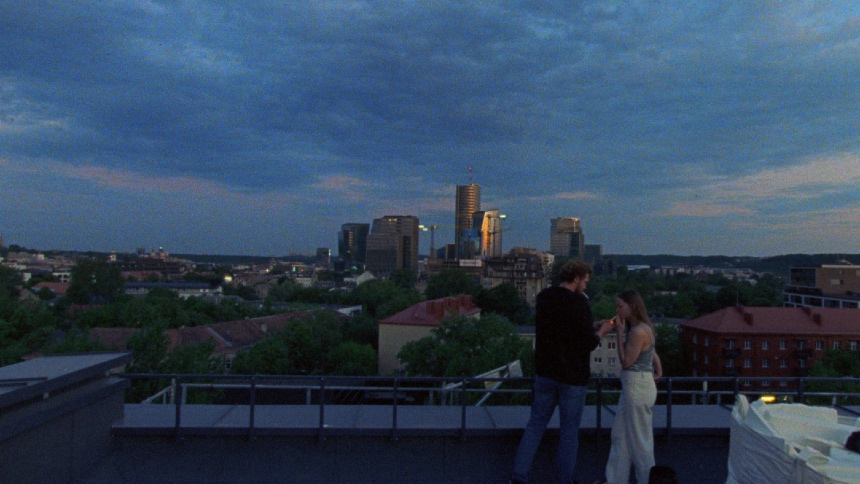
Shot on 16mm, the film adopts a tactile, intimate aesthetic. The grain of the image conveys a muted sense of nostalgia, grounding the present in a visual texture. The camera lingers on small, often overlooked details, hands exchanging objects, plaster dust suspended in light, faces absorbed in thought rather than propelled by action.
The protagonist avoids overt confrontation. The relationship between Oleg and Ilona develops with deliberate ambiguity, neither clearly romantic nor traditionally platonic. Their connection becomes a space for projection, uncertainty, and subtle displacement.
Ilona does not so much discover a new self as confront the limits of the life she has constructed, professionally, emotionally, and ideologically. Her poetry, which begins as a fabrication, evolves into a private means of interpretation. The film resists romanticizing this creative impulse; instead, it frames it as a quiet rupture, an indication that the coherence of Ilona’s carefully ordered existence is beginning to unravel.
Oleg’s presence introduces a parallel register of displacement. Though never explicitly political, the film acknowledges the war in Ukraine as a distant but insistent backdrop, perceptible in silences, sidelong glances, and the careful avoidance of direct discussion. The friendship between Ilona and Oleg becomes a space of shared marginality: he, an outsider by geography and class; she, an insider gradually awakening to a sense of estrangement within her own life.
By centering the narrative on a woman approaching thirty, Urbonaitė frames Renovation within the context of a so-called quarter-life crisis. In some respects, the film unfolds as a chamber version of Joachim Trier’s The Worst Person in the World. Both works examine generational dilemmas shaped by societal expectations around career, relationships, and self-realization. However, Urbonaitė’s approach is more restrained and spatially contained, unfolding within a single location and conveyed through implication rather than overt drama.
Where Trier’s film is largely unmoored from place, Renovation is embedded in its Baltic setting and the historical legacy of the Soviet Union. The film resonates more directly with younger generations in Central and Eastern Europe, whose lives are shaped not only by contemporary pressures but also by the inherited experiences of parents who lived behind the Iron Curtain. That intergenerational transmission of trauma, caution, and cultural memory.
Renovation
Director(s)
- Gabriele Urbonaite
Writer(s)
- Gabriele Urbonaite
Cast
- Helene Bergsholm
- Zygimante Elena Jakstaite
- Sarunas Zenkevicius



