Karlovy Vary 2025 Interview: JIMMY JAGUAR Director Bence Fliegauf Talks Demonic Myth-Making and Chaos of No-Budget Cinema

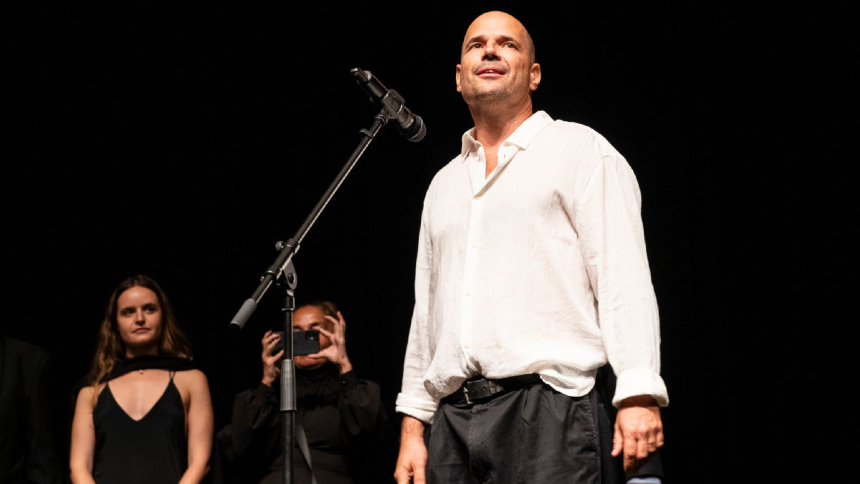
Few filmmakers working today move as fluidly between the spiritual and the political, the intimate and the mythic, as Hungarian auteur Bence Fliegauf.
With Jimmy Jaguar, Fliegauf plunges into perhaps his most volatile terrain yet, a film born not from script or pitch but from a therapeutic hallucination, a failed documentary, and a childhood chant turned metaphysical parasite. The result is a hybrid of pseudo-documentary and experimental narrative: a cinematic séance where personal trauma meets societal pathology, and no frame is left untouched by improvisation, disruption, or possession.
Shot without institutional support and guided more by instinct than formal structure, Jimmy Jaguar continues Fliegauf’s tradition of guerrilla filmmaking, yet it marks a radical evolution even within his own fiercely independent oeuvre. Mixing real-life public intellectuals and therapists with actors in a trance-like dramaturgy, the film orbits around a demonic entity that jumps hosts like a vengeful virus, embodying, at once, justice, obsession, and moral ambiguity.
Talking to Screen Anarchy, Fliegauf reflects on the chaotic genesis of Jimmy Jaguar, the ethical limits of artistic freedom, and why his latest work is less a conventional feature and more a “patchwork of experiments.” With characteristic intensity, he confronts the challenges of working outside the system, the allure of revenge, and the burden of being both medium and message for a meme that may have chosen him, rather than the other way around.
Screen Anarchy: JIMMY JAGUAR began as a personal, even mystical experience, triggered by a childhood chant and a therapeutic session. How do you navigate the fine line between private obsession and public storytelling when shaping such an intimate genesis into cinema?
Bence Fliegauf: I'm still processing what happened during those wicked two and a half years. There were many turbulent weeks, gut decisions, deep inner confusion. That’s usual when making a film, especially a no-budget one, but with Jimmy Jaguar, the whole thing was especially chaotic.
The idea that the film was born from a failed documentary project is fascinating. How did that shift, from observing reality to embodying myth, reshape your approach as both writer and director?
A revenge demon that possesses seemingly random people and uses them to accomplish its goals, this idea was stronger than anything else. That logline became our compass. A wickedly spinning compass, I should say. We tried to follow it and failed many times. The result is less a proper feature film and more a patchwork of experiments.
Like FOREST and FOREST – I SEE YOU EVERYWHER, JIMMY JAGUAR evolved organically during shooting. What unique challenges or freedoms does this hybrid, scene-by-scene development process present for narrative coherence and emotional pacing?
The Forest films were a much clearer process because at least the form was strict: one dramatic situation between people, in real time, using extreme close-ups. If the author fills this form with their own mini-dramas, it somehow becomes coherent, the form highlights the similarities between the scenes.
But in Jimmy Jaguar, everything moved and shifted around. We didn’t channel the force into a form, we just followed it.
You’ve described the workflow as “catching a wave” and the experience as being on a haunted train. How did that sense of improvisation affect your direction of actors, especially within such a metaphysically charged and psychologically volatile narrative?
Since it's a pseudo-documentary, we used the classical method of documentary filmmaking: shoot, edit, reflect, wait, then shoot again. The difference was that I wrote the content.
This method affects everything: the relationships with actors, characters, the crew, the atmosphere. And don’t forget, this is a no-budget film. So I think we really maxed out the boundaries of improvisation on many levels, except the dialogue. The lines were written and acted precisely.
The film incorporates real experts, therapists, sociologists, public intellectuals, who essentially play themselves. What was your intention behind blurring the boundary between fictional narrative and documentary realism?
I guess my aim was to combine the rationality of experts and the social-scientific point of view with much more emotional, and therefore irrational, perspectives. That part was really exciting to play with.
-thumb-800x533-99202.jpg)
The inclusion of real-life figures like András Feldmár and Márton Gulyás lends JIMMY JAGUAR a docufiction quality. What do you believe this hybrid format offers audiences that traditional genre forms do not?
People light up when you mention pseudo-documentaries, I’m one of them. I wanted to make one of my own, hoping people would like it. Feldmár has been a good friend of mine for over twenty years. He’s a modern-day Socrates, very skeptical, very deep. What he says in the film precisely mirrors my thoughts about demonic obsession.
For Márton Gulyás, well, you have to be Hungarian to fully grasp his persona. He began as a radical political activist and now runs Hungary’s most powerful independent media outlet, Partizán. And yet, he remains authentic.
I hoped this would offer a kind of unusual complexity to the audience. But judging by the first reactions, maybe we went too far with experimental filmmaking. People expected a completely different kind of film when they heard keywords like “demonic obsession” or “mockumentary.”
You return repeatedly to the theme of evil, not as spectacle, but as pathology. What does JIMMY JAGUAR allow you to express about systemic or spiritual evil that earlier works like DEALER or JUST THE WIND could not?
I don’t really have an answer to that. But let me tell you how I think about evil in general. Evil only exists from the outside, not from the practitioner’s point of view.
Hitler truly believed Jews were parasites who needed to be exterminated. He literally used insecticide, Zyklon-B, for that purpose. Pol Pot genuinely believed capitalism was an evil force. This kind of insane “cleansing” happened in Rwanda, China—everywhere. And not just on a macro scale.
“Making the world a better place” is often the motivation behind school shootings—the perpetrator believes they’re doing the right thing. It’s creepy.
The demon Jimmy Jaguar is a metaphysical entity, but it’s also a mechanism of justice. How do you view the ethical ambiguity of this spirit, vengeance versus justice, possession versus liberation?
Vengeance often reflects the dysfunction of the justice system. As one of the characters says: “There are people who are only alive because it’s illegal to kill them.” So, you could call the demon an angel, uif you want.
Your films often create a hypnotic sensory space, at once minimalist and dense with metaphysical undertone. How did you and cinematographer Mátyás Gyuricza approach visualizing possession, trance, and the spectral presence of Jagu?
Some directors radiate humor like Fellini, or the Coens. Others radiate social sensitivity like the Dardenne brothers. What I radiate is a hypnotic state.
But the radiation doesn’t come from me, it comes through me. Mátyás Gyuricza, the cinematographer, tuned into that signal. I love his sensitivity.
In my opinion, Jimmy Jaguar is lets say...a challenging experiment in storytelling and in other aspects too. But the cinematography and acting are amazing. Of course, that’s just my opinion.
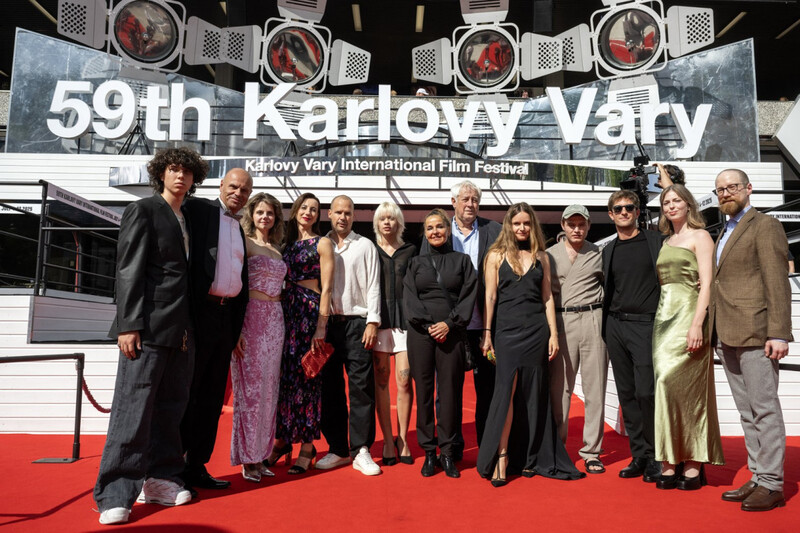
Your cast includes returning collaborators like Juli Jakab and Lilla Kizlinger. In a project so intuitive and open-ended, how important is this kind of trust and mutual language with your creative “circus”?
Juli Jakab is more than an actress, she’s the motherland of these no-budget films in the Fliegauf Circus. We shot and rehearsed in her backyard. She’s a wonderful host, a script doctor, everything. Lilla lives in a tornado. When she steps out of the turbulence, she shows up, plays her part, and then disappears again in the storm. Strange how these things go.
You made JIMMY JAGUAR with no institutional support, much like FOREST – I SEE YOU EVERYWHERE. Beyond necessity, is there an aesthetic or ethical reason you keep returning to this mode of guerrilla filmmaking?
It’s a love-hate thing. I love working with multi-talented, flexible people who are dedicated, free-spirited, and bright. In professional filmmaking, it’s hard to find such people, not because they lack those qualities, but because multifunctionality is, in some ways, the opposite of professionalism.
Some films are intimate, fragile, you need special talent to make them with a pro crew. I don’t have that talent. I can’t make these films the conventional way. But now I’m fed up. I really want to do a funded project, especially because the next one will be logistically and technically demanding.
In your view, how does the precariousness of independent production influence risk-taking, not only in style but in tackling difficult themes like abuse, war crimes, and the failure of justice?
You’re free, that’s great. But freedom can also make you a prisoner in your own custom-made chaos. It sounds cryptic, perhaps, but I feel it deeply. Artistic freedom is just as difficult to manage as the constraints of a scripted, budgeted production. Or just as easy, for some artists. But not for me.
The name Jimmy Jaguar emerges from a nonsense chant, yet becomes a vessel for dark myth. Do you see myth-making as a way to process contemporary traumas, legal, personal, or societal?
Yes, I do. In my view, myths, whether Marvel, Greek mythology, or Christianity, are meme-complexes. They’re mental parasites that evolve and replicate in our minds.
Jimmy Jaguar is one of millions. I firmly believe the concept would make an exciting mini-series for streaming. A superhero with no physical body who manifests in people, changes their life goals and personality, and hunts down those who are only alive because it’s illegal to kill them. What more could you want?
Your films often invoke spiritual or ritualistic experiences, not just narratively, but formally. Do you consider cinema a space for modern rites? And if so, what kind of rite is JIMMY JAGUAR enacting?
I think a good revenge drama has a purifying quality. I personally enjoy writing revenge, bloody revenge even, in scripts and films. I think it helps me avoid seeking revenge in real life.
You’ve built a body of work marked by psychological and social excavation. Where does Jimmy Jaguar fit in your cinematic continuum, and what kind of departure or evolution does it represent?
I didn’t choose to make this project, it chose me. Nothing mystical about it. It’s pure memetics. My decision was to let this meme use me. I’m not sure it was the best career decision, to make a no-budget pilot that’s a horror but not a horror, a mockumentary but not a mockumentary. It is what it is, I can’t find better words.
What’s certain is that I’m done generating cultural projects out of nothing. That approach sends the wrong message: “You don’t need to support us, we’ll do it anyway.” It’s noxious. It’s false. Culture, especially cinema, needs proper funding. What happened here was: possessed people made a film about possessed people for possessed people. My exorcism is still ongoing.