
Jacob Tierney Talks GOOD NEIGHBOURS

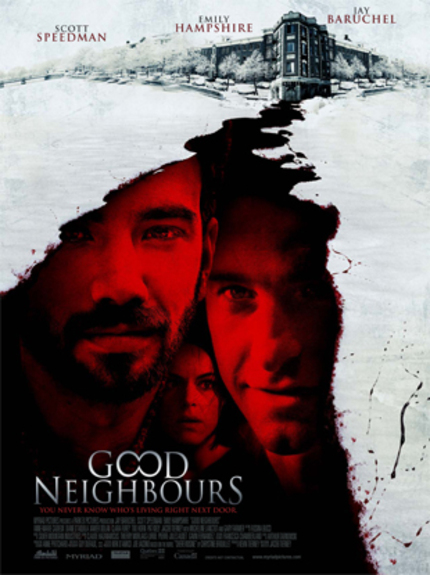
One of the biggest surprises at this year's Toronto International Film Festival was Jacob Tierney's Good Neighbours. Surprising not because Tierney doesn't already have a reputation as one of Canada's bright up and coming talents - last year's The Trotsky was very warmly received - but because the film is so radically different from anything Tierney has done before. A dark serial killer thriller this is a world away from the John Hughes inspired high school comedy of The Trotsky. We had the chance to ask Tierney a few questions about his latest film, which you'll find below.
For those unfamiliar with the way language issues really affect things here in Canada, can you talk a bit about the setting of Good Neighbours, the political background of the story, and what it was like to be an Anglophone living in Montreal at the time?
At the time the film is set, Quebec (the French province in Canada, and the one I live in) held a referendum on whether or not to declare sovereignty from the rest of the country. The result was a federalist (pro-Canada?) victory to the tune of 50.5 percent. Needless to say, it was a tense time in Montreal. Quebec is a place where there is often an assumption that the language you speak is a declaration of your political identity. I was sixteen at the time, a senior in high school, and a seperatist. And by seperatist, I probably mean shit-disturber. I went to school in probably the most English-neighbourhood on the island, Montreal West, and the uniformity of opinion bored me to the point taking up a different stance. But like a lot of people my age (anglo, franco and everyone else), what I came out of that time with was a sense that neither the federal government nor the provincial one really gave a shit about Montreal - the jewel of the Saint Laurence estuary - that was abandoned and vilified by both sides.
Your three features so far are all radically different in terms of content, what draws you to a project? Do you see any common threads running through your own work?
I love movies, and I love different kinds of movies. It wasn't part of some master plan to have them all be different, I just have no real desire to repeat myself, in tone or in content. I think that my movies are all about individuals trying to come to terms with the world they live in, and in that sense, they all have something in common. But more so, I think all my movies essentially take place in the heads of their protagonists, emotionally and visually. Twist is a film like Nick Stahl's character - although it secretly wants you to love it, it doesn't want you to know it, and it will do everything it can to keep you at a distance. The Trotsky is just like Jay Baruchel's character - it is desperate to be heard and understood and loved. Good Neighbours is like Emily Hampshire's Louis - it doesn't really give a shit what you think, it's gonna keep doing it's thing, just to see if it can get away with it. Does that make sense?
Are you a cat person? [There is a reason for this question.]
No. I'm a dog person.
You've developed a really interesting working relationship with Jay Baruchel - who clearly loves working with you - and have pushed him in wildly different directions between this and The Trotsky. Is he someone you'd like to continue working with? Do you see any other areas you'd like to push him in to?
I will definitely keep working with Jay - I love working with him. He's amazingly versatile. There's no particular direction I would want to move Jay in, but what's awesome about him is he's game for anything.
Speaking of Jay, when he was in Montreal for Fantasia he spoke very proudly about the level of violence. And it is quite violent and graphic, but presented in a very non-sensationalized, matter of fact way that almost felt like something from the 1970s. What principles did you lay down for yourself when deciding how violent it should be and how to present that violence on screen? How concerned were you about potential responses to the sexual nature of the violence?
I was very concerned about that. I almost cut the whole idea of rape out of the script. But when I decided - after a lot of consideration and consultation with some smart, smart folks - to keep it in, I knew I had to go all the way with it. There's nothing really graphic about the, um "sequence" in question, but it's long and it's detailed. I learned from watching the way people reacted to Twist that an audience will fill in any blanks for you, and what they come up with in their heads will affect them far more than anything I could put on screen. I can't tell you the number of people - in print and in life - who told me how "racy" and "porny" Twist was. Pretty bold for a film where no one even takes their t-shirt off.
What sold me on keeping the sexual violence in the film was the idea of staying true to Louise, and also of capturing the times. Paul Bernardo [Canada's most notorious serial rapist and killer] was on trial during this epoch in Canadian history. The way I decided to shoot it was actually decided in the ride to work with Guy Dufaux (my cinematographer). I wanted it to be dreamy, elusive and shocking. I think I fished my wish to the best of my ability.
And still on Jay, he's the only really likeable character in the film though still neurotic on an almost Woody Allen level. It totally works, but you were taking a big risk by creating a film with so many unsympathetic characters. Was that a concern when writing?
Not for me. I love movies where there's no one to like, where everyone seems to learn the wrong lessons from the experiences they've had. And I love it when people tell me how sweet they think Jay is in the movie. My reaction is always along these lines: He is sweet! For a compulsive liar.
Something that I really enjoyed about the film was how aggressively you reworked the rules of the genre. Killer movies always tend to play out as either a whodunit or as some sort of character study revolving around the killer himself but you've chosen an entirely different path through the material. Where did the idea come from?
I've got to give the book it's based on a lot of credit here - it was always Louise's story. What appealed to me about adapting it was the idea that you've got this very "classic" set-up (two guys, one girl) and it plays out completely differently than you think it will. Though by the time it's over, you're pretty much back to where you thought you'd be. But the things you've learned about these people make it impossible to be happy for them. I always told Emily - Louise is a femme fatale, she just doesn't know it, or care about it. I love that nonchalance.
Is there a particular reason why you chose to cast the film 100% Canadian?
Not really. I wrote this film for the four main actors - Emily, Jay, Scott Speedman and Anne-Marie Cadieux. I know them all, love them all, and they just happen to be Canadian.
Any ideas on what might be next for you?
I'm adapting Doris Lessing's book The Good Terrorist and she has, very coolly, allowed me to re-situate the film from London in 1980, to Montreal, during the October Crisis of 1970. I'm pretty psyched about this one.
For those unfamiliar with the way language issues really affect things here in Canada, can you talk a bit about the setting of Good Neighbours, the political background of the story, and what it was like to be an Anglophone living in Montreal at the time?
At the time the film is set, Quebec (the French province in Canada, and the one I live in) held a referendum on whether or not to declare sovereignty from the rest of the country. The result was a federalist (pro-Canada?) victory to the tune of 50.5 percent. Needless to say, it was a tense time in Montreal. Quebec is a place where there is often an assumption that the language you speak is a declaration of your political identity. I was sixteen at the time, a senior in high school, and a seperatist. And by seperatist, I probably mean shit-disturber. I went to school in probably the most English-neighbourhood on the island, Montreal West, and the uniformity of opinion bored me to the point taking up a different stance. But like a lot of people my age (anglo, franco and everyone else), what I came out of that time with was a sense that neither the federal government nor the provincial one really gave a shit about Montreal - the jewel of the Saint Laurence estuary - that was abandoned and vilified by both sides.
Your three features so far are all radically different in terms of content, what draws you to a project? Do you see any common threads running through your own work?
I love movies, and I love different kinds of movies. It wasn't part of some master plan to have them all be different, I just have no real desire to repeat myself, in tone or in content. I think that my movies are all about individuals trying to come to terms with the world they live in, and in that sense, they all have something in common. But more so, I think all my movies essentially take place in the heads of their protagonists, emotionally and visually. Twist is a film like Nick Stahl's character - although it secretly wants you to love it, it doesn't want you to know it, and it will do everything it can to keep you at a distance. The Trotsky is just like Jay Baruchel's character - it is desperate to be heard and understood and loved. Good Neighbours is like Emily Hampshire's Louis - it doesn't really give a shit what you think, it's gonna keep doing it's thing, just to see if it can get away with it. Does that make sense?
Are you a cat person? [There is a reason for this question.]
No. I'm a dog person.
You've developed a really interesting working relationship with Jay Baruchel - who clearly loves working with you - and have pushed him in wildly different directions between this and The Trotsky. Is he someone you'd like to continue working with? Do you see any other areas you'd like to push him in to?
I will definitely keep working with Jay - I love working with him. He's amazingly versatile. There's no particular direction I would want to move Jay in, but what's awesome about him is he's game for anything.
Speaking of Jay, when he was in Montreal for Fantasia he spoke very proudly about the level of violence. And it is quite violent and graphic, but presented in a very non-sensationalized, matter of fact way that almost felt like something from the 1970s. What principles did you lay down for yourself when deciding how violent it should be and how to present that violence on screen? How concerned were you about potential responses to the sexual nature of the violence?
I was very concerned about that. I almost cut the whole idea of rape out of the script. But when I decided - after a lot of consideration and consultation with some smart, smart folks - to keep it in, I knew I had to go all the way with it. There's nothing really graphic about the, um "sequence" in question, but it's long and it's detailed. I learned from watching the way people reacted to Twist that an audience will fill in any blanks for you, and what they come up with in their heads will affect them far more than anything I could put on screen. I can't tell you the number of people - in print and in life - who told me how "racy" and "porny" Twist was. Pretty bold for a film where no one even takes their t-shirt off.
What sold me on keeping the sexual violence in the film was the idea of staying true to Louise, and also of capturing the times. Paul Bernardo [Canada's most notorious serial rapist and killer] was on trial during this epoch in Canadian history. The way I decided to shoot it was actually decided in the ride to work with Guy Dufaux (my cinematographer). I wanted it to be dreamy, elusive and shocking. I think I fished my wish to the best of my ability.
And still on Jay, he's the only really likeable character in the film though still neurotic on an almost Woody Allen level. It totally works, but you were taking a big risk by creating a film with so many unsympathetic characters. Was that a concern when writing?
Not for me. I love movies where there's no one to like, where everyone seems to learn the wrong lessons from the experiences they've had. And I love it when people tell me how sweet they think Jay is in the movie. My reaction is always along these lines: He is sweet! For a compulsive liar.
Something that I really enjoyed about the film was how aggressively you reworked the rules of the genre. Killer movies always tend to play out as either a whodunit or as some sort of character study revolving around the killer himself but you've chosen an entirely different path through the material. Where did the idea come from?
I've got to give the book it's based on a lot of credit here - it was always Louise's story. What appealed to me about adapting it was the idea that you've got this very "classic" set-up (two guys, one girl) and it plays out completely differently than you think it will. Though by the time it's over, you're pretty much back to where you thought you'd be. But the things you've learned about these people make it impossible to be happy for them. I always told Emily - Louise is a femme fatale, she just doesn't know it, or care about it. I love that nonchalance.
Is there a particular reason why you chose to cast the film 100% Canadian?
Not really. I wrote this film for the four main actors - Emily, Jay, Scott Speedman and Anne-Marie Cadieux. I know them all, love them all, and they just happen to be Canadian.
Any ideas on what might be next for you?
I'm adapting Doris Lessing's book The Good Terrorist and she has, very coolly, allowed me to re-situate the film from London in 1980, to Montreal, during the October Crisis of 1970. I'm pretty psyched about this one.

Do you feel this content is inappropriate or infringes upon your rights? Click here to report it, or see our DMCA policy.


