
Steve McQueen's HUNGER DVD Review

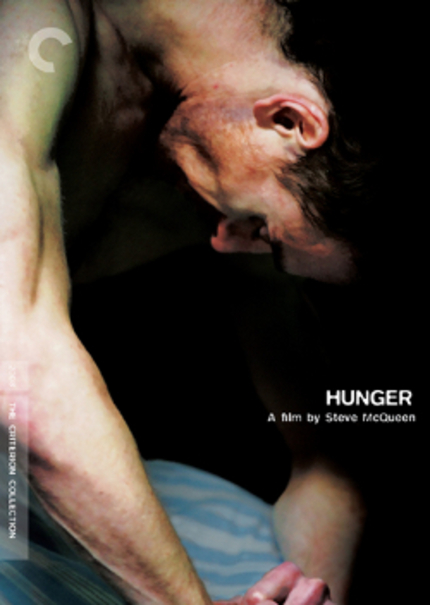
Steve McQueen's Hunger is one of the latest IFC pickups to be released on DVD and Blu-Ray by The Criterion Collection. Hunger uses history as raw material for a poetically visceral examination of the effects of political extremism.
In 1981, Irish Republican Army (IRA) leader Bobby Sands participated in a hunger strike that was allegedly ordered by IRA leadership. Within 66 days, Sands was dead of malnutrition. Visual artist Steve McQueen, whose work has mostly consisted of short avant-garde films, interest in this subject for his first feature. As one might expect from someone with McQueen's background, Hunger is not a straight forward docudrama.
Hunger follows a traditional three-act structure that uses a historical timeline as a backbone. Within this framework, however, the film focuses as much attention on small moments and seemingly minor details as it does on historical events. Bobby Sands (played by Michael Fassenbender) does not emerge until the second act. Instead, McQueen uses the virtually dialogue-free first act to develop the world of the Maze, a labyrinthine prison where Sands spent his final days. The Maze is presented as an ecosystem that mentally and physically connects the characters. A police officer whose everyday life is haunted by the specter of the Maze. A young IRA member is checked into the prison. An inexperienced guard in riot gear experiences the rush and confusion of a ritualistic beating of the prisoners. These and various other threads eventually intersect in the film's second act, which shifts the focus to Bobby Sands. At around the 45 minute mark, the film's centerpiece occurs: a conversation between Sands and Father Dominic Moran (Liam Cunningham) that was shot in a single twenty-five minute take. This intensely dramatic scene bridges the first and third acts by providing context and motives for everything that has taken place. The third act is dedicated to Sands' slow, grisly death.
The technical specs and extras for this Criterion release are of the usual high-quality. The transfer is flawless, and the film's 2:35.1 aspect ratio is preserved through black bars at the top and bottom of the screen. The fully digital audio track is presented in 5.1 surround sound.
Extras include lengthy interviews with Steve McQueen and Michael Fassbender, a "making of" documentary about the making of the film, and a 1981 episode of the BBC news show Panorama that provides significant background on the IRA and the hunger strikes. McQueen obviously used this documentary as source material (e.g., the speeches by Margaret Thatcher, the look of the police and prisoners, the layout of the prison).
McQueen's visual palette is rich and varied. He is particularly taken with long, lingering shots that revel in movement and small details. One of his main assets is an ability to tease beauty and poetry out of gruesome imagery. A prison guard slowly mopping urine from the floors is the subject of a slow zoom that draws a rhythm out of the lowly task. McQueen portrays IRA members smearing their prison cells in food and bodily waste in protest of their treatment with particular relish. The walls resemble abstract paintings replete with geometrical patterns and meticulously dabbed flecks. Sands' ascetic demise is presented in graphic detail. His wasting, bony body is covered in seeping sores. He bleeds and vomits profusely. McQueen's painterly approach renders these otherwise ugly moments in a way that is both attractive and repulsive.
The technical specs and extras for this Criterion release are of the usual high-quality. The transfer is flawless, and the film's 2:35.1 aspect ratio is preserved through black bars at the top and bottom of the screen. The fully digital audio track is presented in 5.1 surround sound.
Extras include lengthy interviews with Steve McQueen and Michael Fassbender, a "making of" documentary about the making of the film, and a 1981 episode of the BBC news show Panorama that provides significant background on the IRA and the hunger strikes. McQueen obviously used this documentary as source material (e.g., the speeches by Margaret Thatcher, the look of the police and prisoners, the layout of the prison).

Do you feel this content is inappropriate or infringes upon your rights? Click here to report it, or see our DMCA policy.


