Director Christopher Denham Talks HOME MOVIE

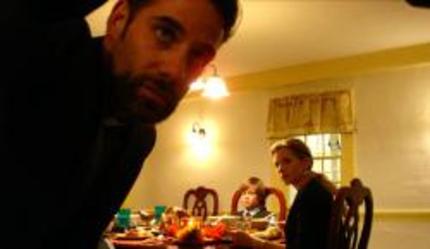
With Chris Denham's first-person horror film Home Movie freshly arrived on DVD here in Canada we had the chance to fire a few questions his way. Read on for his thoughts on first person perspective, keeping horror in the home and more!
TB: There are some obvious strengths and weaknesses to making a first-person film. What drew you to that style, where do you think it helped you and where did you find it limiting?
CD: The first person narrative was attractive for both dramatic and economic reasons. Dramatically, I was interested in the power-play of self-documentation. The roles we pretend to play when the camera is rolling. Also, a first person narrative lends itself to suggestion rather than blatancy. I have a weak stomach. I don't like blood and guts. The audience is collectively smarter and sicker than me. Their imagination is stronger than my concoctions. Using a hand-held camera, the shots veered towards subliminal visuals, which I always prefer. Economically, it's obviously cheaper to not use film. We were not limited to a finite amount of takes. We could focus on the acting, without having to worry about burning film. Digital provides a singular amount of freedom. Michael Mann is on to something.
TB: There is - obviously - a long tradition of children-gone-evil films out there, what are the greats in your opinion? Did any of them have a particularly strong influence on your film?
CD: My favorite "scary kid" film is Michael Haneke's "BENNY'S VIDEO." It's a masterpiece of restraint and suggestion. Terrifying. I also love William Wyler's "THE CHILDREN'S HOUR". A potent exploration of childhood deification. The danger of trusting children too much. Of making children too precious. Though not a typical "scary kid" film, "BOY A" scared the hell out of me. I highly recommend it.
TB: I was intrigued by your choice to make the father a minister and actually treat both him and the profession with a degree of complexity you don't often see in horror films, where the church is often very cliché. What lay behind that decision?
CD: As an audience member, I'm bored by one-dimensional horror archetypes. The character I wrote, and the way Adrian Pasdar plays it, is not a cardboard cut-out. I have no interest in condemning religious figures. I don't like movies that preach or put themselves on a pedestal. Audiences are too smart to be talked down to. David Poe is a pastor, but he's also an alcoholic and a loving husband. These things are not contradictory.
TB: There has been a nice little run of what I'd call 'domestic' horror films recently, what do you think makes these films - where the horror lies in the home rather than some outside force - so compelling?
CD: For me, domestic horror is the most harrowing. A wake-up call from the Norman Rockwell dream. I'm not scared by killers who can't be killed. I'm scared by my next-door neighbor. Read a newspaper. There is enough real horror and tragedy. There's no need to make anything up. Cinematically, we need boogeymen to divert us from the awful truth: we are own monsters.
TB: As an independent film maker can you say a few words about the changing distribution landscape and the importance of the festival circuit? I know it has played a very key role in the success of this film.
CD: The festival circuit is essential for the independent film-maker. We had a great festival run with HOME MOVIE and secured distribution (IFC in America, Anchor Bay in Canada). Without the festivals, independent films have virtually no chance at distribution. But even if you aren't lucky enough to get distribution, the festivals are an amazing world of collaboration and community. Good people who give a shit about good movies.