TCM: SUMMER UNDER THE STARS—Robert Osborne on Vincent Price

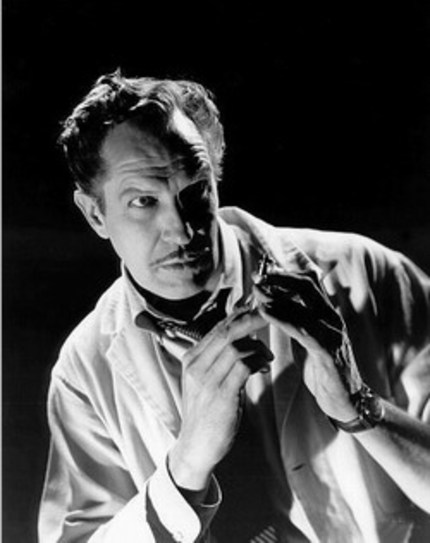
For the fifth consecutive year, Turner Classic Movies ("TCM") is dedicating all of August to its "Summer Under the Stars" movie festival, in which each of the 31 days showcases a Hollywood legend for an entire 24 hours. Assembled from the network's library of more than 5,000 films, this one-of-a-kind festival is something only TCM can present. For viewers, this is an opportunity to enjoy a varied selection from a star's body of work, uncut and commercial free, whether it's indulging in the work of a favorite actor or sampling something new. The full schedule of stars and movies can be found at TCM's website. For Twitch, Robert Osborne and I appreciated "Master of the Macabre" Vincent Price.
Michael Guillén: Turning to Vincent Price—whose films you're highlighting this coming Friday, August 10—I was curious to know who wrote the image associations for "Summer Under the Stars" at the front of this month's issue of Now Playing? For some reason I've never associated Vincent Price with "the scarlet wealth of fresh tomatoes."
Robert Osborne: I have no idea. You'd have to ask Sarah Hamilton about that.
Guillén: Did you ever meet Vincent Price?
Osborne: Yeah, I did. I met him socially several times in California with his wife Coral Browne. He was a really interesting guy. He had a great theater background, which nobody ever really knew. He did the original Angel Street—which became the movie Gaslight—on Broadway, and he played for years with Helen Hayes in her most successful play Victoria Regina. So he had quite a lofty background; but, he's one of those people that just seems to be kind of happy and enjoy himself no matter where he was. He loved art. He could talk about art. He could talk about almost anything and he was also wonderful about giving people suggestions about what art to buy and what not to buy. He was a fascinating, well-rounded guy.
Guillén: I actually met him when I was a college student in Emporia, Kansas. He was a friend of Karl Bruder, the theater director at the college, and spoke to the students there. I remember him saying that they had done research that indicated that spiders do not frighten men, but spider webs do.
Osborne: Interesting.
Guillén: As TCM's line-up with Vincent Price reflects, most people associate him as "The Master of Menace" though I'm fond of his performances in Laura and The Song of Bernadette, where you're given the opportunity to see what a fine actor he really was. TCM has included, however, The Private Lives of Elizabeth and Essex, wherein Price plays Sir Walter Raleigh. What were you hoping to point out in his performance there?
Osborne: To show at the beginning of his career the supporting parts he played in classy films like that one. It would be wonderful to have Laura and The Song of Bernadette and Leave Her To Heaven and Dragonwyck and some of those; but, those are Fox films and they have their own movie channels so we don't have access to those films.
Guillén: I didn't realize that. You're also presenting him as the ruthless killer Paul Adams in Dangerous Mission, an Irwin Allen production from 1954. Any comments there?
Osborne: Simply, these films are in our library, films we have access to, and they're programmed that way mainly for the diversity of films and performances to get an overall view of his career; but, as to why they were specifically picked, you'd have to talk to the man who picked them: Charlie Tabesh.
Guillén: Dangerous Mission was originally in 3D, I understand?
Osborne: Yes, it was. I'm not sure it was released that way; but, it was filmed in 3D because it came out in 1954, which at that point 3D was starting to lose its appeal to moviegoers. The Mad Magician was also in 3D.
Guillén: I was just going to say that The Mad Magician—which is one of TCM's four Vincent Price premieres—has the distinction of being the first movie shown in 3D on television. Do we get to see it in 3D?
Osborne: Nope!
Guillén: Interestingly, you're presenting both versions of Tower of London; the 1939 version where Price plays the Duke of Clarence and the 1962 version where Price usurps the lead role of Richard, the Duke of Gloucester. These films render history as horror and it's my understanding that the later version—directed by Roger Corman—actually incorporates footage edited out of the original 1939 production?
Osborne: I wasn't aware of that. I believe the Corman one, isn't that in color? I'm looking at the guide now and it says black and white so it's very possible they did that; but, they would have had to buy the footage from Universal because Universal made the 1939 [film] and Corman released all of his films through American International. If they did use the footage, they would have had to buy the footage to use it. Usually when they lift things, they lift it from one Warner film to the other, one MGM film to another, but that would be very unusual to be buying it from another studio. That, in essence, wouldn't save them any money.
Guillén: TCM is also premiering one of my childhood favorites—William Castle's The Tingler. This movie remains fascinating on so many accounts; not the least of which is Castle's notorious gimmickry, in this case "Percepto!" Are you aware of John Waters writing about how he entered the theater early to purposely look for the seats that had the buzzers attached?
Osborne: [Laughs.] No, what fun. William Castle, he was a great showman on a—what would we say?—a lower budget level; but, he was always fun. He always had gimmicks to try to get people into the theater and he did!
Guillén: And I guess this was the first film to depict LSD usage because the writer had been taking LSD. Also, it features Judith Evelyn, who was Miss Lonelyhearts in Hitchcock's Rear Window.
Osborne: Right. She was an actress that he did Angel Street with on Broadway. She played the Ingrid Bergman part in the original Broadway production of Angel Street, which became Gaslight.
Guillén: And it also had that strange mixture of color and black and white during Evelyn's bloody bathtub scene.
Osborne: It's definitely an interesting movie to watch.
Guillén: Yet another Price premiere is Master of the World, based upon two Jules Verne novels, and directed by Quentin Tarantino favorite William Witney, who likewise directs another TCM "Summer Under the Stars" premiere: the Roy Rogers film The Golden Stallion.
Osborne: He did a lot of the Roy Rogers films.
Guillén: The fourth TCM premiere is Vincent Price's 1964 vehicle The Last Man on Earth, based on Richard Matheson's novel I Am Legend. Matheson, I understand, worked on the script for the film; but, displeased with the final result, he credited himself as "Logan Swanson." I wonder where he came up with the name "Logan Swanson"?
Osborne: I have no idea.
Guillén: That film—and the book it was based on—had an acknowledged influence upon such later greats as George Romero's Night of the Living Dead. Any comments on Last Man on Earth?
Osborne: It will be specifically interesting to watch since Will Smith has his new version coming out later this year that's done as a multi-multi-multi-million dollar movie and it should be interesting to see it done on a very low-budget and the first take on it. It's interesting how sometimes those lower budget films done at a poverty level can be even more effective than the bigger budget films that have all the money in the world to spend.
Guillén: They provoke imagination, I think.
Osborne: Exactly. They let the audience do the imagining for them and one's imagination can always be more terrifying than anything you see on screen.
[Along with these four premieres, TCM is also showing the perennial Price favorites: The House of Usher (where Price plays the incestuous Roderick Usher with bleached blonde hair), The Pit and the Pendulum, Tales of Terror, The Masque of the Red Death, The Tomb of Ligeia, The Abominable Dr. Phibes, and Theatre of Blood.]
Cross-published (in expanded format) on The Evening Class.